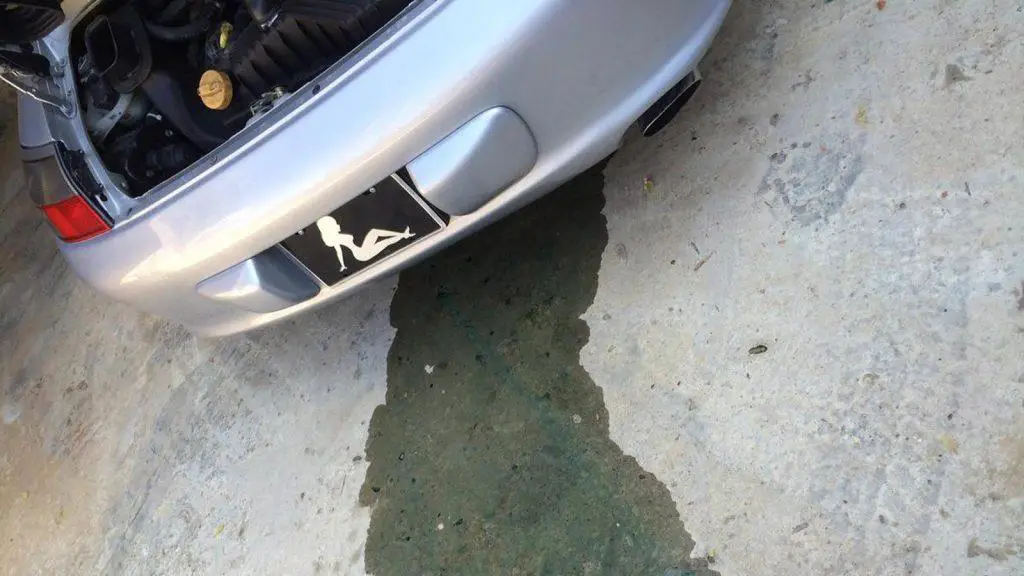
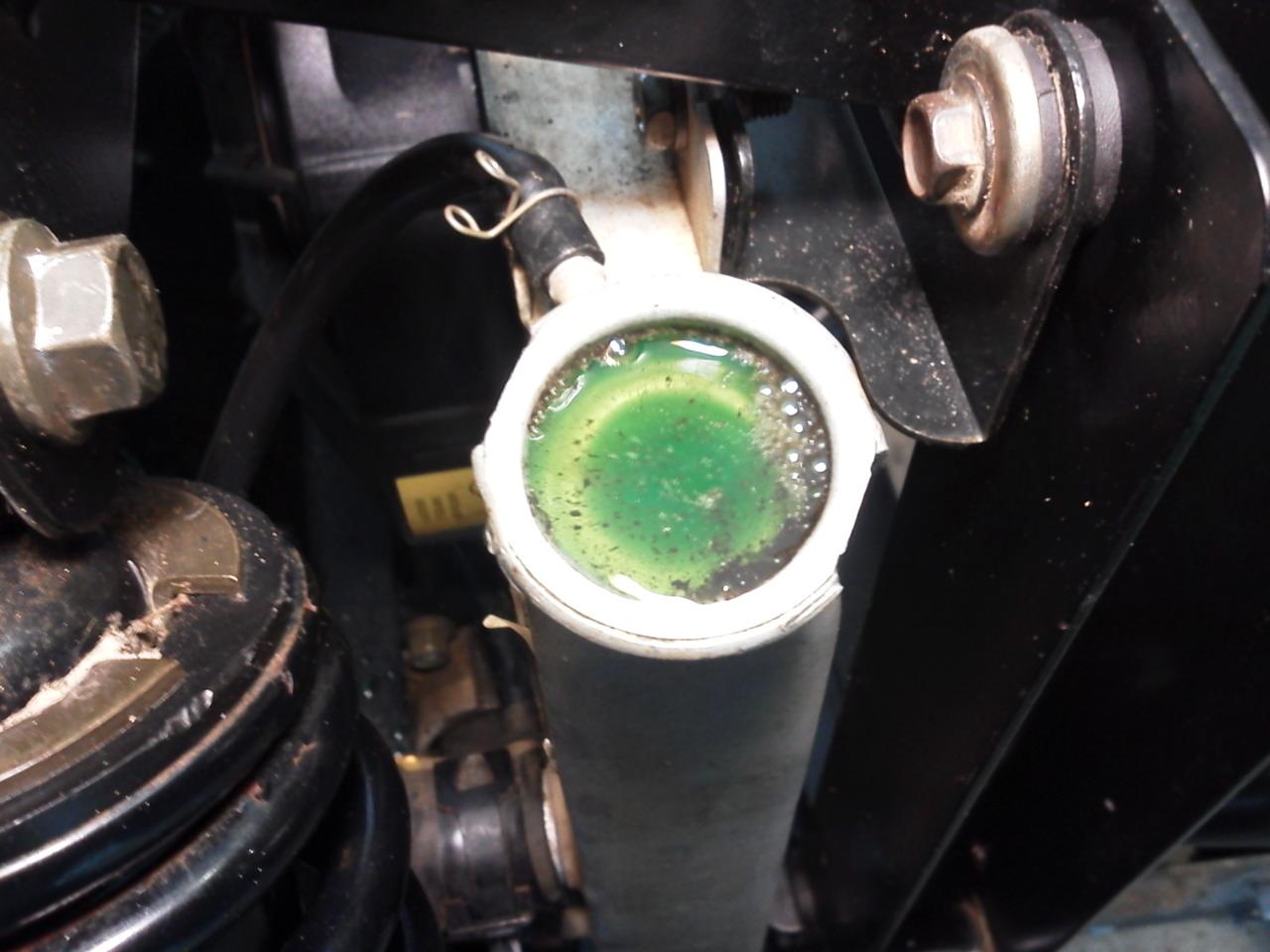
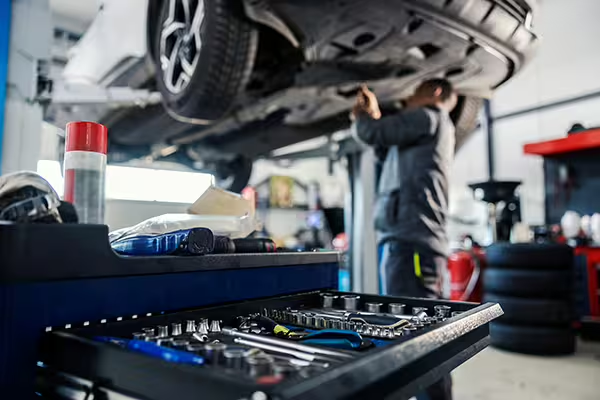
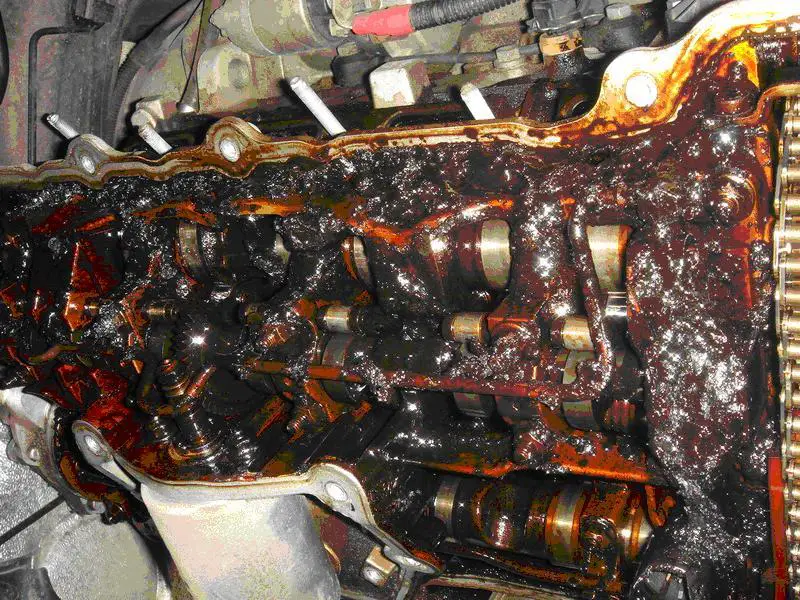
Your car’s coolant plays an essential role in keeping all parts at an optimal temperature and improving engine performance. It can happen that a small coolant leak occurs, which is repairable without spending too much time or money. However, if the leak is not controlled until the cooling system empties, repairs can be quite costly. Vehicle owners should remember that having coolant in the engine oil is never a good idea for the car.
Let’s see what happens when coolant leaks into the engine oil. Coolant is a useful element in your car to keep it cool. However, it can become a source of headaches if it leaks into the engine.
How to handle a coolant leak in the engine oil
If there is a coolant leak in the car, it can overheat and break down. You might then find yourself stranded in the middle of the road. However, if the coolant leaks into the engine oil, the damage will be expensive to repair.
On the other hand, if you try to drive the vehicle without coolant, there is a high chance that it will damage the thermal seal. In addition to leaving your car in the garage for repair, you will have a large repair bill to pay. In the worst case, the car’s engine would fail and require a complete replacement. You can browse online to find the best maintenance tips for the proper functioning of your vehicle.
We will help you understand what would happen if coolant were present in your vehicle’s oil.
1. Changes in lubricant
The mixture of coolant and engine oil can completely alter the properties of the lubricant. The antifreeze would cause the oil to thicken and prevent it from flowing as easily as before. It then moves to other parts of the engine, which require a thinner fluid for lubrication and protection. Due to the coolant leak in the engine oil, an acidic environment is created inside the oil, leading to internal corrosion of the system. Additionally, the additives in the oil are compromised.
Learn more about coolant in engine oil
2. Oil balls
Once coolant is present in the oil, small oil balls form. These balls measure between 5 and 40 microns but can cause significant damage to your vehicle. They are abrasive and lead to surface erosion. The most common area to check is the inner wall of the car’s cylinder, where these balls cut and notch the wall. They can quickly cause surface fatigue and may even lead to lubrication failure.
Coolant in engine oil
In summary
So, when you notice a coolant leak in the engine oil, immediately contact an automotive repair specialist to resolve the issue in time.
Best Gas Pump for Optimal Engine Performance
Summary of our Engine101 lesson: your vehicle’s internal combustion engine requires a constant supply of fuel, as well as air, as inputs for combustion. This requires that gasoline or diesel be transported from the fuel tank to the fuel injectors or carburetors, depending on the type of vehicle you own, by the fuel pump. It goes without saying that you will need the best fuel pump for a constant fuel supply and optimal engine performance.
You might think that since it’s simply a “pump,” it should be a simple and easy-to-maintain component of your car and that purchasing such a pump should be a no-brainer.
In reality, when it comes to your precious vehicle, especially anything related to the performance of the complex and delicate engine, choosing the best fuel pump that will last you many years on the road and provide reliable service requires some research.
We’ve done the hard work and compiled in this comprehensive fuel pump guide everything every car owner needs to know to get the best fuel pump for their particular vehicle and specific needs.
Learn the importance of a good fuel pump, the different types, symptoms of a bad fuel pump, important purchasing criteria, and a list of the best fuel pump models on the market.
Function of a Fuel Pump
A fuel pump transfers fuel from the tank to the engine. (Photo source: redflagdeals)
While your engine needs air and fuel to be injected into the combustion chamber, the fuel is stored in the fuel tank.
Therefore, a fuel pump, also called a “fuel transfer pump,” is needed to transfer fuel from the fuel tank to the engine, specifically to the carburetors or fuel injectors, which disperse the fuel into the engine’s combustion chambers.
Fuel pumps accomplish their job by combining mechanical or electrical forces with pressure.
A fuel pump is actually made up of several pumping systems inside a can-shaped container, which is about the size of a small jar of jelly. First, the fuel supply pump works like a vacuum to suck gasoline or diesel from the tank.
The fuel is then filtered through a mesh screen to block any residue in the tank, then introduced into a metering pump. Here, piston-like mechanisms push, pull, spin, and shake the fuel to achieve the required pressure.
Once the fuel has been pressurized to a precise level, it is pushed out of the pump, into the fuel line. From there, a small nozzle sprays a fine mist of fuel into the engine’s combustion chamber. This fuel mist is combined with air at a precise ratio, then ignited to create combustion.
Symptoms of a Faulty Fuel Pump
It goes without saying that when your vehicle’s fuel pump fails, the engine will not receive the correct amount of fuel at the right time, which will harm its performance. Below are the most common symptoms of a faulty pump.
If your car shows any of these signs, you will certainly want to inspect the fuel pump to determine if it needs to be replaced or not, as well as a few other possible culprits.
Difficulty Starting
Since fuel pumps run continuously as soon as the ignition is turned on, they can end up wearing out and deteriorating over time. A weakened fuel pump may continue to pump fuel, but the vehicle may have difficulty starting due to lack of pressure.
A weakened fuel pump can cause the vehicle to require more key turns than normal to start and, in the most severe cases, may even require several key turns before starting.
When a fuel pump fails, fuel cannot reach the engine upon ignition. The engine cranks and turns over but never starts.
Before attempting to replace the pump, it is always wise to check that there is no blown fuse and/or low pressure in the fuel line.
Engine Stalling at High Temperature
Many problems can cause stalling, but when it occurs frequently at high temperatures indicated on the car’s thermometer, the culprit is likely the fuel pump motor. If stalling continues to occur as the temperature gauge rises, it may indicate a deteriorating fuel pump and the need to replace it.
Sputtering Engine
One of the surest indicators of a faulty fuel pump is an engine that sputters at high RPM, as the fuel pump cannot provide a steady flow of fuel to the engine at the ideal pressure. If you are driving at a consistently high speed and the engine suddenly sputters before returning to normal operation, there are most likely problems with the fuel pump.
Engine Overheating
If the pump sends too much gasoline to the engine, it can cause engine surging. Although this symptom is usually associated with fuel pump problems, it can also be a sign of bad gasoline. To understand why this is the case, as well as other symptoms of the common engine surge problem, check out our comprehensive guide on engine surges: how to troubleshoot and repair.
Types of Fuel Pumps
Depending on the type of machine, fuel pumps are powered differently, but they can be classified into 3 main types.
1. Mechanical Fuel Pumps
Mechanical fuel pumps are often mounted under the hood. (Photo source: magnusmotorsports)
Mechanical fuel pumps are more common on older vehicles, especially those equipped with carburetors. Before fuel pumps became a necessity for cars, fuel was routed directly from the tanks to the carburetor.
This happened thanks to gravity. Since the mechanical fuel pump pumps fuel into the carburetor, it slows down the efficiency of the fuel supply.
Carburetors are no longer very common as they pump fuel at very low pressure. They are now only used in older models. These pumps are suitable for cases where electrical conductivity can be dangerous.
Over time, mechanical fuel pumps gave way to electric fuel pumps due to improved energy efficiency and the demand for higher fuel pressures.
Mechanical pumps are equipped with a number of valves and levers that help pump the fuel to the desired location. A lever is placed on the camshaft which exerts pressure on the diaphragm. Therefore, they are usually located under the hood, near the front of the engine. The valves serve to prevent the backflow of fuel and thus ensure one-way flow to the engine.
2. Electric Fuel Pumps
Electric fuel pumps do not require a direct physical connection to initiate fuel movement. Instead, these pumps require a steady direct current to transfer fuel. For this reason, they generally improve fuel economy.
Another advantage of electric fuel pumps is that they can be optimized to deliver significantly higher fuel pressures, required by modern fuel injection systems and direct injection systems.
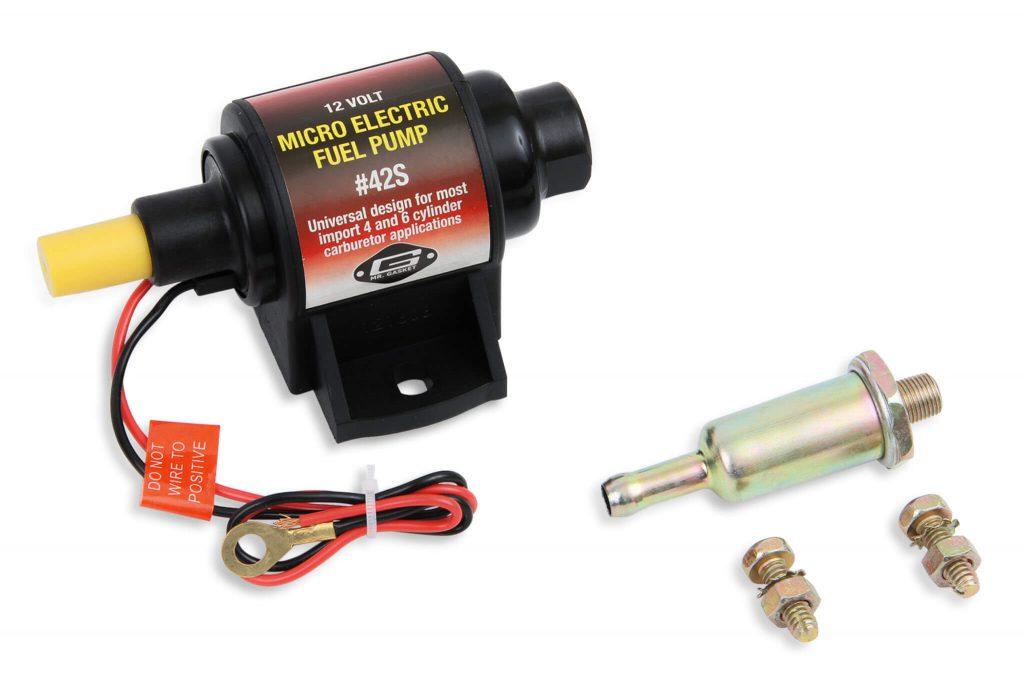
Electric fuel pumps can be mounted anywhere. (Photo source: Amazon)
Furthermore, since they do not require a mechanical connection, these units are more portable and easier to use: they can be placed anywhere flexibly. Manufacturers most often place electric fuel pumps inside the fuel tank.
The cost of using cutting-edge technology is higher, but these pumps are well worth the extra dollars as they offer added safety by minimizing the risk of explosion. The pump’s robust coating also serves to avoid damage.
In-Tank Electric Fuel Pump and Inline Fuel Pump
When a fuel pump is mounted outside the tank, it is an externally mounted or inline fuel pump. If it is placed inside the tank, it is an in-tank fuel pump.
In the past, electric pumps were placed inside the fuel tank. This helped reduce the risk of fire from extreme heat or a spark, as both gasoline and diesel are cold in liquid form and do not explode.
On the other hand, if you run out of fuel or take a sharp turn, the fuel flow in the pump can be interrupted, which can not only cause your vehicle’s engine to misfire but also damage the pump itself.
Technology has progressed and the inline fuel pump was developed, which can be safely mounted outside the fuel tank. Balance and stress sensors ensure that if the pump is clogged or damaged, or if the vehicle is involved in a collision, the pump stops, thus cutting off the fuel supply to the engine and killing it.
3. Manual Fuel Pumps
As the name implies, fuel is transferred from the fuel tank to the combustion chamber manually using hand pumps that, by turning, siphon fuel from one place to another.
This type of pump is particularly handy in case of power shortage, as the device does not require electricity and in the case where the car is equipped with a non-conventional fuel tank, such as jerry cans. The manual pump is the cheapest type.
Fuel pumps can also be classified into three types based on fuel flow rate:
1. Low Speed
This category includes pumps that can move 50 liters of fuel per minute from one point to another. These pumps are useful for transferring fuel in smaller vehicles as they minimize the risk of spillage.
2. Medium Speed
By transferring 70 liters per minute, these pumps serve at a moderate speed and are suitable for large trucks or vehicles with large tanks.
3. High Speed
By pumping 90 liters per minute, these pumps do the job quickly and efficiently and are therefore highly recommended for rigorous work. Heavy machinery will get the most out of these powerful pumps.
The Best Fuel Pump: Buying Guide
Choosing the best fuel pump most suited to your vehicle and engine requires thorough research, as there are many purchasing criteria, from flow rate to pressure to compatibility, all of which are important.
Consider the following purchasing factors to decide which is the best fuel pump that offers the right balance between different requirements.
Power
Your engine’s power determines the fuel flow rate needed to run it. As power increases, the volume of fuel needed to run it also increases.
A good indicator of the volume/power ratio is about 10 hp per gallon or 2.64 hp per liter. For example, if your pump flows at 60 gph, it should be able to support a 600 hp engine. However, to actually know the gph, you must also take into account the fuel pressure required for your engine.
Fuel Pressure
Fuel pressure is also an important element in fuel management. Fuel pressure is rated at one gallon per hour and one liter per hour at different psi.
Different engines require different fuel pressures. For example, a carbureted engine typically requires between 4 and 7 psi, while a General Motors small-block V8 LS engine runs at about 58 psi.
It is important to know the maximum pressure required by your engine, as fuel pressure has a significant effect on the flow that a pump can produce. A fuel pump will flow at its highest volume when there is no pressure, or “free flow.” When fuel pressure increases, fuel flow decreases.
Each pump has a different flow rate at a given pressure. That’s why it’s important to examine the flow chart of the pump you decide to buy.
It should also be noted that different types of fuel will produce a different type of fuel pressure. Sometimes, certain fuel pumps can only handle one specific type of fuel.
In this case, they may work with non-designated fuel types but will deteriorate very quickly. Using an incompatible fuel type will create suboptimal fuel pressure, thereby reducing the fuel pump’s durability.
Note:
Fuel pressure determines the use of different types of filters and accessories for better performance. Additionally, electric pump installation locations depend on fuel pressure.
Voltage
Fuel pumps have different flow rates depending on voltage. When voltage increases, the fuel pump speed also increases, which increases the flow rate at a given pressure.
Therefore, when looking for the best fuel pump for your vehicle, it is advisable to check the pump’s rating at a given voltage. Most cars produce about 13.5 volts when running.
Fuel Type
Although most pumps are capable of working with different types of fuels, some are not. So it’s best to check if the fuel pump you are considering works with the type of fuel consumed by your vehicle.
Fuel Pump Locations
Depending on the fuel pump installation location, the pump can vary. Most mechanical pumps are mounted on the engine and placed outside the fuel tank. Electric fuel pumps can be mounted inside the tank or outside.
Materials Used / Durability
Even if you don’t necessarily need a heavy-duty fuel pump for your vehicle, durability is always a crucial factor. A durable fuel pump will save you a lot of time and money on maintenance and offer you better value for money.
Materials that claim to meet the “OE standard” will result in a longer lifespan.
The warranty will be another indicator of a fuel pump’s quality and durability. In general, you can expect that the longer a product’s warranty, the more confident the manufacturer is in its products, or the higher their quality and durability.
Nowadays, a good number of products offer replacement and repair warranties for varying durations.
AC/DC – Alternating Current/Direct Current
DC products are often portable and easier to use.
Purpose
You might be buying a fuel pump for heavy machinery while others are buying it for their daily commute.
If that’s the case, there’s no need to get an unnecessarily powerful fuel pump, even if it’s considered the best fuel pump. That would be overkill and would surely cost you more.
Best Fuel Pump 2024: Mechanical Fuel Pump
Airtex 40987 Fuel Pump – $15.50
Airtex 40987 Fuel Pump. (Photo source: amazon)
Highlights
Materials comply with OEM standards
Requires only one gasket
Heat treatment and more durable performance
Adapts to multi-blend fuels
Disadvantages
Has only one inlet and outlet
May not be compatible with older vehicle models
For only less than $20, this mechanical fuel pump can provide from 7.5 to 9 psi per minute with a single gasket. Furthermore, the hardened shafts and rocker arms are modified to offer better performance. They are heat treated for an extended lifespan.
How Long Can a Dealer Keep Your Car for Repair
It’s a frustrating situation: you drop off your car at the dealership for a repair, and days turn into weeks. And you want to know exactly how long a dealership can keep your car for repair?
The answer lies in the complex nature of the repair, the availability of parts, and the dealership’s workload!
How Long Can a Dealership Keep Your Car for Repair?
Generally, dealerships typically have a maximum period of 30 days to diagnose and repair your car under warranty.
However, this timeframe is not always strictly adhered to, and some repairs may take longer.
Several factors can influence how long a dealership can keep your vehicle for repair. Complex repairs requiring specialized parts or tools can extend the repair time.
Furthermore, the dealership’s workload and the availability of technicians can impact the speed of service.
Therefore, it is important to maintain open communication with the dealership throughout the repair process.
Factors Affecting Repair Timelines
Now that you know how long a dealership can hold your car for repair, here are some factors that affect your car’s repair timelines at your dealership!
Repair Complexity
The complexity of the repair has a significant impact on the time required. Simple repairs, like an oil change or tire rotation, can often be completed within a few hours.
However, more complex repairs, involving engine or transmission issues, may require significant disassembly and specialized tools. These repairs can take several days, or even weeks.
Parts Availability
The availability of necessary parts can also influence repair timelines. If the required parts are in stock at the dealership, the repair can be completed quickly. However, if parts are out of stock or need to be ordered from the manufacturer, this can significantly delay the process.
Factors affecting parts availability include the car’s make and model, the specific part needed, and the manufacturer’s production and shipping schedules.
Dealership Workload
The number of vehicles currently being repaired at the dealership can affect the speed of service. If the dealership is experiencing a high volume of repairs, it may take longer to get to your vehicle.
Additionally, the availability of qualified technicians can influence repair timelines. If there are not enough technicians to handle the workload, this can lead to delays.
Manufacturer Repair Guidelines
Manufacturers often provide specific instructions and recommendations for repairs. These guidelines may include recommended repair procedures, specific tools to use, and even estimated repair times.
Although dealerships are generally required to follow these guidelines, deviations can occur due to unforeseen circumstances or the complexity of the repair.
Furthermore, manufacturers may set minimum or maximum repair timeframes, which can influence the dealership’s schedule.
Manufacturers may set minimum or maximum repair timeframes. (Photo: Carfect)
Consumer Rights and Protections
When your car needs repair, you should not only know how long a dealership can hold your car for repair, but also be aware of your rights as a consumer.
These laws vary by state, but generally, they require the manufacturer to replace or buy back a vehicle if it has been repaired multiple times for the same issue.
In addition to Lemon Laws, the implied warranty of merchantability applies to all new and used vehicles.
This warranty ensures that the vehicle is fit for the purpose for which it is intended, meaning, in this case, driving. If your car breaks down or malfunctions repeatedly, this may constitute a breach of this warranty.
Dealerships have an obligation to keep customers informed throughout the repair process. This includes providing updates on the repair status, estimated completion times, and any unforeseen delays.
Negotiating Repair Timelines
Be mindful of Lemon Laws and the implied warranty of merchantability, as these laws can offer protection in certain cases.
By understanding your options, you will be able to negotiate more effectively with the dealership. Express your concerns and expectations clearly and respectfully.
If the dealership is unable to provide a satisfactory timeline, request alternative transportation or compensation such as loaner vehicles, reimbursement for a rental car, or discounts on future services.
It can be helpful to negotiate a deadline for the repair to ensure the dealership takes your concerns seriously. Set a reasonable deadline based on the complexity of the repair and the dealership’s workload.
If the dealership does not meet the deadline, be prepared to discuss consequences. This may include escalating the issue to a higher manager, seeking legal advice, or exploring other repair options.
Be mindful of Lemon Laws and the implied warranty of merchantability. (Photo: Insurance Business America)
Alternatives to Dealership Repairs
Although dealerships offer convenient service and a warranty, it can be advantageous to explore other repair options. Independent mechanics often offer competitive prices and personalized service.
They may have more flexibility in scheduling appointments and can offer a wider range of services. However, you must research and choose a reputable independent mechanic experienced in working on your specific car model.
When choosing an independent mechanic, consider the following:
Reputation: Look for mechanics with positive reviews and recommendations.
Experience: Ensure the mechanic has experience working on your car’s make and model.
Certifications: Check if the mechanic holds industry certifications.
Warranty: Inquire about warranties offered on repairs.
Mobile mechanics offer the convenience of on-site repairs. They can come to your home or office, saving you time and hassle.
These mechanics often specialize in specific types of repairs, like oil changes or brake repairs. However, they may have limitations in terms of the complexity of repairs they can perform.
Ultimately, consider the factors and weigh the pros and cons of each option to make a suitable decision.
FAQ
Can a dealership charge me storage fees if my car is held for an extended period?
In some cases, if your car is left at the dealership for a long time after repairs are completed and you have not picked it up, the dealership may charge storage fees.
Clarify this upfront with the dealership to avoid unexpected charges.
What happens if the dealership cannot repair my car within a reasonable time?
If a dealership cannot repair your car within a reasonable time, you may have options such as requesting a loaner vehicle, reporting the issue to the manufacturer, or even exploring Lemon Law protections, if applicable.
It’s worth asking the dealership about their policy in these situations.
Can a dealership hold my car if there is a dispute over the repair bill?
In some jurisdictions, a dealership may hold your car if there is a dispute regarding payment for repairs.
This is often called a mechanic’s lien. It is important to communicate and resolve any billing disputes promptly to avoid this situation.
How long can a dealership wait for a part before being required to provide me with an update?
While there is no universal standard, many dealerships are required to provide regular updates if there are delays in obtaining parts.
Ask the dealership about their communication policy for parts delays to stay informed throughout the process.
If a recall repair takes longer than expected, can I demand compensation or a rental car?
If your vehicle is held for an extended period due to a recall repair, you might be entitled to a rental car or compensation, depending on the manufacturer’s policy and the nature of the recall.
Always inquire about what the manufacturer or dealership offers in such scenarios.
What happens if a dealership damages my car while it’s in for repair, can they still hold it?
If a dealership damages your car during the repair process, they are generally responsible for repairing the damage.
The length of time the vehicle may be held depends on the extent of the additional repairs needed. In this case, you can negotiate compensation or other corrective measures.
Can I request a written estimate of how long it will take to repair my car?
You can request a written estimate regarding the repair timeline. While this estimate is not legally binding, it can serve as a reference point.
If the dealership significantly exceeds the estimated time, use this as a basis to request a status update or explore other options.
Can I retrieve my car before repairs are finished if I decide to go elsewhere?
Yes, you generally have the right to retrieve your vehicle before repairs are completed, although you may have to pay for any work already performed.
Communicate clearly with the dealership if you decide to take your car to another mechanic.
Final Words
Understanding how long a dealership can hold your vehicle for repair and the factors that influence repair timelines is essential for managing expectations and protecting your rights as a consumer.
When dealing with dealerships regarding repairs, be proactive, voice your concerns, and negotiate reasonable deadlines!
When is it not worth repairing a car
Determining whether repairing a car is a significant financial and practical decision is an important choice. This guide will help you assess the costs and benefits to decide if it’s time to say goodbye to your vehicle.
Factors to Consider When It’s Not Worth Repairing a Car
Repair Costs vs. Vehicle Value
The first step in deciding whether to repair or replace your car is to compare the cost of repairs to the overall value of the car. It’s essential to calculate both figures accurately. To determine the cost of repairs, get detailed estimates from several reputable mechanics.
These estimates should outline the necessary parts and labor. Consider additional costs such as taxes and fees.
At the same time, assess the current market value of your car. Online tools like Kelley Blue Book and Edmunds can provide estimated values based on your car’s make, model, year, mileage, condition, and location. Keep in mind that these are estimates, and the actual value of your car may vary.
Once you have both figures, compare them. If the cost exceeds a significant percentage of the car’s value (often around 50%), it may be more financially prudent to consider replacing the vehicle.
However, this is only one factor to consider, and other elements, such as the car’s age, safety, and your personal situation, should also be taken into account.
Age and Mileage
Another element to consider when determining if repairing a car is not worth it is its age and the mileage on the odometer. Newer models often incorporate advanced engineering and materials that can enhance durability and performance.
However, even the newest cars can encounter unexpected problems. While age is a general indicator, other factors should be considered.
Mileage is another determining factor of a car’s condition. High mileage is typically associated with increased wear on components such as the engine, transmission, and brakes.
Driving conditions, however, play a crucial role. A car that primarily travels on highways may experience less wear than one subjected to stop-and-go city traffic. Regular maintenance and careful driving habits can mitigate the impact of high mileage.
Beyond age and mileage, the overall condition of the car is paramount. Factors such as rust, body damage, and interior wear can provide clues about its history and potential future problems.
A well-maintained vehicle with a documented maintenance history is more likely to provide reliable transportation. Conversely, a car with a neglected past may require significant investments to restore its reliability.
A vehicle’s age is an important factor influencing its reliability. (Photo: MOTORS Advice Hub)
Safety Issues
Determining when it’s not worth repairing a car is a complex decision influenced by various factors, including safety.
In case of a safety issue, prioritize your well-being and that of others. Start by identifying essential safety components, such as brakes, steering, and airbags.
Assess the risk of driving with unresolved safety problems. Even seemingly minor issues, like worn brake pads or faulty steering, can escalate into dangerous situations.
Consider the severity of the problem, its potential impact on your ability to control the vehicle, and the likelihood of a sudden breakdown. A car with significant safety issues poses a higher risk of accidents, which could lead to serious or fatal injuries.
Compare the safety features of your car with those of newer models. Technology evolves rapidly, and modern vehicles are equipped with advanced safety systems such as lane departure warnings, automatic emergency braking, and adaptive cruise control.
If your car lacks these features and the cost of repairs is high, it may be wiser to consider a newer, safer car. Remember that investing in safety is an investment in your well-being and peace of mind.
When safety is compromised, you must always carefully assess the risks and prioritize your safety and that of others.
If the cost of repairs outweighs the safety benefits, or if the severity of the problems raises significant concerns, it may be time to consider a safer alternative.
Frequency and Cost of Repairs
The decision to repair or replace a car often boils down to one fundamental question: how much does it cost to keep it running? A steady stream of repair bills can quickly erode your budget, and the cost of repairing your old car may exceed the car’s value.
To determine if it’s time to let go of your vehicle, analyze your repair history. Track each repair by noting the problem, cost, and date. This data can reveal patterns of breakdowns, helping you forecast future expenses.
Assess whether the frequency and cost of repairs are trending upward. Are you constantly facing the same issues or needing major repairs more often? This indicates that your car may be approaching the end of its useful life.
Remember to account for the cost of routine maintenance, such as oil changes and tire rotations, which can also add up over time.
It’s difficult to predict future repair costs, but you can estimate the likelihood of major problems based on your car’s age and mileage. Consider potential repairs such as engine replacement, transmission overhaul, or bodywork.
Keep in mind that these repairs can be extremely costly and exceed the value of your vehicle. If the cost of future repairs seems insurmountable, it may be time to consider a newer car.
the cost of repairing your old car can exceed the vehicle’s value. (Photo: Endurance Warranty)
Environmental Impact
While an old, reliable car might seem appealing for your wallet, consider the environmental impact of keeping an aging vehicle on the road. Newer cars are often equipped with fuel-efficient engines and cleaner emission systems, reducing their carbon footprint compared to older models.
By opting for a newer, more fuel-efficient vehicle, you can reduce your dependence on fossil fuels and contribute to cleaner air.
Assessing the environmental impact of disposing of an old car involves understanding end-of-life processes.
While some parts can be recycled, others may end up in landfills. The overall impact depends on factors such as the materials used in the car’s construction and the methods used for disassembly and recycling.
However, the responsible disposal of an old car can be a more sustainable option than continuing to drive it and releasing harmful emissions into the environment.
The decision to keep or replace your vehicle should also take environmental factors into account. While older cars may seem reliable and affordable, they often contribute more to air pollution and resource depletion.
Remember that you can always make a more informed decision that aligns with your personal values and contributes to a more sustainable future.
Alternatives to Repairing or Replacing Cars
Car Sharing
You now know when a car repair is not worth it and, unfortunately, giving up car ownership entirely might seem radical. However, carpooling or public transportation could be a game-changer. These options are perfect for your short-term needs.
Car sharing may seem more expensive at first glance, but it can save you money compared to monthly payments and ongoing expenses. Public transportation, if accessible and reliable in your area, can be an affordable and environmentally friendly choice!
Buying Used Vehicles
For those seeking the freedom of owning their own vehicle, buying a used car can be a smart alternative to a new model. Used cars offer a significant price advantage over new cars, allowing you to potentially purchase a higher-quality vehicle within your budget.
Factors such as age, mileage, and maintenance history can tell you a lot about the car’s past and potential future.
As always, buying used cars carries risks, just like wondering when it’s not worth repairing a car, so be mindful of making choices that are suitable and optimal for your finances and needs!
Be mindful of making appropriate and optimal choices. (Photo: Scene Now)
FAQ
How does parts availability influence the decision to repair a car?
If spare parts for your car become scarce or are only available through specialized suppliers or aftermarket parts, repair costs can skyrocket.
This could be a sign that the car is no longer worth repairing, as finding replacement parts could become increasingly difficult and expensive.
Can insurance costs influence the decision to repair a car?
As cars age and their value decreases, insurance premiums do not necessarily decrease accordingly. If the cost of insuring your car remains high while its market value is low, this can be another factor indicating that it’s not worth repairing.
Is there a point where a car’s safety features become obsolete enough to justify replacement?
Modern cars are equipped with advanced safety features such as lane departure warning, automatic emergency braking, and adaptive cruise control.
If your car lacks these features, the additional risk might justify considering a replacement rather than investing in costly repairs.
Can the emotional stress from frequent breakdowns be a sign that it’s time to stop repairing a car?
Constant repairs and the anxiety of potential breakdowns can harm your mental health.
If the stress of dealing with an unreliable vehicle affects your quality of life, consider moving on, even if the car is technically repairable.
How do lifestyle changes influence the decision to stop repairing a car?
If your lifestyle has changed, for example, if you need more cargo space, better fuel efficiency, or a more reliable daily vehicle, your old car might no longer meet your needs.
In this case, repairing it might not be worth it compared to purchasing a vehicle better suited to your current situation.
Conclusion
Determining when it’s not worth repairing a car requires careful consideration of various factors.
While the desire to repair your vehicle to extend its lifespan is tempting, the financial implications, safety issues, and overall condition of the car must be weighed against the costs and potential risks!
How to coast in neutral with a manual car
Manual cars are efficient in several ways. You have complete control of the car when driving a manual transmission vehicle. But when you need to coast from one gear to another, following the right method is the best choice. For this reason, we have listed three very useful and accurate methods that will help you find the answer to the question: how to coast from one gear to another in a manual car.
So let’s find out right now.
How to Coast in a Manual Car – The Basic Methods
The manual car is an amalgamation of several parts that require perfect handling. These three useful tricks will help you master the clutch easily. So let’s discover them!
1. With the Clutch Disengaged
When you are driving at high speed and wondering how to coast in a manual car, the best way to proceed is to disengage the clutch while the engine is running. Why is this method effective? Because when you do it with the active engine, the braking system is engaged by it and less fuel is consumed. The reason behind lower (or zero) fuel consumption is that the accelerator does not use fuel because it is not pressed. If you try to reduce speed, the risks of pressing the clutch, shifting to neutral, or even stopping abruptly are higher. Try to maintain speed between 40 and 55, regardless of the situation.
Useful tips for driving a manual car (Photo source: flowcar)
2. In Neutral with the Clutch Disengaged
Some people mistakenly think that if you stay in neutral with the clutch disengaged, you will consume more fuel. In fact, that’s not true! Whether the gears are engaged or the car is in neutral, the engine is disconnected from the wheel. Therefore, no brake will function. Being at this stage is not a sign of increased fuel consumption. However, it is true that a small amount of fuel is consumed, but it is not even counted. Nevertheless, disengaging the clutch in neutral is beneficial for the release bearing.
3. With the Clutch Engaged
When both the clutch and gearbox are engaged, you can coast without any problem. But many drivers avoid doing so because they think the pressure on the clutch can damage the disc. In reality, that’s not even logically possible. When the clutch is engaged, there is no connection between the disc and the pressure plate. However, if you press the clutch for a long time, it would damage the disc. There is a hydraulic or mechanical connection between the clutch fork every time you press the clutch. There is a small part attached to the clutch fork that takes the form of a ball bearing with internal and external rotating areas. These two rotating parts manage the tension equally. Therefore, every part of the car remains safe throughout the clutch facing process.
Tips for driving a manual car (Photo source: autogreeknews)
To Conclude
That’s how to coast in a manual car! Choose one of these methods and enjoy a smooth driving experience with the manual car. So add these useful methods to the list of maintenance tips and get ready to make the most of your manual car.
How to disable the anti-theft system in a car
After parking your car in the basement of a shopping mall, the only thought that comes to mind is: “Is your car still parked in the parking space?” This is why car manufacturers include an anti-theft system inside the vehicle to protect it from theft. These systems work through an electrical circuit that disconnects to stop the current and prevent your car from being stolen by an unauthorized person. However, sometimes this system can be a bit faulty, and the owner may want to know how to disable the car’s anti-theft system.
Car Anti-Theft System: How Does It Work?
Car manufacturers today pay great attention to preventing car theft. An “anti-theft system” is one of the common choices of manufacturers. Equipping an anti-theft device on a car is similar to installing a dashcam, but there will be additional sirens, sensors, and magnetic cards… This system will help you know the location of the parked vehicle via a GPS device or a mobile station. In case of theft, the system will alert and send a message to the car owner’s mobile phone and provide the vehicle’s coordinates.
Read Here How to Disable My Car’s Anti-Theft System
First, you need to understand why your car’s anti-theft system may not be working properly. This can happen due to a dead car battery, which loses its memory key. Even a dead battery in the remote can lead to a passive anti-theft system deactivation, thus leaving your car exposed to theft and other damage. Another reason may include a damaged immobilizer chip in your key or door lock.
In short, if you’re wondering how to disable the car’s anti-theft system, you will need to stop the system for that purpose. We have developed a systematic guide on how you can disable the car alarm system.
1. Checking the Key and Cylinder
The first step in knowing how to disable the anti-theft system of your vehicle is to check the key fob battery. A dead battery would result in the anti-theft system being deactivated. You must ensure that the battery has been properly installed inside the key fob. Additionally, make sure to replace the battery at regular intervals so that the key fob remains activated.
The key fob battery must be changed regularly
2. Check the Car Door Cylinder
The second step in knowing how to disable the anti-theft system of your car is to check the door cylinder. If your car was damaged in a previous theft attempt, the alarm system may have been deactivated. You should check the lock cylinder or under the door handle, where thieves may have drilled with a screwdriver. If the lock is damaged, try the passenger side one.
However, remember that even if the driver’s door lock is damaged, the passenger door does not necessarily have to be damaged as well.
3. Use the Correct Key
Many cars are equipped with a “valet” type key or a door key, which performs limited functions such as unlocking the doors. These keys are easily identifiable as they have a “V” on the key shaft, or sometimes a different color. It’s possible that the key used does not have the chip required to start your car. This is one of the essential tips for disabling the anti-theft system of your vehicle.
Checking the Car’s Ignition
If the anti-theft alarm is blocking the car’s engine, you will not be able to start the vehicle. You will need to bypass the anti-theft by following the steps mentioned below.
1. Checking the Anti-Theft Light
The first step to disable your car’s anti-theft alarm system is to check the anti-theft light, located on your car’s dashboard and featuring a blue or red light. This is an effective maintenance tip to protect your car from thieves.
2. Check the Anti-Theft Light
If the anti-theft light is no longer flashing, turn the key to the OFF position and leave it like that for a minute or two. This will allow the alarm system to rest; otherwise, you won’t be able to start the car.
3. Turn the Vehicle’s Ignition to the ON Position
We advise you to insert the key into the vehicle’s ignition and turn it to the ON position. This will activate the vehicle’s accessories but not the engine. Then, leave the key in the same position for at least 10 to 15 minutes.
4. Start the Engine
Now, try to restart the car’s engine. If it still doesn’t start, make sure the battery is not dead.
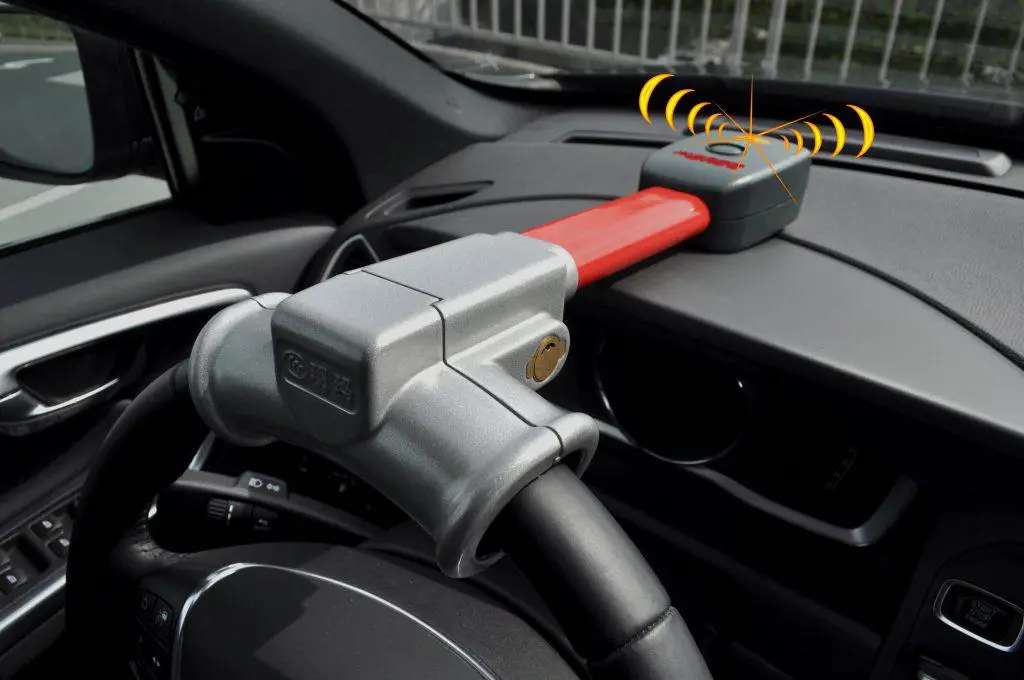
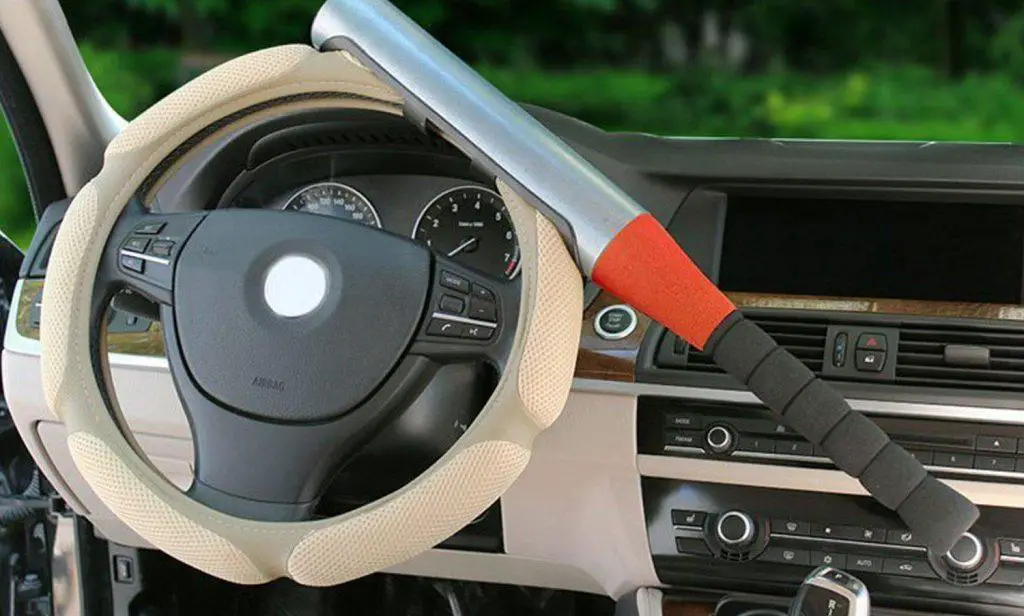
Steering wheel lock can be useful from time to time
Using the Key in the Car Door
The last method to know for disabling the anti-theft light is to use the car key. You need to use the car key on the driver’s side door and the physical key even if the car is equipped with a keyless entry system.
Finally, turn the key to unlock the car door, but do not release it. We recommend holding the key in the same position for at least 20 to 30 seconds. This will allow the car’s system to know that you have the correct key and bypass the alarm system.
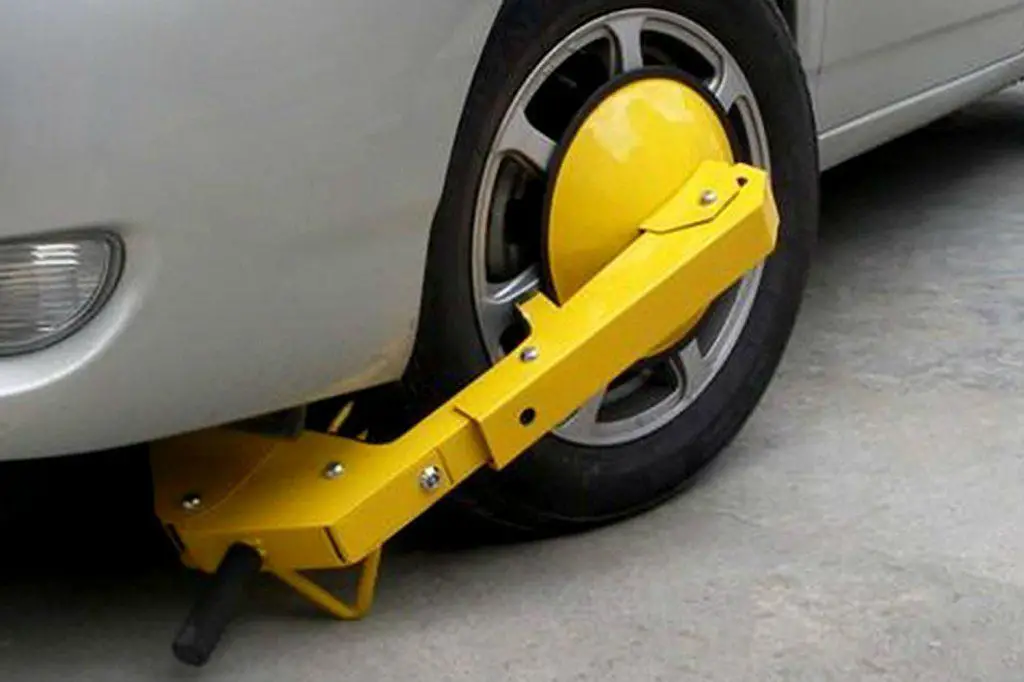
Wheel lock is a cumbersome device to deploy
In Summary
So, when you want to know how to disable the anti-theft system of your car, these guidelines will help you accomplish the task without much hassle.
How Long Do Alternators Last
The alternator is an essential component of your car. Using the engine’s power, it recharges your battery and prevents it from discharging and dying. It also provides power to your car’s electrical components, such as the headlights and GPS systems. But how long do alternators last from when the car is new? What factors contribute to the longevity of this important component?
The alternator is an automotive part that requires regular attention because if it fails, you may not be able to start your engine. If your alternator fails, it’s highly likely you’ll need to replace it. Discover how long alternators last, what affects their lifespan, when to replace them, and other maintenance tips.
What Contributes to the Alternator’s Lifespan
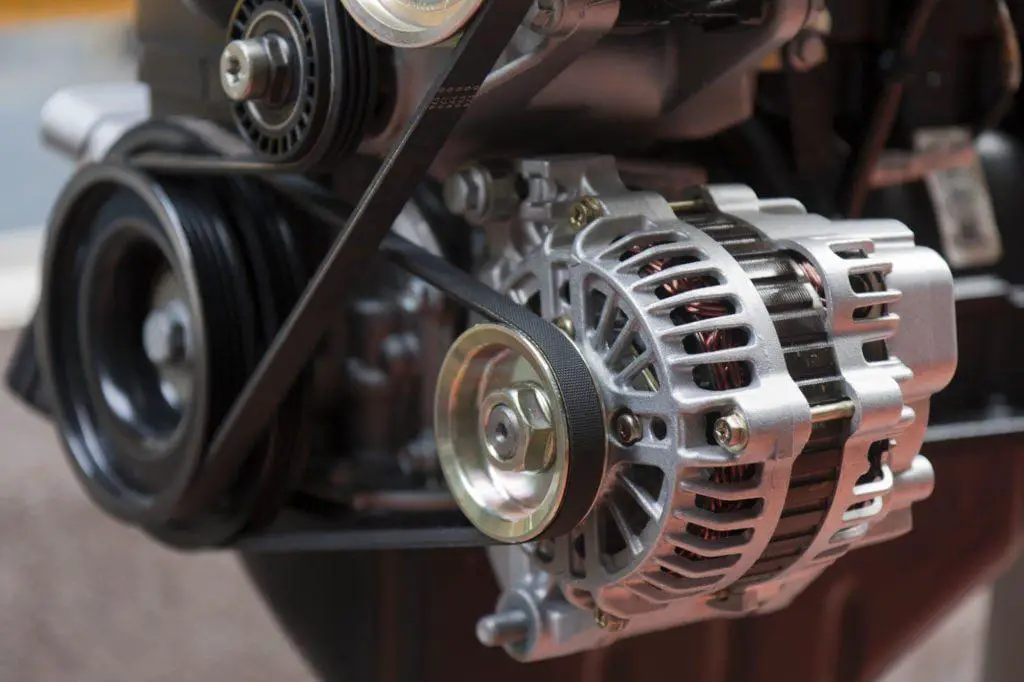
An alternator produces alternating current (AC), unlike the generator in older vehicles, which produces direct current (DC), hence its name. Cars equipped with an alternator use a diode pack to convert AC to DC, which the car’s electrical system components need to function.
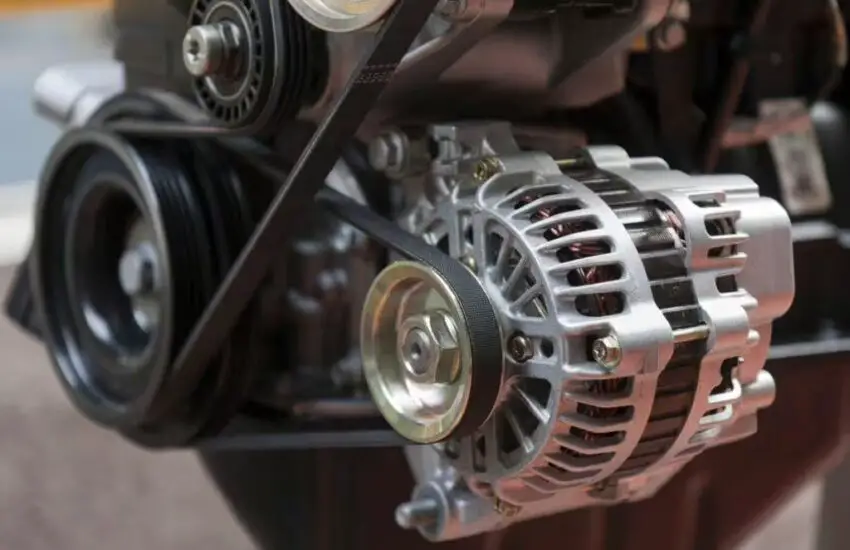
Many components and accessories in your car are powered by the alternator. Source: Drive2
The main role of the alternator is to prevent the battery from losing its charge and dying because when the battery dies, all the electrical components in your vehicle don’t receive the necessary power to operate.
A few decades ago, the alternator only powered your headlights and a few basic electrical accessories like your radio. In contrast, modern vehicles are now fully equipped with a multitude of accessories.
GPS navigation systems and entertainment systems, for example, consume a lot of power. Additionally, you probably have an onboard navigation system, power windows, power mirrors, and maybe even heated seats. All these elements together consume a lot of power from your alternator.
In short, your alternator works all day, throughout your entire journey. The more electricity you consume with all these accessories, the harder your alternator has to work, and thus, the shorter its lifespan.
How Long Do Alternators Last
Generally speaking, depending on whether you maintain your vehicle appropriately and regularly, you can expect the average lifespan of an alternator to be between 40,000 and 100,000 miles.
Many factors can affect the lifespan of your alternator, so it’s hard to say for sure how long you can expect it to last. However, the alternator typically won’t last as long as your car.
For one, the alternator’s rotor spins on a needle bearing, a component that can break due to wear and tear or dirt buildup. The diodes in the voltage regulator can also fail. Additionally, engine heat puts enormous pressure on the alternator, as it does on other components under your car’s hood.
Can I Drive with a Failed Alternator?
Technically, the car can still run, but only for a short period, as it uses only the energy stored in the battery. You might get a quick start with the help of a friend or a helpful passerby with jumper cables, but the car won’t last very long with a failed alternator.
It is also extremely dangerous to drive this way. This is because a car with low electrical power doesn’t have enough “food” to power many components necessary for its operation. Remember that a number of other important car parts also consume power: headlights, brake lights, interior lighting, engine control unit (ECU), etc.
Even if you’re lucky enough to avoid accidents, you risk getting stuck in the middle of the road due to a failed alternator. If alternator problems manifest on the road, especially during a long trip, your safety is compromised. You should test the alternator and battery at regular intervals, for example, every 4 to 6 months.
Test the alternator and battery every 4 to 6 months to ensure they are in perfect condition. Source: Late Model Restoration
Once you encounter one or more of the telltale signs below, you should try to get to an auto repair shop immediately.
Signs Your Alternator Is Wearing Out
Below are the most common symptoms of a failing alternator:
Warning light on the dashboard: Usually, this light is shaped like a battery, or in some cases, it’s labeled “GEN” (for “generator”) or “ALT” (for “alternator”);
Dim headlights. This is because the headlights and other parts that use electricity don’t have enough “power” to function normally;
Interior lighting: the dashboard gradually dims while the car is running;
Loss of power to various electrical accessories, such as the air conditioner, when your car is idling;
A radio hum in the speakers. This is a sign that the alternator’s diodes are not in good condition and are leaking energy in the wrong places.
You hear a screeching noise coming from the front of the car when the engine is running;
Slow cranking;
The car doesn’t start at all.
Alternator Maintenance
If you encounter these issues, resolve them immediately. Follow this guide to learn how to test an alternator in less than 10 minutes at home to ensure hassle-free driving. After all, it’s pointless to know how long alternators last without seeking ways to maximize their lifespan. And it’s much easier and cheaper than you think.
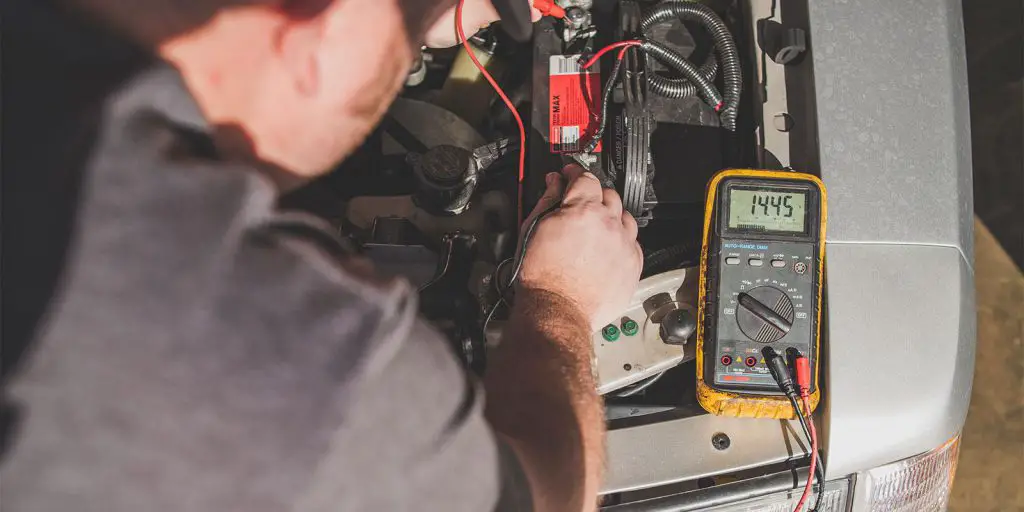
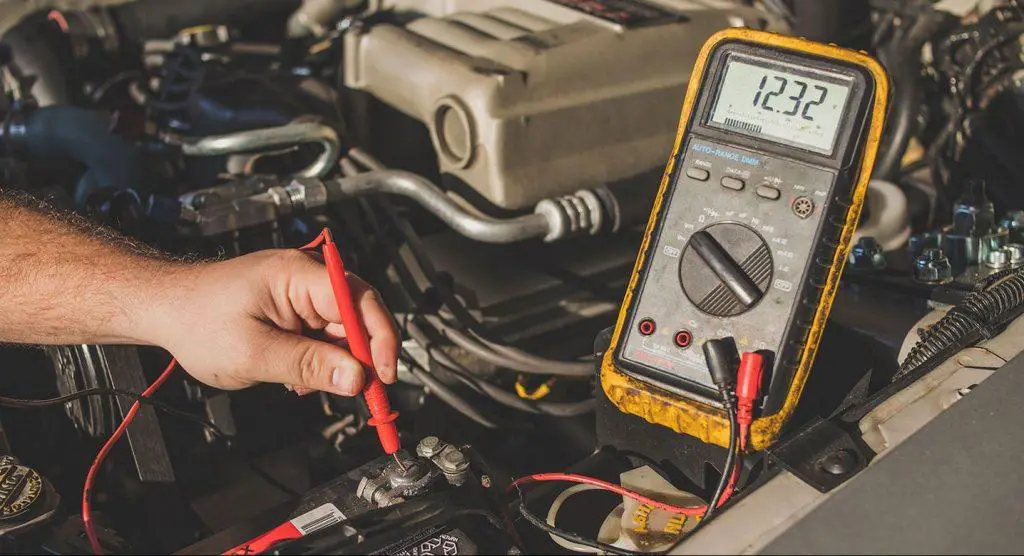
There are several ways to test the condition of your car’s alternator. One of them is to use a multimeter, while another common method is to use a digital voltmeter. The multimeter measures a number of different electrical properties, including voltage, current, and resistance, while the voltmeter is used to measure electrical power. Both are available at almost any auto parts or electronics store and typically cost between $10 and $20.
How to test an alternator at home. Source: AutoVfix.com
It’s important to always test the battery first when checking the condition of your alternator. To test an alternator, you must first test the battery. This is because the battery allows the car to start; when the car is running, it spins the alternator, and this spinning keeps the battery charged. If the battery is too weak, it won’t start the car, and any subsequent test to check the alternator will therefore be useless.
Among the above symptoms of a failing alternator, if slow cranking only happens early in the morning, the battery is likely the cause. In contrast, if the slow cranking problem occurs while the car is running, meaning when the engine is warm, the alternator is more likely to be the culprit.
How to Test Crankshaft and Camshaft Position Sensors
Crankshaft and camshaft position sensors are part of a vehicle’s engine and are responsible for rotation. A faulty sensor can prevent your car from moving; it will make noise, but it won’t start. You may experience loss of power in the engine, misfires, and there may be no spark when starting the engine.
In many cases, a car can run with a faulty sensor, but it shouldn’t, as it only worsens the dangers. If you don’t address it, you risk having to perform costly repairs, and the engine may also suffer permanent damage. Now let’s move on to “testing the crankshaft and camshaft position sensors.”
How to test crankshaft and camshaft position sensors?
This is what a sensor looks like
Well, testing the sensors is the solution once you’ve identified the correct category. By category, it means whether it’s a 2-wire or 3-wire type. You can check by looking at the connector to see if it includes two or three wires. Let’s find out the testing process for both mechanisms.
1. Testing a two-wire sensor
In the two-wire system (magnetic type), you first need to perform the resistance test. Take the multimeter and set it to AC voltage. Also check the connector and make sure there’s no dirt or mud inside.
To continue with the crankshaft position sensor test, have someone turn the ignition key; do not start the engine.
Now, take the probe or the metal part and touch it to the ground while the other touches the sensor wires. If you see current flowing, it’s a good sign.
Now restart the engine and this time, check the signal. Take the probes and place them on one of the sensor wires and touch the other wire with the other. The reader will display the result, and here it must match the specifications in the manual. If there’s a signal, you’re good to go; otherwise, maintenance is needed.
2. Testing a three-wire sensor
Now move on to the crankshaft position sensor test for three wires if that’s what you have. First identify the three wires as the power, ground, and signal wires. Use your vehicle’s repair manual and you can easily distinguish the three wires.
This time, take the multimeter and set it to DC voltage. Similarly, turn the ignition key without starting the engine.
You get the black probe that you need to connect to ground and the other to the power cable. The reading will display and must match the specifications as written in your manual.
Start the engine. Connect the signal wire to the red probe and the ground wire to the black probe. If the measured values are lower than the mentioned specification, it’s a faulty sensor.
Testing a 3-wire sensor requires many steps
Conclusion
Do not drive with faulty crankshaft and camshaft position sensors. Instead, use these methods and test the crankshaft and camshaft position sensors once you know the type of sensors. If symptoms are detected, take the car to the center or call the home service provider.
Why are diesel engines so noisy?
Diesel cars have an incessant relationship with knocking noise. Diesel engine manufacturers have taken all necessary measures to eliminate these irritating noises, but the result is always the same. The noise from diesel engines has nothing to do with weather conditions and temperature. One might wonder: “Why are diesel engines so noisy?” Many reasons are responsible for the noise made by diesel engines.
Let’s find the reasons that cause noise inside the diesel engine!
Basic Information on Gasoline and Diesel Engines
Gasoline Engines
A vehicle powered by a gasoline engine compresses the mixture of gasoline and air to the appropriate pressure. At the end of the compression stroke, the spark plug ignites the compressed mixture. The piston pushes from top dead center to bottom dead center due to the heat generated by this process. As a result, the crankshaft rotates and transmits motion to the transmission and then to the wheels. Gasoline engines cannot do without spark plugs; this is also a sign of the gasoline engine’s fuel supply system.
Diesel Engines
Unlike gasoline engines, diesel/oil engines do not need spark plugs to create a spark to ignite the intake air mixture. At the end of the compression period and the beginning of the expansion combustion period, diesel oil will be injected into the diesel engine’s combustion chamber. Under the influence of the high temperature and pressure of the compressed air, spontaneous combustion will occur.
Furthermore, some diesel/oil engines are equipped with an additional glow plug. In winter, the compressed air does not create sufficient temperature and pressure, which can cause spontaneous combustion upon diesel injection. The reason is that the engine’s combustion chamber is too cold. At that point, the glow plug has the effect of heating the combustion chamber before starting the engine.
Why Are Diesel Engines So Noisy? The Main Reasons
The knocking noise from diesel engines comes from the combustion and the mechanism under the hood. The main reason for the knocking noise is the pressure buildup inside the engine. A diesel engine operates on a pressure mechanism that causes a lot of noise when it starts running. Vibrations from the engine structure also cause knocking in diesel engines.
Let’s talk about some specific factors that make diesel engines noisy.
1. Vibrations Inside the Engine’s Internal Surface
A diesel engine is composed of many small parts that function correctly. These small parts cause vibrations after the ignition is turned on. The small valves, oil pipes, and metal caps produce a lot of noise. So, have you found the answer to why diesel engines make so much noise? If not, let’s find out more about the reasons why diesel engines are so noisy.
Need to know about internal vibrations for “why are diesel engines noisy” (Photo source: pixy)
2. Combustion and Pressure
Combustion inside the engine produces high pressure to move the car forward. The combustion force of a diesel engine is the main force that accelerates the car to its maximum speed. The noise from a combustion force can exceed 5,000 Hz. This amount of force and pressure through a machine always results in irritating noise. This is why manufacturers place multiple layers of coating on the engine structure to reduce noise as much as possible.
3. Surface and Accessory Vibrations – Outer Surface
The force inside the diesel engine also causes the car’s outer surface and accessories to vibrate. This high pressure inside the car’s engine makes the entire outer surface of the engine and its parts vibrate. The automobile’s structure starts to shake when the engine is running. The cause of this is that every part of a diesel engine is excited in the same way, as another explanation for your “Why are diesel engines so noisy?“
4. Size of Engine Parts
The size of the diesel engine plays a crucial role in the noise. This is because the small engine parts start to wear out much more often than the larger ones. Noise problems are often present in small diesel engines. Irregular maintenance and services can lead to poor performance and noise from diesel engines. Following professionals’ maintenance tips would be highly appreciated.
Engine size matters (Photo source: peakpx)
5. Use of a Turbocharger
Most diesel engines are equipped with at least one turbocharger. A turbocharger is essentially an exhaust gas-driven compressor that forces more air into the engine. This way, the engine receives more air without increasing the RPM. With the right amount of additional fuel, a diesel engine can produce the same maximum power as a gasoline engine while offering superior torque and fuel economy.
When the engine runs at high speed, the exhaust gases are released faster and cause the turbine to spin faster. Sometimes, the rotational speed can reach over 100,000 RPM.
Final Words
Overall, here are some reasons why diesel engines are so noisy. At this point, do you have the answer to the question: why are diesel engines so noisy?
What Happens When Car Oil Isn’t Changed Regularly
Just like blood in your body, car oil is just as important for the engine. Car oil allows the engine to run smoothly and precisely. But oil cannot stay clean on its own, and it’s your job to change it for the good of your car. Changing a car’s oil irregularly will reduce the car’s working efficiency, its lifespan, and many other things.
Hidden Dangers of Not Regularly Changing Car Oil
No matter how modern your car is, you will send it to an early grave if you don’t change the lubricant every 16,000 km. It is the key factor in mitigating the impact between metals. And as many drivers are unaware, the effects of used oil on their vehicle are much worse:
1. Reduce the Efficiency of the Car Engine’s Operation
Used car oil creates problems for the engine (photo source: tcservicecenter.com)
After a long period of maintenance, the heat from the operating process burns all the coolant, causing the engine to overheat. Used oil is one of the causes of engine overheating. This not only reduces the car engine’s efficiency but also causes the engine to heat up and damages other car parts.
2. Create Dirt Inside the Engine
A horrible scene for all lazy drivers! (photo source: piximus)
During operation, engine parts will be damaged, leading to abrasion. Leaving the oil unchanged for too long will lead to oil loss; more dirt will accumulate and the filter will not work effectively. At that point, the dirt can wear down the engine. If the engine oil runs out, dirt will stick to the engine parts and damage the vehicle. Furthermore, high oil temperatures will also create dirt. Normally, this dirt is collected by the “oil filter” to prevent it from sticking under the car’s engine. However, if car owners are too lazy to change the oil, the remaining oil in the car might be too little to “carry” all the dirty dirt to the filter.
Why do we need to filter this dirt? You can see the horror in the image above. The dirt will firmly adhere to the engine and slowly destroy it if drivers wait too long to change the car oil.
3. Release Polluted Smoke
Imagine a luxury car emitting black smoke, terrible isn’t it? (photo source: thingsautos)
The older the oil, the more easily it burns and releases toxic smoke. If you are a big environmentalist, this is a huge problem! Drivers must change their car oil often, as new oil creates less exhausting black smoke.
4. Consume More Fuel
Used oil actually affects fuel consumption (photo source: Dmitry Kalinovsky)
After driving for a long period, the lubricating effect of the oil decreases. As a result, car engines heat up much more during operation, which consumes more fuel. So, if you don’t want to lose a huge sum of money on your gas bill, change the oil regularly!
5. Reduce the Car’s Lifespan
Change your car oil regularly or change your car regularly (photo source: Kevin/Flickr)
This is by far the most common reason your car breaks down so early. Irregular oil changes not only decrease engine efficiency but also scratch and damage other important vehicle parts. Not to mention, if your car runs out of oil, car owners might have to replace the engine with a new one.
When Should Engine Oil Be Changed?
Car manufacturers often recommend changing engine oil after 5,000 km or 10,000 km… These recommendations are correct but not for all cases.
Depending on the vehicle’s usage conditions, oil changes can vary. For example, vehicles operating in harsh climate conditions, on bad roads, driving a lot… will need to change their oil sooner than vehicles operating in favorable conditions.
Another way is to use the dipstick. Based on the engine’s oil dipstick. The best way to check is when the engine is cold, the oil level should not be below the minimum; when the engine is hot, the oil level should not be above the maximum. Look at the color of the oil on the top of the dipstick. If the oil is black, it’s time to change it. If it is yellow or orange, the oil is still good and should not be changed.
Note: engine oil is not always thicker the better. Currently, multigrade lubricants ensure viscosity and facilitate vehicle starting, whether at high or low temperatures. This type of lubricant is not too thick like the previous single-grade lubricating products.