
P20F0 – SCR NOx Catalyst – Overheating, Row 2

How severe is this DTC?

All stored SCR-related codes can trigger the SCR system shutdown. The stored code P20F0 should be considered severe and addressed as quickly as possible. Catalyst damage could occur if the code is not corrected promptly.

What are some symptoms of the code?

Symptoms of a P20F0 fault code may include:

  • Excessive black smoke from the vehicle’s exhaust
  • Decreased engine performance
  • Reduced fuel efficiency
  • Other stored SCR and emission-related codes

What are some common causes of the code?

Causes

of this code may include:

  1. Faulty exhaust temperature sensor
  2. Inoperative SCR system
  3. Defective SCR injector
  4. Incorrect or insufficient DEF fluid
  5. Incorrect SCR controller or programming error
  6. Pre-catalyst exhaust leaks
  7. Installation of aftermarket or high-performance exhaust parts

What are the troubleshooting steps for P20F0?

If other SCR or exhaust emission codes or exhaust temperature codes are stored, these should be addressed before attempting to diagnose the stored P20F0.

All pre-catalyst exhaust leaks must be repaired before attempting diagnosis for this type of code.

Access to a diagnostic scanner, digital volt/ohmmeter (DVOM), infrared thermometer with laser pointer, and vehicle-specific SCR system diagnostic information source will be necessary to diagnose a P20F0 code.

Finding a technical service bulletin (TSB) that matches the vehicle’s year, make, and model; as well as engine size, stored codes, and presented symptoms could provide useful diagnostic information.

Begin your diagnosis with a visual inspection of the SCR injection system, exhaust temperature sensors, NOx sensors, and oxygen sensor (O2) harnesses and connectors. Burned or damaged wiring and/or connectors should be repaired or replaced before continuing.

Continue by locating the vehicle’s diagnostic connector and connecting the scanner. Retrieve all stored codes and relevant freeze frame data and record this information before clearing the codes. Then test drive the vehicle until the PCM enters readiness mode or the code resets.

If the PCM enters readiness mode, the code is intermittent and may be much more difficult to diagnose at this point. The conditions that contributed to the code storage may need to worsen before a diagnosis can be reached.

If the code resets immediately, consult your vehicle information source for diagnostic flowcharts, connector pinout diagrams, connector face views, as well as component testing procedures and specifications. This information will be needed to complete the next steps of your diagnosis.

Observe the scanner data stream to compare exhaust temperature sensor data (pre and post cat) between engine banks. If inconsistencies are detected, test the exhaust temperature sensors using the DVOM. Sensors that do not meet manufacturer specifications should be considered faulty.

If all sensors and circuits appear to be functioning as expected, suspect that the catalyst element is defective or the SCR system has failed.

Ensure the DEF tank is filled with the appropriate fluid and has not been contaminated in any way
P20F1 – SCR NOx Pre-Catalyst – Overheating, Bank 2

How severe is this DTC?

All stored SCR-related codes can trigger the SCR system shutdown. The stored code P20F1 should be considered severe and addressed as soon as possible. Catalyst damage could occur if the code is not corrected promptly.

What are some symptoms of the code?

Symptoms of a P20F1 fault code may include:

  • Excessive black smoke from the vehicle’s exhaust
  • Decreased engine performance
  • Reduced fuel efficiency
  • Other stored SCR and emission-related codes

What are some common causes of the code?

Causes

of this code may include:

  1. Faulty exhaust temperature sensor
  2. Non-operational SCR system
  3. Defective SCR injector
  4. Incorrect or insufficient DEF fluid
  5. Incorrect SCR controller or programming error
  6. Pre-catalyst exhaust leaks
  7. Installation of aftermarket or high-performance exhaust parts

What are the troubleshooting steps for P20F1?

If other SCR or exhaust emission codes or exhaust temperature codes are stored, these should be addressed before attempting to diagnose the stored P20F1.

All pre-catalyst exhaust leaks must be repaired before attempting diagnosis for this type of code.

Access to a diagnostic scanner, digital volt/ohmmeter (DVOM), infrared thermometer with laser pointer, and vehicle-specific SCR system diagnostic information source will be necessary to diagnose a P20F1 code.

Finding a technical service bulletin (TSB) that matches the vehicle’s year, make, and model; as well as engine size, stored codes, and presented symptoms could provide useful diagnostic information.

Begin your diagnosis with a visual inspection of the SCR injection system, exhaust temperature sensors, NOx sensors, and oxygen sensor (O2) harnesses and connectors. Burned or damaged wiring and/or connectors should be repaired or replaced before continuing.

Continue by locating the vehicle’s diagnostic connector and connecting the scanner. Retrieve all stored codes and relevant freeze frame data and record this information before clearing the codes. Then test drive the vehicle until the PCM enters readiness mode or the code resets.

If the PCM enters readiness mode, the code is intermittent and may be much more difficult to diagnose at this point. The conditions that contributed to the code storage may need to worsen before a diagnosis can be reached.

If the code resets immediately, consult your vehicle information source for diagnostic flowcharts, connector pinout diagrams, connector face views, as well as component testing procedures and specifications. This information will be needed to complete the next steps of your diagnosis.

Observe the scanner data stream to compare exhaust temperature sensor data (pre and post cat) between engine banks. If inconsistencies are detected, test the exhaust temperature sensors using the DVOM. Sensors that do not meet manufacturer specifications should be considered defective.

If all sensors and circuits appear to be functioning as expected, suspect that the catalyst element is defective or the SCR system has failed.

Ensure the DEF tank is filled with the appropriate fluid and has not been contaminated in any way

P20F2 – SCR NOx Catalyst Efficiency Below Threshold, Bank 2

How severe is this DTC?

All stored SCR-related codes can trigger SCR system deactivation. The stored code P20F2 should be considered severe and addressed as quickly as possible. Catalyst damage could occur if the code is not corrected promptly.

What are some symptoms of the code?

Symptoms of a P20F2 trouble code may include:

  • Excessive black smoke from vehicle exhaust
  • Decreased engine performance
  • Reduced fuel efficiency
  • Other stored SCR and emission-related codes

What are some common causes of the code?

Causes

of this code may include:

  1. Faulty O2, NOx, or temperature sensor
  2. Non-operational SCR system
  3. Defective SCR injector
  4. Incorrect or insufficient DEF fluid
  5. Incorrect SCR controller or programming error
  6. Pre-catalyst exhaust leaks
  7. Installation of aftermarket or high-performance exhaust parts

What are the troubleshooting steps for P20F2?

If other SCR or exhaust emission codes or exhaust temperature codes are stored, these should be addressed before attempting to diagnose the stored P20F2.

All pre-catalyst exhaust leaks must be repaired before attempting diagnosis for this type of code.

Access to a diagnostic scanner, digital volt/ohmmeter (DVOM), infrared thermometer with laser pointer, and vehicle-specific SCR system diagnostic information source will be necessary to diagnose a P20F2 code.

Finding a technical service bulletin (TSB) that matches the vehicle’s year, make, and model; as well as engine size, stored codes, and presented symptoms could provide useful diagnostic information.

Begin your diagnosis with a visual inspection of the SCR injection system, exhaust temperature sensors, NOx sensors, and oxygen (O2) sensor harnesses and connectors. Burned or damaged wiring and/or connectors should be repaired or replaced before continuing.

Continue by locating the vehicle’s diagnostic connector and connecting the scanner. Retrieve all stored codes and relevant freeze frame data and record this information before clearing codes. Then test drive the vehicle until the PCM enters readiness mode or the code resets.

If the PCM enters readiness mode, the code is intermittent and may be much more difficult to diagnose at this point. Conditions that contributed to code storage may need to worsen before diagnosis can be achieved.

If the code resets immediately, consult your vehicle information source for diagnostic flowcharts, connector pinout diagrams, connector face views, as well as component testing procedures and specifications. This information will be needed to complete the next steps of your diagnosis.

Observe scanner data flow to compare O2, NOx, and exhaust gas temperature sensor data (pre and post cat) between engine banks. If inconsistencies are detected, test the respective sensors using the DVOM. Sensors that do not meet manufacturer specifications should be considered faulty.

If all sensors and circuits appear to be functioning as expected, suspect that the catalyst element is defective or the SCR system has failed.

Ensure the DEF tank is filled with the appropriate fluid and has not been contaminated in any way

P20F3 – SCR NOx Catalyst Efficiency Below Threshold, Bank 2

How severe is this DTC?

All stored SCR-related codes can trigger the SCR system shutdown. The stored code P20F3 should be considered severe and addressed as soon as possible. Catalyst damage could occur if the code is not corrected promptly.

What are some of the symptoms of the code?

Symptoms of a P20F3 fault code may include:

  • Excessive black smoke from the vehicle’s exhaust
  • Decreased engine performance
  • Reduced fuel efficiency
  • Other stored SCR and emission-related codes

What are some common causes of the code?

Causes

of this code may include:

  1. Faulty O2, NOx, or temperature sensor
  2. Non-operational SCR system
  3. Defective SCR injector
  4. Incorrect or insufficient DEF fluid
  5. Incorrect SCR controller or programming error
  6. Pre-catalyst exhaust leaks
  7. Installation of aftermarket or high-performance exhaust parts

What are the troubleshooting steps for P20F3?

If other SCR or exhaust emission codes or exhaust temperature codes are stored, these should be addressed before attempting to diagnose the stored P20F3.

All pre-catalyst exhaust leaks must be repaired before attempting diagnosis for this type of code.

Access to a diagnostic scanner, a digital volt/ohmmeter (DVOM), an infrared thermometer with a laser pointer, and a vehicle-specific SCR system diagnostic information source will be necessary to diagnose a P20F3 code.

Finding a technical service bulletin (TSB) that matches the vehicle’s year, make, and model; as well as engine size, stored codes, and presented symptoms could provide useful diagnostic information.

Start your diagnosis with a visual inspection of the SCR injection system, exhaust temperature sensors, NOx sensors, and oxygen (O2) sensor harnesses and connectors. Burned or damaged wiring and/or connectors should be repaired or replaced before continuing.

Continue by locating the vehicle’s diagnostic connector and plugging in the scanner. Retrieve all stored codes and relevant freeze frame data and record this information before clearing the codes. Then, test drive the vehicle until the PCM enters readiness mode or the code resets.

If the PCM enters readiness mode, the code is intermittent and may be much more difficult to diagnose at this point. The conditions that contributed to the code storage may need to worsen before a diagnosis can be reached.

If the code resets immediately, consult your vehicle information source for diagnostic flowcharts, connector pinout diagrams, connector face views, as well as component testing procedures and specifications. This information will be needed to complete the next steps of your diagnosis.

Observe the scanner data stream to compare O2, NOx, and exhaust gas temperature sensor data (pre and post catalyst) between engine banks. If inconsistencies are detected, test the respective sensors using the DVOM. Sensors that do not meet manufacturer specifications should be considered faulty.

If all sensors and circuits appear to be functioning as expected, suspect that the catalyst element is defective or the SCR system has failed.

Ensure the DEF tank is filled with the appropriate fluid and has not been contaminated in any way.

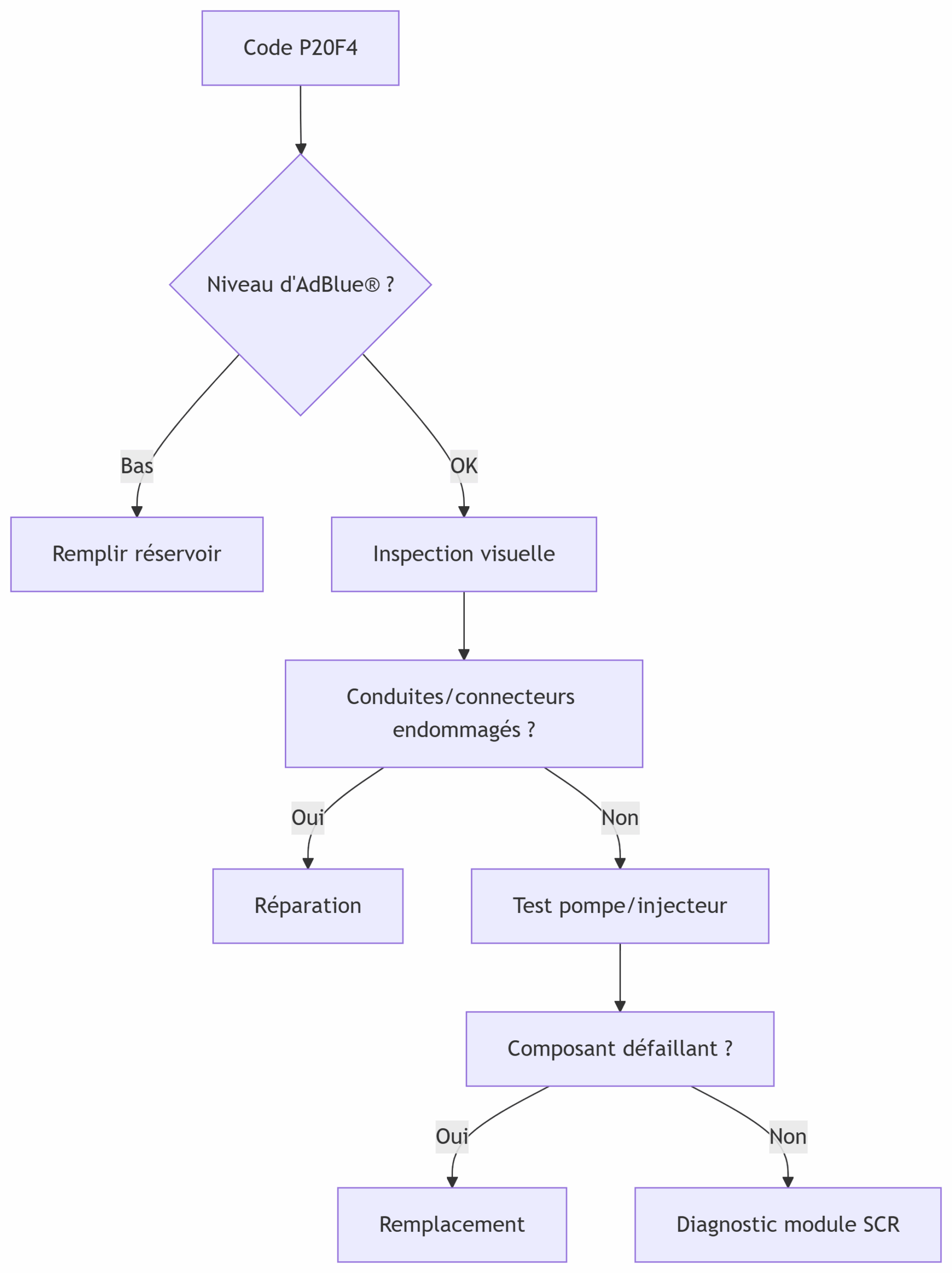
P20F4 – Reductant Consumption Too Low

Code Meaning

P20F4 indicates that the reductant (AdBlue®) flow is lower than expected by the SCR (Selective Catalytic Reduction) system. This fluid is essential for reducing NOx emissions on diesel vehicles.


Probable Causes

Priority Cause
1. Low AdBlue® level or degraded quality
2. Clogged cap/piping (urea crystallization)
3. Faulty AdBlue® pump
4. Clogged or faulty SCR injector
5. Defective AdBlue® quality/flow sensor
6. Electrical issue (wires, connectors, relay)
7. SCR module (DCU) failure

Diagnostic Procedure

Step 1: Initial checks (40% of cases)

  • AdBlue® level:

    • Check the tank (refill if < ⅓ full).

    • Check fluid quality (no water or contaminants).

  • 🔍 Visual inspection:

    • Examine pump/injector connectors and cables (look for corrosion, bent pins).

    • Inspect AdBlue® lines (swelling, leaks, white crystals).

Step 2: System tests (requires diagnostic tool)

  • ⚙️ Live data reading:

    • Actual vs. expected AdBlue® flow rate.

    • Tank temperature (must be > -7°C to operate).

  • 🔧 Pump/injector activation:

    • Activate the pump with the diagnostic tool to verify its operation.

Step 3: Electrical tests

Component Test
AdBlue® pump Measure voltage (12V) and resistance (10-20 Ω depending on model)
SCR injector Check resistance (often 10-15 Ω)
Level sensor Verify voltage curve according to level

Step 4: System cleaning

  • Decrystallization:

    • Remove the SCR injector and soak it in hot distilled water (30 min).

    • Use a specific cleaning kit for the lines (e.g., Liqui Moly SCR System Clean).


Repair Solutions

Cause Solution Estimated Cost
Low level Refill with ISO 22241 certified AdBlue® 10-20 €
Clogged lines Chemical cleaning or replacement 50-150 €
Faulty pump Replacement 300-600 €
Faulty SCR injector Replacement 200-500 €
Electrical issue Wiring harness/connector repair 50-200 €

⚠️ Important:

  • Reset the SCR system with a diagnostic tool after repair (e.g., Delphi DS150E or Autel MaxiCOM).

  • An unresolved P20F4 can lead to power limitation and exceeding anti-pollution standards.


Technical Tips

  1. Crystal prevention:

    • Use only new and certified AdBlue®.

    • Avoid parking the vehicle on a slope (the injector must remain submerged).

  2. Related codes:

    • If P20F4 is accompanied by P207F (flow too high), suspect a faulty sensor.

  3. Software update:

    • Check your manufacturer’s TSBs (Technical Service Bulletins) for software corrections.

P20F5 – Reductant Consumption Too High

How to Fix Code P20F5

Check the “Possible Causes” listed above. Visually inspect the wiring harness and associated connectors. Check for damaged components and look for broken, bent, pushed out, or corroded connector pins.

P20F5

Symptoms

Possible

Check Engine Light On (or Service Engine Soon Warning Light)

P20F5 Meaning

Reductant Consumption Too High is the generic description for code P20F5, but the manufacturer may have a different description.

P20F6 – Reductant Injection Valve Stuck Open, Bank 1, Unit 1

How severe is this DTC?

A stored P20F6 code should be considered severe and addressed as soon as possible. The SCR system may be disabled because of this. Catalyst damage could occur if the conditions that contributed to the code being stored are not corrected in a timely manner.

What are some of the symptoms of the code?

Symptoms of a P20F6 trouble code may include:

  • Decreased engine performance
  • Excessive black smoke from the vehicle’s exhaust
  • Reduced fuel efficiency
  • Other SCR-related codes
  • What are some common causes of the code?

What are some common causes of the code?

Causes of this code may include:

  1. Faulty reductant injector valve
  2. Open or shorted circuits in the reductant injector valve control
  3. Insufficient DEF in the tank
  4. Faulty SCR controller/PCM or programming error

What are the troubleshooting steps for P20F6?

You will need access to a diagnostic scanner, a digital volt/ohmmeter (DVOM), and a source of vehicle-specific diagnostic information to diagnose a P20F6 code.

If you can find a technical service bulletin (TSB) that matches the vehicle’s year, make, and model; as well as the engine size, stored code(s), and presented symptoms, it could provide helpful diagnostic information.

You’ll want to start your diagnosis with a visual inspection of the reductant heater system’s wiring harnesses and connectors. Burned or damaged wiring and/or connectors should be repaired or replaced before continuing.

Proceed by connecting the scanner to the vehicle’s diagnostic connector and retrieving all stored codes and relevant freeze frame data. Note this information before clearing the codes and test drive the vehicle until the PCM enters readiness mode or the code resets.

The code is intermittent and may be much harder to diagnose (for now) if the PCM enters readiness mode. If this is the case, the conditions that contributed to the code being stored may need to worsen before an accurate diagnosis can be made.

If the code resets, consult your vehicle information source for diagnostic flowcharts, connector pinout charts, connector face views, as well as component testing procedures and specifications. This information will be needed to complete the next step of your diagnosis.

Use the DVOM to test the SCR control system’s power supply. Test fuses with the circuit loaded to avoid misdiagnosis. If proper power and ground circuits are detected, use the scanner to activate the reductant injector valve (solenoid) and test the output control circuit voltage. If voltage is insufficient, suspect the controller is faulty or has encountered a programming error.

If the voltage output circuit is within parameters, use the DVOM to test the reductant injector valve in question. If the valve does not meet manufacturer specifications, suspect it has failed.

The reductant injector valve is actually a solenoid injector that sprays reductant fluid into the exhaust

P20F7 – Reductant Injection Valve Stuck Open, Row 2, Unit 1

How severe is this DTC?

A stored P20F7 code should be considered severe and addressed as quickly as possible. The SCR system may be disabled because of this. Catalyst damage could occur if the conditions that contributed to the code being stored are not corrected in a timely manner.

What are some of the symptoms of the code?

Symptoms of a P20F7 trouble code may include:

  • Decreased engine performance
  • Excessive black smoke from the vehicle’s exhaust
  • Reduced fuel efficiency
  • Other SCR-related codes

What are some common causes of the code?

Causes

of this code may include:

  • Faulty reductant injector valve
  • Open or shorted circuits in the reductant injector valve control
  • Insufficient DEF in the tank
  • Faulty SCR controller/PCM or programming error

What are the troubleshooting steps for P20F7?

You will need access to a diagnostic scanner, a digital volt/ohmmeter (DVOM), and a source of vehicle-specific diagnostic information to diagnose a P20F7 code.

If you can find a technical service bulletin (TSB) that matches the vehicle’s year, make, and model; as well as the engine size, stored code(s), and presented symptoms, it could provide helpful diagnostic information.

You’ll want to start your diagnosis with a visual inspection of the reductant heater system harnesses and connectors. Burned or damaged wiring and/or connectors should be repaired or replaced before continuing.

Proceed by hooking up the scanner to the vehicle’s diagnostic connector and retrieving all stored codes and relevant freeze frame data. Note this information before clearing the codes and test drive the vehicle until the PCM enters readiness mode or the code resets.

The code is intermittent and may be much harder to diagnose (for the time being) if the PCM enters readiness mode. If this is the case, the conditions that contributed to the code being stored may need to worsen before an accurate diagnosis can be made.

If the code resets, consult your vehicle information source for diagnostic flowcharts, connector pinout charts, connector face views, as well as component testing procedures and specifications. This information will be needed to complete the next step of your diagnosis.

Use the DVOM to test the SCR control system’s power supply. Test fuses with the circuit loaded to avoid misdiagnosis. If proper power and ground circuits are detected, use the scanner to activate the reductant injector valve (solenoid) and test the output control circuit voltage. If voltage is insufficient, suspect the controller is faulty or has encountered a programming error.

If the voltage output circuit is within parameters, use the DVOM to test the reductant injector valve in question. If the valve does not meet manufacturer specifications, suspect it has failed.

The reductant injector valve is actually a solenoid injector that sprays reductant fluid into the exhaust

P0C00 – Drive Motor ‘A’ Current Low

P0C00 Possible Causes

  • Faulty hybrid vehicle motor assembly
  • Hybrid vehicle motor assembly wiring harness is open or short-circuited
  • Poor electrical connection in hybrid vehicle motor assembly circuit

What Does It Mean?

How to Fix Code P0C00

Check the “possible causes” listed above. Visually inspect the wiring harness and related connectors. Check for damaged components and look for broken, bent, pushed out, or corroded connector pins.

P0C00 Possible Symptoms

Check engine light on (or service engine soon warning light)

P0C00 Meaning

When three-phase alternating current flows through the three-phase windings of the stator coil, a rotating magnetic field is generated in MG2. The system controls the rotation of the magnetic field based on the rotation position and speed of the rotor. As a result, the permanent magnets provided in the rotor are pulled in the direction of rotation, generating torque. The generated torque is almost proportional to the amount of current. The system controls MG2 speed by regulating the frequency of the alternating current. Additionally, the system properly controls the rotating magnetic field and the angle of the rotor magnets to generate high torque efficiently, even at high speeds.

P0C01 – Drive Motor ‘A’ Current High

P0C01 Possible Causes

  • Faulty hybrid vehicle motor assembly
  • Hybrid vehicle motor assembly wiring harness is open or short-circuited
  • Poor electrical connection in hybrid vehicle motor assembly circuit

What Does It Mean?

How to Fix Code P0C01

Check the “possible causes” listed above. Visually inspect the wiring harness and related connectors. Check for damaged components and look for broken, bent, pushed out, or corroded connector pins.

P0C01 Possible Symptoms

Check engine light on (or service engine soon warning light)

P0C01 Meaning

When three-phase alternating current flows through the three-phase windings of the stator coil, a rotating magnetic field is generated in MG2. The system controls the rotation of the magnetic field based on the rotation position and speed of the rotor. As a result, the permanent magnets provided in the rotor are pulled in the direction of rotation, generating torque. The generated torque is almost proportional to the amount of current. The system controls MG2 speed by regulating the frequency of the alternating current. Additionally, the system properly controls the rotating magnetic field and the angle of the rotor magnets to generate high torque efficiently, even at high speeds.