
Catalyst Temperature Sensor Circuit Low B1S2

What does it mean?

This diagnostic trouble code (DTC) is a generic powertrain code, meaning it applies to OBD-II equipped vehicles that have a catalytic converter temperature sensor (Subaru, Ford, Chevy, Jeep, Nissan, Mercedes-Benz, Toyota, Dodge, etc.). Although generic, the specific repair steps may vary by make/model.

The catalytic converter is one of the most important emission devices on a vehicle. Exhaust gases pass through the catalytic converter where a chemical reaction occurs. This reaction transforms carbon monoxide (CO), hydrocarbons (HC), and nitrogen oxides (NOx) into harmless water (H2O) and carbon dioxide (CO2).

The converter’s efficiency is monitored by two oxygen sensors; one mounted upstream of the converter and one mounted downstream. By comparing the oxygen sensor (O2) signals, the powertrain control module (PCM) can determine whether the catalytic converter is functioning properly. A standard zirconia pre-catalyst O2 sensor will rapidly switch its output signal between approximately 0.1 and 0.9 volts. A reading of 0.1 volt indicates a lean air/fuel mixture, while 0.9 volts indicates a rich mixture. If the converter is working correctly, the downstream sensor should read steadily around 0.45 volts.

The catalytic converter’s efficiency and temperature go hand in hand. If the converter is operating as it should, the outlet temperature should be slightly higher than the inlet. The old rule of thumb was a 100-degree Fahrenheit difference. However, many modern vehicles might not show that much of a difference.

There is no actual “catalyst temperature sensor.” What the codes described in this article refer to is the oxygen sensor. The “bank 1” part of the code indicates the issue is with the engine’s first bank. That is, the bank that includes cylinder number 1. “Sensor 2” refers to the sensor mounted downstream of the catalytic converter.

Trouble code P042C is set when the PCM detects a low catalyst temperature sensor signal in bank 1, catalyst temperature sensor 2 circuit. This typically indicates the circuit is shorted.

Code Severity and Symptoms

The severity of this code is moderate. Symptoms of a P042C engine code may include:

  • Check engine light illuminated
  • Poor engine performance
  • Reduced fuel economy
  • Increased emissions

Causes

Possible causes of this P042C code include:

  • Faulty oxygen sensor
  • Wiring issues
  • Unbalanced air/fuel mixture
  • PCM programming / faulty PCM

Diagnostic and Repair Procedures

Start by visually inspecting the downstream oxygen sensor and its associated wiring. Look for loose connections, damaged wiring, etc. Also check for exhaust leaks visually and audibly. An exhaust leak can cause a false oxygen sensor code. If damage is found, repair as necessary, clear the code, and see if it returns.

Next, check for technical service bulletins (TSBs) regarding the issue. If nothing is found, you’ll need to move on to step-by-step diagnosis of the system. The following is a generalized procedure, as tests for this code vary by vehicle. To accurately test the system, you will need to refer to a diagnostic flowchart specific to your vehicle’s make/model.

Check for Other DTCs

Oxygen sensor codes can often be set due to engine performance issues causing an unbalanced air/fuel mixture. If other trouble codes are stored, you should address those first before proceeding with oxygen sensor diagnosis.

Check Sensor Operation

To do this, it’s best to use a scan tool or, even better, an oscilloscope. Since most individuals don’t have access to an oscilloscope, we will cover diagnosing the oxygen sensor using a scan tool. Connect the scan tool to the OBD port under the dashboard. Turn on the scan tool and choose the Bank 1 Sensor 2 voltage parameter from the data list. Bring the engine to operating temperature and view the sensor’s operation on the scan tool in graph mode.

The sensor should have a steady reading of 0.45 volts with only very small fluctuations. If it is not responding correctly, it will likely need to be replaced.

Check the Circuit

Oxygen sensors produce their own voltage signal that is sent back to the PCM. Before proceeding, you’ll want to consult factory wiring diagrams to determine which wires are which. Autozone offers free online repair manuals for many vehicles, and ALLDATADIY offers single-vehicle subscriptions. To check continuity between the sensor and the PCM, turn the ignition key to the “off” position and disconnect the O2 sensor connector. Connect a digital multimeter set to ohms (ignition off) between the PCM’s O2 sensor signal terminal and the signal wire. If the meter reads out of limits (OL), there is an open circuit between the PCM and the sensor that will need to be located and repaired. If the meter reads a numerical value, there is continuity.

Next, you’ll want to check the ground side of the circuit. To do this, turn the ignition key to the “off” position and disconnect the O2 sensor connector. Connect a digital multimeter set to ohms (ignition off) between the O2 sensor connector ground terminal (harness side) and chassis ground. If the meter reads out of limits (OL), there is an open circuit on the ground side of the circuit that will need to be located and repaired. If the meter reads a numerical value, there is continuity to ground.

Finally, you’ll want to verify that the PCM is processing the O2 sensor signal correctly. To do this, leave all connectors connected and insert a back-probe pin into the PCM’s signal terminal. Set the digital multimeter to the DC volts setting. With the engine warmed up, compare the voltage reading on the meter to that on the scan tool. If the two do not match, the PCM is likely faulty or requires reprogramming.
P042D High Catalyst Temperature Sensor Circuit B1S2

What does it mean?


This diagnostic trouble code (DTC) is a generic powertrain code, meaning it applies to OBD-II equipped vehicles that have a catalytic converter temperature sensor (Subaru, Ford, Chevy, Jeep, Nissan, Mercedes-Benz, Toyota, Dodge, etc.). Although generic, the specific repair steps may vary by make/model.

The catalytic converter is one of the most important emission control devices on a vehicle. Exhaust gases pass through the catalytic converter where a chemical reaction occurs. This reaction transforms carbon monoxide (CO), hydrocarbons (HC), and nitrogen oxides (NOx) into harmless water (H2O) and carbon dioxide (CO2).

The converter’s efficiency is monitored by two oxygen sensors; one mounted upstream of the converter and one mounted downstream. By comparing the signals from the oxygen sensor (O2), the Powertrain Control Module (PCM) can determine if the catalytic converter is functioning correctly. A standard zirconia pre-catalyst O2 sensor will rapidly switch its output signal between approximately 0.1 and 0.9 volts. A reading of 0.1 volt indicates a lean air/fuel mixture, while 0.9 volts indicates a rich mixture. If the converter is working properly, the downstream sensor should settle steadily around 0.45 volts.

The efficiency and temperature of the catalytic converter go hand in hand. If the converter is working as it should, the outlet temperature should be slightly higher than the inlet. The old rule of thumb was a 100-degree Fahrenheit difference. However, many modern vehicles might not show that much of a difference.

There is no actual “catalytic converter temperature sensor.” What the codes described in this article refer to is the oxygen sensor. The “bank 1” part of the code indicates the issue is with the engine’s first bank. That is, the bank that includes cylinder number 1. “Sensor 2” refers to the sensor mounted downstream of the catalytic converter.

Trouble code P042D is set when the PCM detects a high catalytic converter temperature sensor signal in bank 1, catalytic converter temperature sensor 2 circuit. This typically indicates an open circuit.
Code Severity and Symptoms


The severity of this code is moderate. Symptoms of a P042D engine code may include:

Check Engine Light illuminated
Poor engine performance
Reduced fuel economy
Increased emissions

Causes


Possible causes of this P042D code include:

Faulty oxygen sensor
Wiring issues
Unbalanced air/fuel mixture
PCM programming / Faulty PCM

Diagnostic and Repair Procedures


Start by visually inspecting the downstream oxygen sensor and its corresponding wiring. Look for loose connections, damaged wiring, etc. Also check for exhaust leaks visually and audibly. An exhaust leak can cause a false oxygen sensor code. If damage is found, repair as necessary, clear the code, and see if it returns.

Next, check for Technical Service Bulletins (TSBs) regarding the issue. If nothing is found, you will need to proceed with step-by-step diagnosis of the system. The following is a generalized procedure, as tests for this code vary by vehicle. To accurately test the system, you will need to refer to a diagnostic flowchart specific to the vehicle’s make/model.
Check for Other DTCs

Oxygen sensor codes can often be set due to engine performance issues causing an unbalanced air/fuel mixture. If other trouble codes are stored, you should address them first before proceeding with oxygen sensor diagnosis.
Check Sensor Operation

To do this, it is best to use a scan tool or, even better, an oscilloscope. Since most individuals do not have access to an oscilloscope, we will cover diagnosing the oxygen sensor using a scan tool. Connect the scan tool to the OBD port under the dashboard. Turn on the scan tool and choose the Bank 1 Sensor 2 voltage parameter from the data list. Bring the engine to operating temperature and view the sensor’s operation on the scan tool in graph mode.

The sensor should have a steady reading of 0.45 volts with only very small fluctuations. If it is not responding correctly, it will likely need to be replaced.

Check the Circuit


Oxygen sensors produce their own voltage signal which is sent back to the PCM. Before continuing, you will want to consult factory wiring diagrams to determine which wires are which. Autozone offers free online repair manuals for many vehicles and ALLDATADIY offers single-vehicle subscriptions. To check continuity between the sensor and the PCM, turn the ignition key to the “off” position and disconnect the O2 sensor connector. Connect a digital multimeter set to ohms (ignition off) between the PCM’s O2 sensor signal terminal and the signal wire. If the meter reads Out of Limits (OL), there is an open circuit between the PCM and the sensor that will need to be located and repaired. If the meter reads a numerical value, there is continuity.

Next, you will want to check the ground side of the circuit. To do this, turn the ignition key to the “off” position and disconnect the O2 sensor connector. Connect a digital multimeter set to ohms (ignition off) between the O2 sensor connector ground terminal (harness side) and chassis ground. If the meter reads Out of Limits (OL), there is an open circuit on the ground side of the circuit that will need to be located and repaired. If the meter reads a numerical value, there is continuity to ground.

Finally, you will want to verify that the PCM is processing the O2 sensor signal correctly. To do this, leave all connectors connected and insert a back-probing pin into the PCM’s signal terminal. Set the digital multimeter to the DC volts setting. With the engine warmed up, compare the voltage reading on the meter to the one on the scan tool. If the two do not match, the PCM is likely faulty or requires reprogramming.

P042E Exhaust Gas Recirculation A Control Stuck Open

P042E Exhaust Gas Recirculation A Control Stuck Open

What does it mean?


This is a generic powertrain diagnostic trouble code (DTC) that applies to OBD-II vehicles. It may include, but is not limited to, vehicles from Ford, Chevrolet/GM/Cummins, Dodge/Ram, Isuzu, Pontiac, Toyota, BMW, Mercedes, etc. Although generic, the exact repair steps may vary depending on the year, make, model, and powertrain configuration.

If your vehicle has stored a P042E code, it means that the powertrain control module (PCM) has detected a problem with the exhaust gas recirculation (EGR) valve control system.

In the case of P042E, the valve appears (to the PCM) to be stuck in the open position. The designation A applies to a particular position or step of the lowered EGR valve control system, which is explained below.

The EGR system is responsible for allowing the engine to consume some of the unburned fuel from the exhaust system. The EGR system is necessary to reduce harmful levels of nitrogen oxides (NOx) created as a byproduct of gasoline and diesel engine operation.

The focal point of the EGR system is an electronically controlled valve (EGR) that opens to allow exhaust gases to re-enter the engine intake. The PCM uses input signals from the throttle position sensor (TPS), vehicle speed sensor (VSS), and crankshaft position sensor (CKP) to determine when conditions are suitable for opening/closing the EGR valve.

Vehicles that exhibit this type of code are equipped with a lowered EGR valve. The lowered EGR valve operates in stages based on the degree of throttle opening, the amount of load placed on the engine, and the speed at which the vehicle is moving.

In some models, the position of the EGR valve piston is also monitored by the PCM. If the desired EGR valve position (as commanded by the PCM) is different from the actual position, a P042E code will be stored and a malfunction indicator light (MIL) may illuminate. Most vehicles will require several ignition cycles (with a fault) before the MIL illuminates.

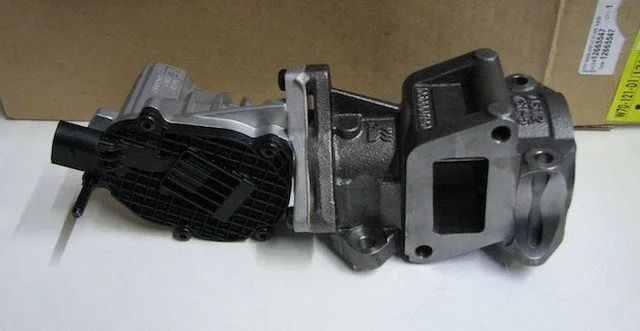
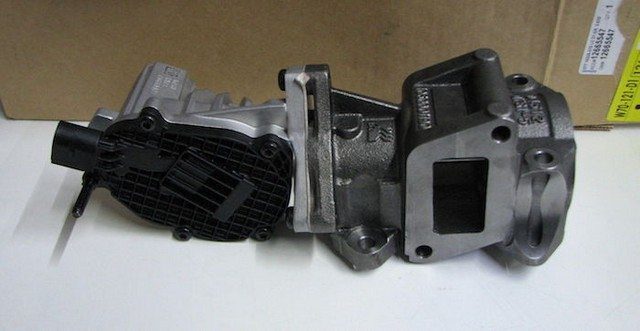
Photo of the Exhaust Gas Recirculation EGR Valve:


How severe is this DTC?


Conditions that lead to a stored P042E code can also cause serious driving problems. For this reason, a P042E code should be addressed urgently.

What are some of the symptoms of the code?


Symptoms of a P042E EGR fault code may include:

  • Irregular engine idle
  • Reduced fuel efficiency
  • Excessively lean exhaust
  • Other drive codes may be stored

What are some common causes of the code?


Causes of this P042E code may include:

  • Faulty EGR valve
  • EGR valve piston clogged with carbon or other debris
  • Faulty EGR control solenoid/valve
  • Open or shorted wiring/connectors in the EGR A control circuit
  • Faulty DPFE sensor
  • Bad EGR valve position sensor
  • PCM malfunction or PCM programming error

What are the P042E troubleshooting steps?


A diagnostic scanner, a digital volt/ohmmeter, and a reliable source of vehicle information are among the tools needed to diagnose a P042E code.

Visual inspection of all cables and connectors related to the EGR system is an ideal precursor to diagnosing a P042E code. Repair or replace any corroded or burnt components as needed.

Continue by connecting the scanner to the diagnostic port and retrieving all stored codes and freeze frame data. Note all of this as it will prove useful if the P042E is an intermittent code. Now, clear the codes and test-drive the vehicle to see if the code resets.

If the code resets, connect the scanner and observe the data stream. Check the desired EGR position (usually measured as a percentage) and the actual EGR position, as shown on the data stream display. Within milliseconds, they should be identical. If the actual EGR position indicates it is open too far, suspect that a piece of carbon has clogged the piston opening or that the EGR valve is faulty.

Obviously, the simplest method to inspect the EGR plunger would be to remove the valve and take a look. Unfortunately, the location of the EGR valve on some models makes the removal (and reinstallation) of the EGR valve less than convenient. If the EGR valve can be easily removed for inspection, that would be my first step (especially if the vehicle in question has over 100,000 km). Carbon fouling and clogged passages are fairly common issues for high-mileage vehicles. If the piston appears to be obstructed, remove the blockage and test the EGR system again.

If no obstruction is found in the EGR valve piston opening, follow the manufacturer’s recommendations for testing the EGR actuator solenoids with the DVOM. Lowered EGR valves may use multiple solenoids to affect the full spectrum of EGR system operation.

If the EGR system for the vehicle in question uses an EGR valve position sensor, it is likely integrated into the valve itself. Follow the manufacturer’s recommendations, along with connector pinout charts and vehicle wiring diagrams found in your vehicle information source, to test individual components. Replace faulty parts as needed and test the system again.

The DVOM can be used to test individual circuits between the PCM connector and the EGR valve connector. All associated controllers must be disconnected from the circuit before testing begins.

*Carbon deposits are caused by the high levels of detergent found in modern fuels
*Once repairs are made, allow the PCM to enter readiness mode before assuming they were successful.

P042F Exhaust Gas Recirculation Closed Control Blocked

P042F Exhaust Gas Recirculation Control A Stuck Closed

What does it mean?

This is a generic powertrain diagnostic trouble code (DTC) that applies to OBD-II vehicles. This may include, but is not limited to, vehicles from Ford, Chevrolet/GM/Cummins, Dodge/Ram, Isuzu, Pontiac, Toyota, BMW, Mercedes, etc. Although generic, the exact repair steps may vary depending on the year, make, model, and powertrain configuration.
If your vehicle has stored a P042F code, it means the Powertrain Control Module (PCM) has detected a problem with the Exhaust Gas Recirculation (EGR) valve control system.

In the case of P042F, the valve appears (to the PCM) to be stuck in the closed position. The designation A applies to a particular position or step of the lowered EGR valve control system, which is explained below.

The EGR system is responsible for allowing the engine to consume some of the unburned fuel from the exhaust system. The EGR system is necessary to reduce harmful levels of nitrogen oxides (NOx) created as a byproduct of gasoline and diesel engine operation.

The focal point of the EGR system is an electronically controlled valve (EGR) that opens to allow exhaust gases to re-enter the engine’s intake. The PCM uses input signals from the Throttle Position Sensor (TPS), Vehicle Speed Sensor (VSS), and Crankshaft Position Sensor (CKP) to determine when conditions are suitable for opening/closing the EGR valve.

Vehicles that exhibit this type of code are equipped with a lowered EGR valve. The lowered EGR valve operates in stages depending on the degree of throttle opening, the amount of load placed on the engine, and the speed at which the vehicle is moving.

In some models, the position of the EGR valve piston is also monitored by the PCM. If the desired position of the EGR valve (as commanded by the PCM) is different from the actual position, a P042F code will be stored and a Malfunction Indicator Lamp (MIL) may illuminate. Other vehicles use data from the Manifold Absolute Pressure (MAP) sensor and/or the Differential Pressure Feedback EGR (DPFE) sensor to determine whether the EGR valve is in the desired position (or not). Most vehicles will require several ignition cycles (with a failure) before the MIL illumination occurs.

Photo of the Exhaust Gas Recirculation (EGR) Valve:


P042F EGR Valve

How severe is this DTC?

Since the closed position of the EGR valve does not present any serious issues from a driving perspective, a P042F code can be addressed as soon as possible.

What are some of the symptoms of the code?

Symptoms of a P042F fault code may include:

There will likely be no exposed symptoms with this code. Slightly decreased fuel efficiency.

What are some of the common causes of the code?

Causes of this P042F code may include:

  • Faulty EGR valve
  • Faulty EGR control solenoid/valve
  • Open or shorted wiring/connectors in the EGR control circuit
  • Faulty DPFE sensor
  • Faulty EGR valve position sensor
  • PCM malfunction or PCM programming error

What are the troubleshooting steps for P042F?

A diagnostic scanner, a digital volt/ohmmeter, and a reliable source of vehicle information are among the tools needed to diagnose a P042F code.

Visual inspection of all cables and connectors related to the EGR system is an ideal precursor to diagnosing a P042F code. Repair or replace any corroded or burnt components as necessary.

Continue by connecting the scanner to the diagnostic port and retrieving all stored codes and freeze frame data. Note all of this as it will prove useful if the P042F is an intermittent code. Now, clear the codes and test-drive the vehicle to see if the code resets.

If the code resets, connect the scanner and observe the data stream. Check the desired EGR position (usually measured as a percentage) and the actual EGR position, as shown on the data stream display. Within a few milliseconds, they should be identical.

The DPFE and MAP sensors should reflect that the EGR valve has opened and/or closed (as desired). If MAP sensor or DPFE sensor codes are present, they may be related to P042F and should be treated as such.

If the desired EGR position differs from the actual position, follow the manufacturer’s recommendations for testing the EGR actuator solenoids with the DVOM. Lowered EGR valves may use multiple solenoids to affect the full operating spectrum of the EGR system.

If the EGR system for the vehicle in question uses a DPFE sensor, follow the manufacturer’s recommendations for testing it. Connector pinout charts and vehicle wiring diagrams found in your vehicle information source will facilitate testing. Replace faulty sensors as necessary and retest the system.

The DVOM can be used to test individual circuits between the PCM connector and the EGR valve connector. All associated controllers must be disconnected from the circuit before testing begins.

Once repairs are made, allow the PCM to enter readiness mode before assuming they were successful.

P0430 Catalyst System Efficiency Below Threshold (Bank 2)

What does it mean?

This diagnostic trouble code (DTC) is a generic powertrain code, meaning it applies to OBD-II equipped vehicles. Although generic, specific repair steps may vary by make/model.

Basically, it means the downstream oxygen sensor for catalytic converter bank 2 detects the converter isn’t operating as efficiently as it should (to specifications). It’s part of the vehicle’s emission system.

Symptoms

You likely won’t notice any driveability problems, though there may be symptoms such as rough/harsh cold idle.

Causes

A P0430 code can mean one or more of the following has occurred:

• The catalytic converter is no longer working properly
• An oxygen sensor isn’t reading (functioning) correctly
• There’s an exhaust leak

Possible Solutions

First inspect for exhaust leaks.

The next step is to measure the voltage at the bank 2 oxygen sensor. Actually, it would be a good idea to test each O2 oxygen sensor while you’re at it.

One thing to note is that many automobile manufacturers offer longer warranties on emission-related parts. So if you have a newer car but it’s out of its bumper-to-bumper warranty, there may still be a warranty covering this type of issue. Many manufacturers offer a five-year unlimited mileage warranty on these items. It’s worth checking.

P0431 Catalyst Heater Efficiency

What does it mean?

This diagnostic code (DTC) is a generic powertrain code, meaning it applies to OBD-II equipped vehicles. Although generic, specific repair steps may vary by make/model.

Basically, it means the downstream oxygen sensor of the catalytic converter on bank 2 detects that the converter isn’t working as efficiently as it should (according to specifications). It’s part of the vehicle’s emission system.

Symptoms

You probably won’t notice any driving issues, although there might be symptoms such as rough/hard cold idle.

Causes

A P0431 code can mean one or more of the following has occurred:

The catalytic converter is no longer working properly
An oxygen sensor isn’t reading (functioning) correctly
There’s an exhaust leak

Possible Solutions

Inspect for exhaust leaks. The next step is to measure the voltage at the bank 2 oxygen sensor. Actually, it would be a good idea to test each O2 oxygen sensor while you’re at it.

One thing to note is that many automobile manufacturers offer longer warranties on emission-related parts. So if you have a newer car but it’s out of its bumper-to-bumper warranty, there might still be a warranty covering this type of issue. Many manufacturers offer a five-year unlimited mileage warranty on these items. It’s worth checking.

P0432 Main Catalyst Efficiency Below Threshold (Bank 2)

What does it mean?


This diagnostic code (DTC) is a generic powertrain code, meaning it applies to vehicles equipped with OBD-II. Although generic, specific repair steps may vary by brand/model.

A vehicle’s catalytic converter helps improve exhaust emissions by oxygenating exhaust gases. It helps convert hydrocarbons (HC), carbon monoxide (CO), and nitrogen oxides (NOx) into water vapor (H₂O), carbon dioxide (CO₂), and nitrogen (N).

The PCM (Powertrain Control Module) monitors catalyst efficiency through a post-catalyst oxygen sensor. This sensor is primarily used for this purpose. It should switch much slower than the upstream oxygen sensors. If at any time the PCM detects that the post-catalyst oxygen sensor is switching too quickly (indicating no change between the catalytic converter’s input and output), it interprets this as a malfunctioning catalyst.

Bank 2 is the engine side that does *not* contain cylinder #1.

Symptoms


Symptoms of a DTC P0432 may include:

    Increased exhaust emissions
    MIL (Malfunction Indicator Lamp) illumination

Causes


Potential causes

of a P0432 code include:

    Faulty or non-functioning catalytic converter
    Engine running with non-optimal air/fuel ratio

Possible Solutions


Catalytic converters contain precious metals like platinum, palladium, rhodium among others. Basically, the cheaper the cat, the fewer precious metals used. It’s worth noting that some car brands are very particular about catalytic converters and the logic the PCM uses to monitor them. Just because the parts guy says it will work doesn’t mean it will. The reason is that the vehicle engineering was done with a high-quality catalyst in mind, and it cannot be replaced with a low-cost catalyst. There are also different types of catalysts. Some brands will allow a cheaper catalyst while others simply won’t. Toyotas & Subarus are most known for this. Subarus require CARB-certified catalysts to turn off the check engine light and will not tolerate an aftermarket catalyst, regardless of price.

So basically, if you have a recurrence of this code after replacing the catalyst with an aftermarket one, that might be your problem. If you have this code and haven’t replaced the cat, there are essentially two likely causes: the catalyst is no good or the engine lacks optimal air/fuel ratio. A tune-up or engine repair might fix it. Otherwise, you’ll need to replace the catalytic converter.

P0433 Heated Catalyst Efficiency Below Threshold (Bank 2)

What Does It Mean?


This diagnostic trouble code (DTC) is a generic powertrain code, meaning it applies to OBD-II equipped vehicles (Dodge, Ram, Ford, GMC, Chevrolet, VW, Audi, Toyota, etc.). Although generic, the specific repair steps may vary depending on the make/model.

If your OBD-II equipped vehicle has stored a P0433 code, it means the Powertrain Control Module (PCM) has detected a problem with the catalytic converter efficiency for engine bank two. Bank 2 indicates the malfunction occurred in the engine bank that does not contain cylinder #1.

The catalytic converter is used to reduce exhaust emissions produced by diesel and gasoline engines. Its key component is a filter block, composed of ceramic fibers interwoven with platinum and other precious metals, enclosed in an inline steel housing and positioned in the exhaust system. Nitrogen oxide (N2O) particles, carbon monoxide, and unburned hydrocarbons are reduced into harmless ions of nitrogen, oxygen, carbon dioxide, and water inside the catalytic converter.

Emission reduction is achieved using the dense filter block combined with the extreme heat from the engine exhaust. Temperatures inside the catalytic converter must reach at least 800 degrees Fahrenheit to effectively reduce emission levels. Signals from the upstream and downstream oxygen (O2) sensors are used by the PCM to monitor catalytic converter efficiency.

Exhaust gases are pushed through the manifold, into the exhaust pipe, past the upstream O2 sensor, and through the catalytic converter. After passing through the catalytic converter, they pass the downstream O2 sensor.

If the signals from the upstream and downstream O2 sensors reflect an exhaust oxygen concentration that is too similar, a P0433 code will be stored and a Malfunction Indicator Lamp (MIL) may illuminate.

Other Bank 2 catalyst efficiency trouble codes include P0430, P0431, P0432, P0434, P0435, P0436, P0437, P0438, and P0439.
Code Severity and Symptoms

A stored P0433 code could indicate the fuel delivery system isn’t operating correctly. It should be treated as severe.

Symptoms of this code may include:

Decreased fuel efficiency
A lack of overall engine performance
Other associated diagnostic trouble codes
MIL (Malfunction Indicator Lamp) illumination

Causes

Possible causes for this code being set include:

Faulty catalytic converter
Misfire(s)
A faulty mass airflow or manifold absolute pressure sensor
Faulty O2 sensor(s)
Burned, broken, or disconnected wiring and/or connectors
Engine exhaust leak upstream of the catalytic converter

Diagnostic and Repair Procedures


A diagnostic scan tool, a digital volt ohmmeter (DVOM), and a reliable source of vehicle information (such as All Data DIY) will be needed to diagnose a P0433 code.

Any misfire codes, throttle position sensor codes, manifold absolute pressure codes, or mass airflow sensor codes should be addressed before attempting to diagnose a stored P0433 code. The engine must also be running efficiently before diagnosing a P0433.

I would typically start with a visual inspection of the system wiring harnesses and connectors. I would focus on harnesses routed near hot exhaust pipes and manifolds, as well as those routed near sharp objects like exhaust shields.

I would continue by connecting the scan tool to the vehicle’s diagnostic port and retrieving all stored trouble codes and freeze frame data. I like to write this information down as it can prove helpful if this turns out to be an intermittent code. Intermittent codes can be much more difficult to diagnose.

Next, I would clear the codes and test drive the vehicle.

If the P0433 reset immediately, I would start the engine and allow it to reach its normal operating temperature. I would let it idle (with the transmission in neutral or park) and use the scanner’s data stream to observe the O2 sensor input data. Limiting the data stream to include only relevant data will provide a more accurate data sample.

If the engine is running efficiently, the upstream O2 sensor will cycle regularly from one millivolt (0.100 volts) to nine millivolts (0.900 volts) and the downstream O2 sensor data should reach a midpoint and settle there, after the PCM enters closed-loop operation. If the signals from the upstream and downstream O2 sensors are too similar, after the PCM has reached closed-loop operation, suspect a faulty catalytic converter.

Consult your vehicle information source for the recommended vehicle specifications and use the DVOM to check the resistance of the O2 sensor in question. Disconnect all associated controller electrical connectors before attempting to test the system circuit resistance with the DVOM.

Additional Diagnostic Notes:

The presence of a stored P0433 does not automatically condemn the catalytic converter
O2 sensor failure is more common than catalytic converter failure
Reconditioned catalytic converters are far less reliable than new OEM replacements

P0434 Heated Catalyst Temperature Below Threshold (Bank 1)

What Does It Mean?

This diagnostic trouble code (DTC) is a generic powertrain code, meaning it applies to vehicles equipped with OBD-II (Dodge, Ram, Ford, GMC, Chevrolet, VW, Audi, Toyota, etc.). Although generic, specific repair steps may vary by make/model.

When I diagnosed a P0434 code, I found that the powertrain control module (PCM) detected an issue with the heated catalytic converter temperature for engine bank two. Bank 2 indicates the malfunction occurred in the engine bank that does not contain cylinder number 1.

While I cannot state with absolute certainty that a P0434 code only applies to diesel engine vehicles; I have never seen it exposed in anything other than diesel engine vehicles.

Heated catalytic converters are used to reduce exhaust emissions produced by diesel engines. A filtration block, composed of ceramic fibers interwoven with platinum and other precious metals, enclosed in an inline steel housing and placed in the exhaust system, is the key component of the heated catalytic converter. Beyond the heat created as a byproduct of engine exhaust, diesel engine exhaust frequently needs additional heating to sufficiently reduce nitrogen oxide (N2O) particles, carbon monoxide, and unburned hydrocarbons into harmless ions of nitrogen, oxygen, carbon dioxide, and water. Temperatures inside the heated catalytic converter are often designed to reach a minimum of 1,200 degrees Fahrenheit. To produce the extreme temperatures needed to reduce diesel engine emissions, diesel exhaust fluid is injected into the heated catalyst at intervals controlled by the PCM.

Upstream and downstream exhaust temperature sensors are used by the PCM to monitor the heated catalytic converter threshold. This is necessary to ensure the filtration element (catalyst) is sufficiently heated.

Exhaust gases are pushed through the manifold, into the exhaust pipe, past the upstream exhaust temperature sensor, and through the heated catalytic converter. After passing through the heated catalytic converter, they go past the downstream exhaust temperature sensor. The PCM is programmed with specific minimum requirements regarding the temperature differential between exhaust gases entering the catalyst and exhaust gases exiting the catalyst. These programmed requirements are referred to here as the heated catalyst temperature threshold.

If the heated catalyst temperature variation (between upstream and downstream exhaust temperature sensors) is below the minimum allowed threshold, a P0434 code will be stored, and a malfunction indicator light (MIL) may illuminate.

Other bank 2 catalyst efficiency fault codes include P0430, P0431, P0432, P0433, P0435, P0436, P0437, P0438, and P0439.
Code Severity and Symptoms


If a P0434 code has been stored in your vehicle, it may indicate that the diesel exhaust fluid injection system is not functioning. This code should be classified as severe.

Symptoms of this code may include:

  • Decreased fuel efficiency
  • A lack of overall engine performance
  • Excessive black smoke from the exhaust
  • Other related diagnostic codes
  • MIL illumination (malfunction indicator light)

Causes

Possible causes for setting this code include:

  • Faulty diesel exhaust fluid injection system
  • Inadequate diesel exhaust fluid
  • Faulty exhaust temperature sensor(s)
  • Burned, broken, or disconnected wiring and/or connectors

Diagnostic and Repair Procedures


To diagnose a P0434 code, I would need a diagnostic scanner, a digital volt/ohmmeter (DVOM), an infrared thermometer (preferably with a laser pointer), and a reliable vehicle information source (such as All Data DIY).

Before attempting to diagnose a stored P0434 code, all codes related to the diesel exhaust fluid injection system should be addressed, and the engine must be running efficiently.

Normally, I start with a visual inspection of the system’s wiring harnesses and connectors, focusing on harnesses routed near hot exhaust pipes and manifolds, as well as those near sharp objects like exhaust shields.

Next, I would connect the scanner to the vehicle’s diagnostic port and retrieve all stored codes and freeze frame data. I’ve found that writing this information down can be helpful later in my diagnosis. Now, I would clear the codes and test-drive the vehicle to see if the P0434 resets immediately.

I would start the engine and allow it to reach normal operating temperature if the P0434 resets. I would test-drive the vehicle while carefully using the scanner’s data stream to observe exhaust temperature sensor input data. Limiting the data stream to include only relevant data will provide a more accurate data sample.

Once the PCM enters closed-loop operation and driving conditions are met for diesel exhaust fluid injection

P0435 Catalyst Temperature Sensor Circuit Malfunction (Bank 2, Sensor 1)

What does it mean?


This diagnostic trouble code (DTC) is a generic powertrain code, meaning it applies to OBD-II equipped vehicles that have a catalytic converter temperature sensor (Subaru, Ford, Chevy, Jeep, Nissan, Mercedes-Benz, Toyota, Dodge, etc.). Although generic, the exact repair steps may vary by make/model.

The catalytic converter is one of the most important emission control devices on a vehicle. Exhaust gases pass through the catalytic converter where a chemical reaction occurs. This reaction transforms carbon monoxide (CO), hydrocarbons (HC), and nitrogen oxides (NOx) into harmless water (H2O) and carbon dioxide (CO2).

The converter’s efficiency is monitored by two oxygen sensors; one mounted upstream of the converter and one mounted downstream. By comparing the signals from the oxygen (O2) sensors, the Powertrain Control Module (PCM) can determine if the catalytic converter is functioning correctly. A standard zirconia pre-catalytic converter O2 sensor will rapidly switch its output signal between approximately 0.1 and 0.9 volts. A reading of 0.1 volts indicates a lean air/fuel mixture, while 0.9 volts indicates a rich mixture. If the converter is working properly, the downstream sensor should settle steadily around 0.45 volts.

The catalytic converter’s efficiency and temperature go hand-in-hand. If the converter is working as it should, the outlet temperature should be slightly higher than the inlet. The old rule of thumb was a 100-degree Fahrenheit difference. However, many modern vehicles might not show that much of a difference.

There is no actual “catalytic converter temperature sensor“. What the codes described in this article refer to is the oxygen sensor. The “Bank 2” part of the code indicates the problem is coming from the engine’s second bank. That is, the bank that does not include cylinder number 1. “Sensor 1” refers to the sensor mounted upstream of the catalytic converter.

Trouble code P0435 is set when the PCM detects a malfunction in the Bank 2 Sensor 1 catalytic converter temperature sensor circuit.

Related diagnostic trouble codes include:

P0436 Catalyst Temperature Sensor Circuit Range/Performance (Bank 2, Sensor 1)
P0437 Catalyst Temperature Sensor Circuit Low (Bank 2, Sensor 1)
P0438 Catalyst Temperature Sensor Circuit High (Bank 2, Sensor 1)

Code Severity and Symptoms


The severity of this code is moderate. Symptoms of a P0435 engine code may include:

Check Engine Light illuminated
Poor engine performance
Reduced fuel economy
Increased emissions

Causes

Possible causes of this P0435 code include:

Faulty oxygen sensor
Wiring issues
Unbalanced air/fuel mixture
PCM programming / Faulty PCM

Diagnostic and Repair Procedures


Start by visually inspecting the upstream oxygen sensor and its corresponding wiring. Look for loose connections, damaged wiring, etc. Also check for exhaust leaks visually and audibly. An exhaust leak can cause a false oxygen sensor code. If damage is found, repair as necessary, clear the code, and see if it returns.

Next, check for Technical Service Bulletins (TSBs) regarding the issue. If nothing is found, you will need to move on to step-by-step diagnosis of the system. The following is a generalized procedure, as tests for this code vary by vehicle. To accurately test the system, you will need to refer to a diagnostic flowchart specific to your vehicle’s make/model.
Check for Other DTCs

Oxygen sensor codes can often be set due to engine performance problems causing an unbalanced air/fuel mixture. If other trouble codes are stored, you should address those first before proceeding with oxygen sensor diagnosis.
Check Sensor Operation

To do this, it’s best to use a scan tool or, even better, an oscilloscope. Since most individuals do not have access to an oscilloscope, we will cover diagnosing the oxygen sensor using a scan tool. Connect the scan tool to the OBD port under the dashboard. Turn on the scan tool and choose the Bank 2 Sensor 1 voltage parameter from the data list. Bring the engine to operating temperature and view the sensor’s operation on the scan tool in graph mode. The sensor should rapidly switch between rich and lean (0.1 volts and 0.9 volts). If the sensor’s response is slow, it is likely faulty and needs replacement.

If the sensor reads consistently above 0.55 volts, either the sensor is faulty, the air/fuel mixture is too rich, or there is an open in the sensor’s signal circuit. If the sensor reads below 0.35 volts consistently, either the sensor is faulty, the air/fuel mixture is too lean, or there is high resistance or a short in the signal wire to the PCM.
Check the Circuit

Oxygen sensors produce their own voltage signal which is sent back to the PCM. Before continuing, you will need to consult factory wiring diagrams to determine which wires are which. Autozone offers free online repair manuals for many vehicles and ALLDATADIY offers single-vehicle subscriptions. To check for continuity between the sensor and the PCM, turn the ignition key to the “off” position and disconnect the O2 sensor connector. Connect a digital multimeter set to ohms (ignition off) between the PCM’s O2 sensor signal terminal and the signal wire. If the meter reads Out of Limits (OL), there is an open circuit between the PCM and the sensor that will need to be located and repaired. If the meter reads a numerical value, there is continuity.

Next, you will want to check the ground side of the circuit. To do this, turn the ignition key to the “off” position and disconnect the O2 sensor connector. Connect a digital multimeter set to ohms (ignition off) between the O2 sensor connector ground terminal (harness side) and chassis ground. If the meter reads Out of Limits (OL), there is an open circuit on the ground side of the circuit that will need to be located and repaired. If the meter reads a numerical value, there is continuity to ground.

Finally, you will want to verify that the PCM is processing the O2 sensor signal correctly. To do this, leave all connectors connected and insert a back-probing pin into the PCM’s signal terminal. Set the digital multimeter to the DC volts setting. With the engine warmed up, compare the voltage reading on the meter to the one on the scan tool. If the two do not match, the PCM is likely faulty or requires reprogramming.