
What Does It Mean?
This is a generic diagnostic trouble code (DTC) and applies to many OBD-II vehicles (1996-newer). This may include, but is not limited to, vehicles from Saturn, Ford, GMC, Mercedes Benz, Holden, etc. Although generic, the specific repair steps may vary depending on the year, make, model, and powertrain configuration.
A stored P0656 code means that the Powertrain Control Module (PCM), or one of the other associated controllers, has detected an anomaly in the fuel level output circuit.
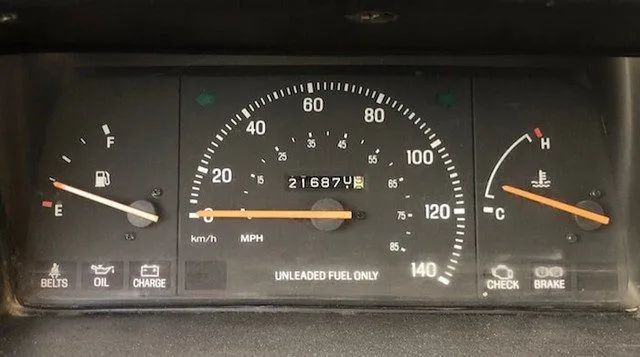
The fuel level gauge is an integral part of the dashboard. With it, the driver can monitor the vehicle’s fuel level while using the vehicle. Typically, the PCM receives a signal from the fuel level sensor (in the fuel storage tank). This signal allows the PCM to calculate fuel consumption and monitor fuel tank pressure as well as fuel temperature. This data is used to calculate the engine’s fuel delivery strategy, and then the fuel level output signal is provided to the fuel gauge and/or the dashboard controller. It may also be sent to the low fuel warning light and other onboard controllers.
If a problem is detected while monitoring the fuel level output circuit, a P0656 code will be stored, and a Malfunction Indicator Lamp (MIL) may be illuminated.
Typical Simple Gauges:

P0656 Simple Gauges
How Severe Is This DTC?
A P0656 should be classified as moderate because it could result in an inoperative fuel gauge and/or driving issues, and you might potentially run out of gas.
What are some of the symptoms of the code?
Symptoms of a P0656 trouble code may include:
Inoperative fuel level gauge
Low fuel warning light is inoperative
Low fuel warning light stays on
Engine driving issues
Fuel temperature codes
Evaporative emission system codes
What are some common causes of the code?
Causes
of this code may include:
Open or shorted circuit between the PCM and the dashboard or other controllers
PCM programming error
Faulty controller or PCM
What are the troubleshooting steps for P0656?
Consult your vehicle’s information source for Technical Service Bulletins (TSBs) that match the stored code, the vehicle (year, make, model, and engine), and the symptoms presented. If you find the appropriate TSB, it may provide helpful diagnostic information.
A diagnostic scanner and a digital volt/ohmmeter will be necessary to accurately diagnose a P0656 code. A reliable source of vehicle information will also be required.
Start by connecting the scanner to the vehicle’s diagnostic port and retrieve all stored codes and freeze frame data. You’ll want to note this information, just in case the code turns out to be intermittent.
After recording all relevant information, clear the codes and test the vehicle (if possible) until the code is reset or the PCM enters readiness mode.
If the PCM enters readiness mode, the code is intermittent and will be even more difficult to diagnose. The condition that caused the P0656 to be stored may need to worsen before an accurate diagnosis can be made. On the other hand, if the code does not reset and no driving symptoms occur, the vehicle may be operating normally.
If the P0656 is immediately reset, proceed with a visual inspection of the wiring and connectors related to the system. Harnesses that are broken or disconnected should be repaired or replaced as needed.
If the wiring and connectors appear functional, use your vehicle information source to obtain the appropriate wiring diagrams, connector face views, connector pinout diagrams, and diagnostic flowcharts.
Once you have the correct information, use your DVOM to test the fuel level output circuit at the appropriate PCM connector pin. If no fuel level output signal is found, suspect that the PCM is faulty or that there is a PCM programming error.
If a fuel level output signal is found at the PCM connector, test the corresponding circuit (as presented) at the fuel level gauge pin of the dashboard connector. If the fuel level output signal is not found, you have an open circuit between the PCM and the fuel gauge in the dashboard. Repair or replace the circuit and retest.
If a P0656 code is stored and the fuel gauge (and low fuel warning light) is operational, suspect a faulty PCM or a PCM programming error