
P062D Fuel Injector Driver Circuit Performance, Bank 1
What Does It Mean?
This is a generic diagnostic trouble code (DTC) and applies to many OBD-II vehicles (1996-newer). This may include, but is not limited to, vehicles from Ford, Honda, Hyundai, Kia, Land Rover, Toyota, Volkswagen, etc. Although generic, the exact repair steps may vary depending on the year, make, model, and powertrain configuration.
If your OBD-II vehicle has stored a P062D code, it means the Powertrain Control Module (PCM) has detected a performance problem with the fuel injector driver circuit for engine bank one. Bank 1 refers to the engine bank that contains cylinder number one.
The fuel injector driver is an integral part of the PCM or the Electronic Fuel Injection (EFI) controller (if applicable).
The PCM controls the injector timing and pulse width by applying a ground pulse to the circuit at precisely the right moment. Since a constant supply of battery voltage is already present on the circuit (whenever the ignition is on), this triggers a precise spray of fuel from the pressurized fuel injector. This action occurs for each cylinder in sequential repetition.
In addition to controlling the fuel injection system, the PCM also monitors the feedback resistance of the individual fuel injector circuit for signs of malfunction. This can allow the PCM to detect a problem before it presents itself as a driving issue.
If the PCM detects a fuel injector feedback signal that is not within the expected parameters, a P062D code will be stored and a Malfunction Indicator Lamp (MIL) may be illuminated. MIL illumination typically occurs upon the initial failure of such a code.
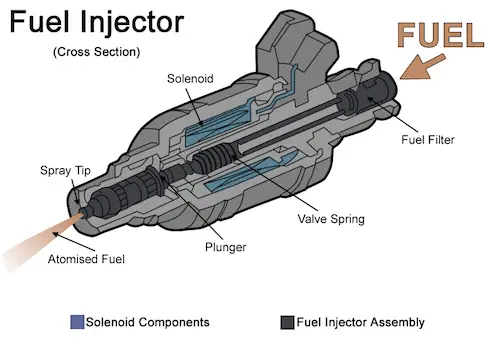
A typical fuel injector:

P062D Fuel Injector
How severe is this DTC?
A stored P062D code, or any code related to fuel injection, should be classified as severe and investigated urgently.
What are some of the symptoms of the code?
Symptoms of a P062D trouble code may include:
- Reduced fuel efficiency
- Engine misfires (with stored codes)
- Hesitation or stalling during acceleration
- Decreased engine performance
What are some of the common causes of the code?
Causes of this code may include:
- Open or shorted wiring or connector in the injector driver circuit for bank 1
- Faulty fuel injector
- Defective PCM or EFI controller
- Controller programming error
What are the troubleshooting steps for P062D?
To accurately diagnose a stored P062D code, a diagnostic scanner, a digital volt/ohmmeter (DVOM), an oscilloscope, and a source of vehicle diagnostic information will be necessary. A scanner, like the Snap-On Modis, with a built-in DVOM and oscilloscope will work well for this task. Without an oscilloscope, it will be impossible to monitor the injector’s function and arrive at a successful diagnosis.
I like to start my diagnosis by connecting the scanner to the vehicle’s diagnostic port and retrieving all stored codes and associated freeze frame data. Before clearing the codes, I write this information down for reference purposes. After clearing the codes from the PCM, I test drive the vehicle until the PCM enters readiness mode or the code resets.
If the PCM enters readiness mode without the code resetting:
There is a high likelihood that you have an intermittent problem. If the code does not reset within a reasonable time, the condition may need to worsen before an accurate diagnosis can be made.
If the code is immediately reset:
Perform a visual inspection of all associated wiring and connectors. You will want to replace any burnt or damaged components as needed. Attempting to patch a fuel injector wiring harness often results in the PCM receiving an asymmetrical fuel injector driver feedback signal and additional stored codes.
If the system wiring and connectors appear functional, use the oscilloscope to test each individual fuel injector. Consult your vehicle information source for diagnostic flowcharts, wiring diagrams, connector face views, connector pinout diagrams, and recommended testing procedures/specifications for the vehicle in question. Once the oscilloscope test leads are connected, note any inconsistency in the waveform (voltage) pattern. Replace faulty fuel injectors as necessary. If no anomalies are discovered in the fuel injector operation, proceed to the next step.
After testing the fuel injectors, disconnect all controllers from the injector driver circuit and use the DVOM to test the system circuits. Replace wiring and/or connectors as needed.
If all fuel injectors and system circuits are operating as expected, suspect a controller failure or a controller programming error.
The fuel injector driver/controller is typically integrated into the PCM