
What does it mean?
This is a generic diagnostic trouble code (DTC) and applies to many OBD-II vehicles (1996-newer). This may include, but is not limited to, vehicles from Chevrolet, Ford, VW, Jeep, Audi, Chrysler, Dodge, Cadillac, etc. Although generic, the specific repair steps may vary depending on the year, make, model, and powertrain configuration.
When a P0690 code is stored, it means that the Powertrain Control Module (PCM) has detected an anomaly in the relay that supplies it with voltage. This particular code will be stored if the voltage of the power relay sensor circuit exceeds the maximum allowed parameter.
The PCM power relay is used to safely apply battery voltage to the appropriate PCM circuits. It is a contact-type relay that is activated with a signal wire from the ignition switch. This type of relay typically uses a five-wire design. A constant battery voltage is applied to one wire; ground to another. A third circuit carries a signal from the ignition switch, and a fourth provides voltage to the PCM. The fifth wire is the power relay sense circuit. It is used by the PCM to monitor the power relay voltage.
If the PCM detects a high voltage condition on the power relay sense circuit, a P0690 code will be stored, and a Malfunction Indicator Lamp (MIL) may be illuminated.
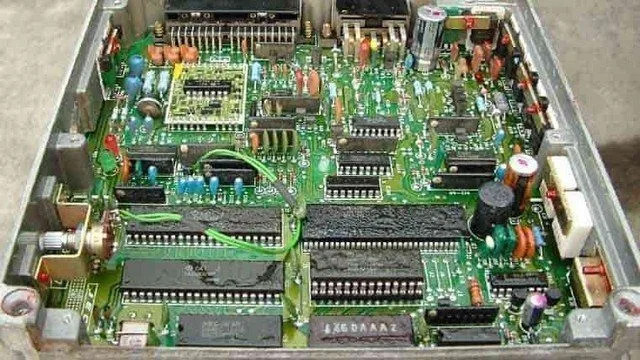
A typical Powertrain Control Module PCM, opened:

Powertrain Control Module P0690
How severe is this DTC?
A P0690 should be classified as severe and treated accordingly. It can result in a no-start condition and/or a variety of driving issues.
What are some of the symptoms of the code?
Symptoms of a P0690 fault code may include:
Delayed or no start
Electrical accessories may not work
Engine driving problems
What are some of the common causes of the code?
Causes
of this code may include:
Faulty PCM power relay
Blown fuse or fusible link
Open or shorted circuit between the power relay and the PCM
What are the P0690 troubleshooting steps?
A diagnostic scanner and a digital volt/ohmmeter (DVOM) will be needed to diagnose a P0690 code.
A reliable source of vehicle information will also be required. From it, you will gather diagnostic flowcharts, wiring diagrams, connector face views, connector pinout diagrams, and component locators. You will also find the testing procedures and specifications for components and circuits. All of this information will be necessary to successfully diagnose a P0690 code.
Connect the scanner to the vehicle’s diagnostic port and retrieve all stored codes and freeze frame data. Note this information as it may prove useful if the code turns out to be intermittent.
After recording all relevant information, clear the codes and test the vehicle (if possible) until the code resets or the PCM enters readiness mode.
If the PCM enters readiness mode, the code is intermittent and will be even more difficult to diagnose. The condition that caused the P0690 to be stored may need to worsen before an accurate diagnosis can be reached. On the other hand, if the code does not reset and no driving symptoms manifest, the vehicle may be operating normally.
Consult your vehicle information source for Technical Service Bulletins (TSBs) that match the stored code, the vehicle (year, make, model, and engine), and the symptoms presented. If you find the appropriate TSB, it may provide helpful diagnostic information.
If the P0690 code resets immediately, proceed with a visual inspection of the wiring and connectors related to the system. Harnesses that have been broken or disconnected should be repaired or replaced as necessary.
If the wiring and connectors appear functional, use your vehicle information source to obtain the appropriate wiring diagrams, connector face views, connector pinout diagrams, and diagnostic flowcharts.
Once you have the relevant information, test all fuses and relays in the system to ensure that the PCM power relay is supplied with battery voltage.
If no constant (or switched) voltage is present at the power relay connector, trace the appropriate circuit back to the fuse or relay it originates from. Repair or replace faulty fuses or fusible links as needed.
If the power relay’s input voltage and ground are present (on all appropriate terminals), use your DVOM to test the relay’s output performance at the appropriate connector pins. If the power relay output circuit voltage is not adequate, suspect a faulty relay.
If the PCM power relay output voltage meets specifications (on all terminals), test the corresponding relay output circuits at the PCM.
If a relay output voltage signal is found at the PCM connector, suspect a faulty PCM or a PCM programming error.
If an excessive relay output voltage signal is found at the PCM connector, you have a short to voltage.
Fuses and fusible links should be tested with the circuit loaded to avoid misdiagnosis