
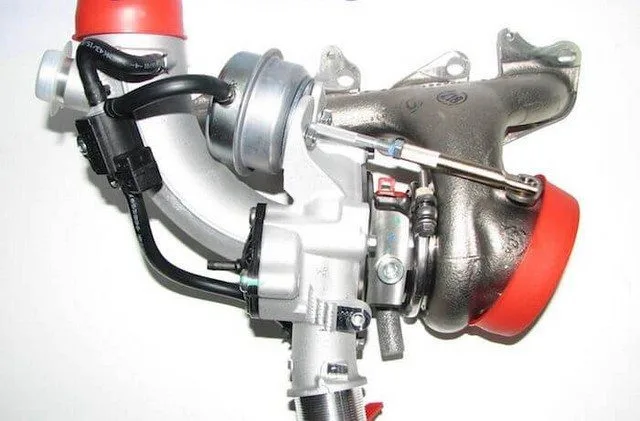
Code P005E: Definition and Explanation
The diagnostic trouble code P005E is a generic OBD-II powertrain code that indicates a low voltage value in the boost control B supply voltage circuit. It applies to many vehicles, including Chevrolet, GMC Duramax, Dodge, Ram Cummins, Isuzu, Ford, Vauxhall, and VW. Precise diagnostic steps may vary by brand, model, year, and engine configuration.
Role of the Boost System
Forced induction systems (turbocharger, supercharger) use engine energy (exhaust gases, belt drive) to increase the amount of air entering the combustion chambers, thereby improving volumetric efficiency and power.
To regulate boost pressure, a control module (often called a wastegate or control solenoid) mechanically adjusts the turbocharger vanes. This system is managed by the Engine Control Module (ECM) to maintain an optimal stoichiometric air-fuel mixture. The letter “B” typically distinguishes a specific circuit, connector, or group within the system.
Severity of Code P005E
The severity is moderate to high. A fault in the boost control system can lead to a dangerous air-fuel mixture (too rich or too lean), causing power loss, excessive fuel consumption, and potentially serious engine damage. The ECM often triggers a limp mode (safe mode) to protect the engine, drastically limiting performance.
Common Symptoms of P005E Fault
- Noticeable and irregular power loss
- Abnormal response during acceleration
- Difficulty climbing hills
- Activation of safety mode (limp mode)
- Excessive fuel consumption
- Intermittent poor driving symptoms
Possible Causes of Code P005E
- Faulty boost control solenoid (stuck, broken lever)
- Corrosion or poor contact in connectors, pins, or grounds
- Wiring issue (frayed wires, open circuit, short circuit)
- Internal ECM failure
- Soot buildup on turbocharger vanes
- Boost control module problem
- Exhaust system leak
Diagnostic Procedure for Code P005E
Step 1: Visual and Mechanical Inspection
WARNING: The engine and turbocharger can be extremely hot. Ensure the engine is cool before any intervention.
Locate the boost control solenoid (usually mounted on the turbocharger). Check that its lever moves freely without being stuck, broken, or bent. On some models, the lever is adjustable.
Step 2: Connector and Seal Check
Inspect the solenoid’s electrical connector and the control module for any signs of corrosion, water intrusion, or physical damage. A corroded assembly will most likely need replacement.
Step 3: Wiring Inspection
Follow the wiring harness connecting the solenoid to the ECM. Look for any signs of heat damage, frayed wires, or burns. Cables are often routed near intense heat sources.
Step 4: Advanced Diagnostics
For accurate diagnosis, using a scan tool is necessary to check the voltage and resistance values of the “B” control circuit. Consult manufacturer-specific technical data (wiring diagram) for reference values. If in doubt, entrust the diagnosis to a professional mechanic.
Conclusion and Call to Action
Code P005E should not be ignored. A faulty boost system can lead to costly repairs. If you are not comfortable with these diagnostic steps, immediately consult a specialized garage for a thorough diagnosis and reliable repair.