
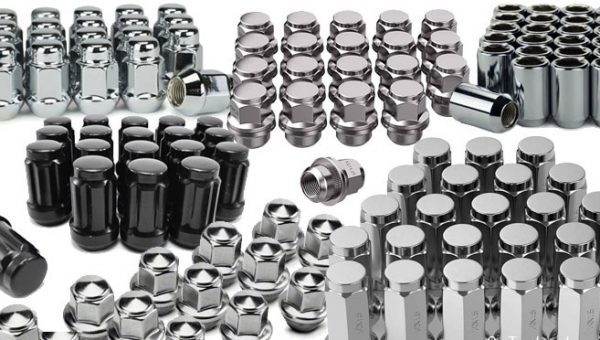

Lug nuts are an interesting beast and may well be the most important hardware pieces on your vehicle. Their job is to secure each wheel of a vehicle to its axle to allow your car to drive and protect you.
Understanding how different lug nut sizes and types can vary from one vehicle to another is essential to be able to replace one when it is lost or damaged.
Types of Lug Nuts
There is actually a variety of different lug nuts and wheel bolts. Each of the eight different types has its own distinctive characteristics. You will rarely encounter them outside of a busy commercial garage.
#1 – Conical Seat
Conical lug nuts (aka: acorn lug nuts) are by far the most common type of lug nut. The seat tapers inward at (usually) a 60-degree angle.
These cone-shaped lug nuts are designed to fit into a cone-shaped hole. They are in most cases very easy to work with and center.

#2 – Ball Seat
Instead of being cone-shaped, the seat of a ball seat lug nut is rounded or spherical. Although not as common as conical seats, ball seat lug nuts can be found on some Honda, Audi, and Volkswagen vehicles.
The heads look almost identical to conical lug nuts, so it can be difficult to see which is which if they are installed.
#3 – Flat Seat
As the name implies, the seat is flat and resembles a washer. Of all the different types of lug nuts, flat seat ones are probably the most frustrating and difficult to use. The problem is that centering them can be very tricky because they have a small shank that fits into the stud.
If not perfectly centered, the shank can catch, giving the impression that the lug nut is tight when it is not in reality. Since the flat surface has more area than the others, they are more likely to seize and can be much harder to remove.
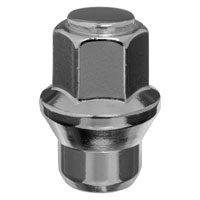
#4 – Extended Thread
Similar to a standard conical lug nut, an extended thread (ET) lug nut adds the benefit of a longer thread. This is useful in cases where the length of the wheel studs and the wheel mounting surface simply do not allow sufficient thread engagement when using ordinary lug nuts.
The longer thread length allows for better engagement to keep the wheels more securely attached.
#5 – Mag Seat
This is another type of extended thread lug nut, this time with a washer seat. It is used in similar situations where a longer thread is needed, but instead of a tapered, conical bottom, they have a flat seat (sometimes with a washer, sometimes without).
They are called mag seat lug nuts because at one time, they were made from magnesium.
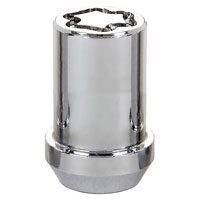
#6 – Tuner Style
Many types of aftermarket wheels, especially for Honda, Acura, and other Asian tuner cars, are designed with smaller diameter holes for the lug nuts. Standard acorn lug nuts will not fit, so narrower tuner style lug nuts are required.
To tighten or loosen these conical seat tuner lug nuts, a special tuner key is also needed that fits just over the lug nut. A regular socket then goes onto the tuner key like any other lug nut. This key is included when you purchase a set of tuner lug nuts, but can also be purchased separately if the key is lost or if your car does not come with one.
Since tuner style lug nuts are open in the center (to accept the tuner key), air and moisture can reach the studs and threads and cause corrosion. For this reason, tuner style lug nuts are no longer commonly used and the spline drive style (below) is a much better alternative.
#7 – Spline Drive
Like tuner style lug nuts, this unique small diameter lug nut has a conical seat and uses a special key. The difference is that instead of an opening in the middle, spline drive lug nuts have narrow grooves on the top and sides of the lug nut to accept the low-profile key. They do not have the same potential corrosion issue.
Keep in mind that the pattern on spline drive lug nuts (and tuner style) is not unique, so do not assume you can use either as a theft deterrent. The respective replacement keys can easily be purchased by anyone at a local auto parts store or online.
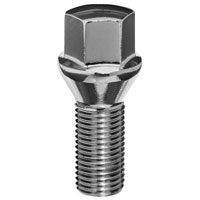
#8 – Lug Bolt
Used primarily on German vehicles such as BMW, Mercedes, Audi, and Volkswagen, these are lug nuts with an attached stud/bolt. They are threaded directly through the brake rotor hat and into the hub.
No one really knows why Germans use bolts instead of lug nuts, but it may be that it is cheaper than having to press studs into a rotor assembly during manufacturing or simply that it is easier to replace a broken lug bolt rather than a stud.
Whatever the reason, it makes installing wheels more difficult because you simply cannot hang the wheel on the studs while putting on lug nuts. Instead, you must first ensure the rotor plate holes are aligned with the hub holes, then lift the wheel assembly and hold it in place while you install the first lug bolts. There are techniques you can use to make the job easier, but regardless, the process is more frustrating than using lug nuts.
Lug Nut Size Chart
To make your life easier (in case you’ve lost your manual and don’t have a good repair manual handy), here is a comprehensive list of car manufacturers and the lug nut sizes they require.
Note: Although we have done our best to make this list as accurate as possible, we cannot guarantee that it is complete or that a manufacturer has not changed its lug nut requirements for a particular model since its publication. Do not use this chart as your only source and instead consult your owner’s manual or contact your local dealer before using this data as more than a reference to avoid potentially damaging your wheels.
|
ACURA
|
Years
|
Size
|
Type
|
| ALL (except below) | 1986-on | 12 mm x 1.5 | Nut |
| MDX | 2002-2006 | 12 mm x 1.5 | Nut |
| MDX | 2007-on | 14 mm x 1.5 | Nut |
| RL | 2005-on | 14 mm x 1.5 | Nut |
| TL | 2004-2008 | 12 mm x 1.5 | Nut |
| TL | 2009-on | 14 mm x 1.5 | Nut |
|
ALFA ROMEO
|
Years
|
Size
|
Type
|
| ALL | 1972-On | 12 mm x 1.5 | Nut |
|
AUDI
|
Years
|
Size
|
Type
|
| ALL (except below) | 1988-on | 14 mm x 1.5 | Bolt |
| 4000 | 1980-1987 | 12 mm x 1.5 | Bolt |
|
BENTLEY
|
Years
|
Size
|
Type
|
| Continental | 2004-2017 | 14 mm x 1.5 | Bolt |
| Flying Spur | 2014-on | 14 mm x 1.5 | Bolt |
| Mulsanne | 2011-on | 14 mm x 1.5 | Bolt |
|
BMW
|
Years
|
Size
|
Type
|
| ALL | 1962-1976 | 12 mm x 1.5 | Nut |
| ALL (except below) | 1977-On | 12 mm x 1.5 | Bolt |
| 7 Series | 2002-2008 | 14 mm x 1.5 | Bolt |
| 7 Series | 2009-on | 14 mm x 1.25 | Bolt |
| X3 | 2003-on | 14 mm x 1.5 | Bolt |
| X5 | 2000-2006 | 14 mm x 1.5 | Bolt |
| X5 | 2006-on | 14 mm x 1.25 | Bolt |
| X6 | 2008-on | 14 mm x 1.25 | Bolt |
|
BUICK
|
Years
|
Size
|
Type
|
| ALL (front-wheel drive) | 1979-1989 | 12 mm x 1.5 | Nut |
| Allure | 2005-on | 12 mm x 1.5 | Nut |
|
|