
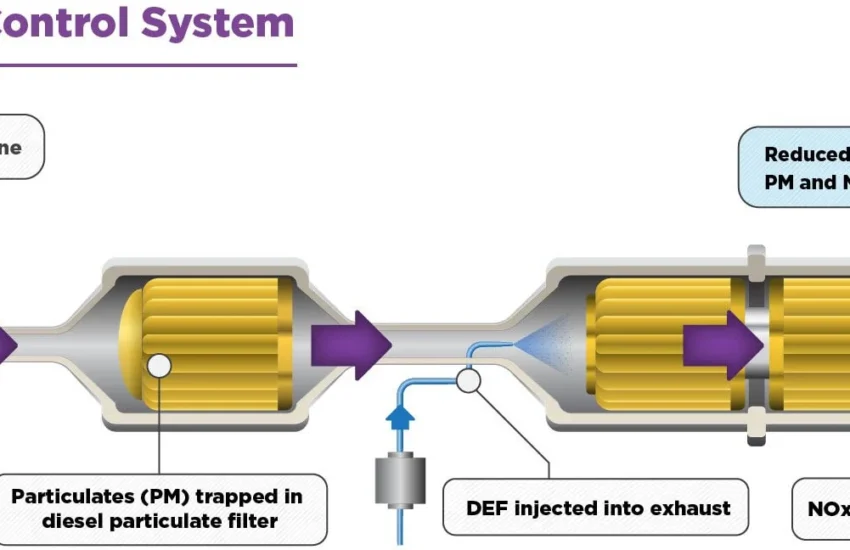
Selective Catalytic Reduction (SCR) is an advanced active emissions control system that reduces nitrogen oxide (NOx) emissions to near-zero levels in next-generation diesel vehicles and equipment. The SCR system includes several components grouped with other parts of the emissions control system. Each manufacturer has its own variations in the type and sequence of the different system components.
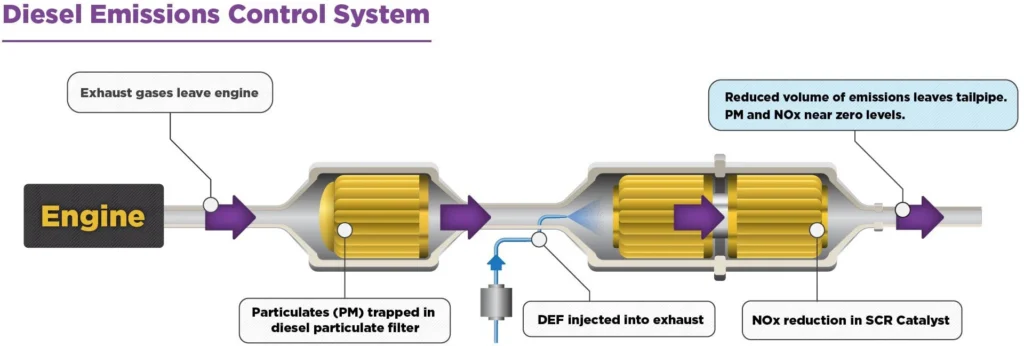
*The diagram is not representative of all manufacturers’ approaches to achieving near-zero emissions.
SCR is an active emissions control system. Hot exhaust gases exit the engine and enter the SCR system where aqueous urea (known as Diesel Exhaust Fluid, or DEF) is sprayed onto a special catalyst. The DEF triggers a chemical reaction in the exhaust on a special catalyst that converts nitrogen oxides into nitrogen, water, and small amounts of carbon dioxide (CO2), which are natural components of the air we breathe. The exhaust also passes through a particulate filter somewhere in the system and is then expelled through the vehicle’s exhaust pipe.
SCR technology is designed to allow nitrogen oxide (NOx) reduction reactions to occur in an oxidizing atmosphere. It is called “selective” because it reduces NOx levels using ammonia as a reductant in a catalytic system. The chemical reaction is known as “reduction,” where DEF is the reducing agent that reacts with NOx to convert pollutants into nitrogen, water, and small amounts of CO2. The DEF is rapidly broken down to produce oxidizing ammonia in the exhaust stream.
What are the specific considerations for using SCR?
SCR systems are active systems. Compared to the passive catalytic converters in gasoline vehicles, SCR systems require periodic replenishment of Diesel Exhaust Fluid (DEF) to ensure emissions system performance. The need to refill DEF is directly related to the vehicle’s fuel consumption. Failure to refill DEF tanks can result in the vehicle or machine being immobilized and requiring service.
Diesel Exhaust Fluid (DEF) is a non-toxic liquid composed of 32% automotive-grade aqueous urea and purified water. DEF is available with a variety of storage and distribution methods. Storage options consist of containers of various sizes such as bulk containers, totes, and bottles or jugs. The American Petroleum Institute rigorously tests DEF to ensure it meets industry quality standards. DEF is sometimes called AdBlue in Europe and the United States.
A nationwide DEF distribution infrastructure is in place, making DEF readily available in bulk, at retail stores, online, and at almost all fuel stations that carry diesel fuel. Onboard tanks for storing DEF typically range in size from 5 to 22 gallons and are easily identifiable by a blue cap and/or “DEF ONLY” labeling. For vans and SUVs, the DEF fill port is usually located next to the fuel fill area. (SEE IMAGE) For heavy semi-trailers, the DEF tank is typically located next to the diesel fuel tank on the side of the vehicle near the driver’s door. Due to the diverse nature of off-road engines and equipment, the location of the DEF tank and fill port is variable.
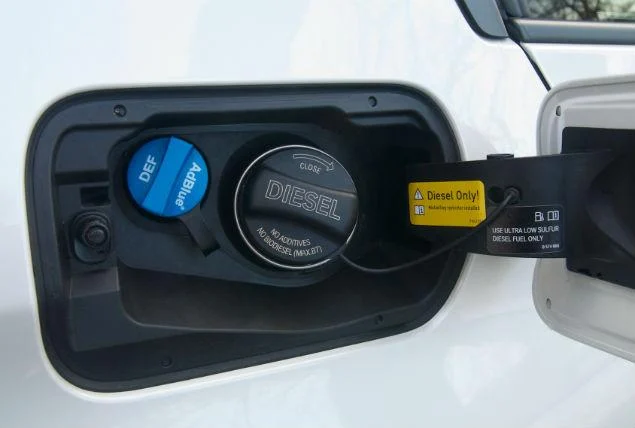
The DEF tank fill opening is designed to accept only a DEF fill nozzle to ensure that only DEF is poured into the tank. Diesel fuel should never be poured into the DEF tank and vice versa. To prevent this type of refill error, a diesel fuel nozzle does not fit into the DEF tank opening. Additionally, the DEF tank has a blue cap to differentiate it from the diesel tank, which may have a yellow or green fuel cap.
For light-duty vehicles, DEF refill intervals typically occur at the recommended oil change time, while DEF refills for heavy-duty vehicles and off-road machinery and equipment vary based on operating conditions, hours of use, miles driven, load factors, and other considerations. Typically, DEF consumption is about 3% of fuel consumption (example: consuming 100 gallons of fuel would use about 3 gallons of DEF).
DEF is an integral part of the emissions control system and must be present in the tank at all times to ensure continuous operation of the vehicle or equipment. A low DEF level triggers a series of escalating visual and audible warnings to the driver or operator. If DEF is not replenished, the series of operator prompts progresses and may eventually lead to reduced engine power and vehicle speed limitation, and ultimately to a start system lockout.
Proper storage of DEF is necessary to prevent the fluid from freezing at temperatures below -12°F. Most vehicle DEF tanks and distribution systems are equipped with heating devices.