
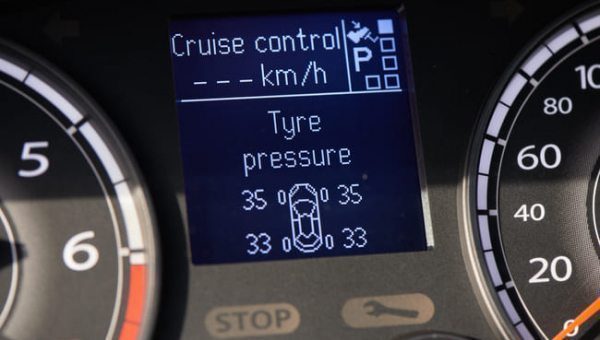

They are mandatory on most cars and are one of the main safety features of modern driving. But what exactly does TPMS do?
With all the talk about new car features like multi-zone climate control systems, heated steering wheels, smart suspension, or evasive steering, it’s easy to forget how vital something as simple as a tire is to your car’s performance. As the only connection point between the road and the vehicle, having the right tires and ensuring they are in perfect condition is more important than the extravagant extras you might have.
Keeping your tires in order and ensuring you can drive safely and efficiently is precisely what tire pressure monitoring sensors are for. These sensors have been deemed so important that they are a mandatory feature on all new passenger cars from 2008 in the United States and from 2014 in the EU, and there is a wide variety of aftermarket systems you can install on older vehicles. Although extremely useful, what these systems do may not be immediately obvious, and if they go wrong, they can often mean an expensive trip to the dealership. This is a comprehensive guide on what tire pressure monitoring systems are, how they work, and what the benefits of having them are.
What are Tire Pressure Monitoring Systems (TPMS)
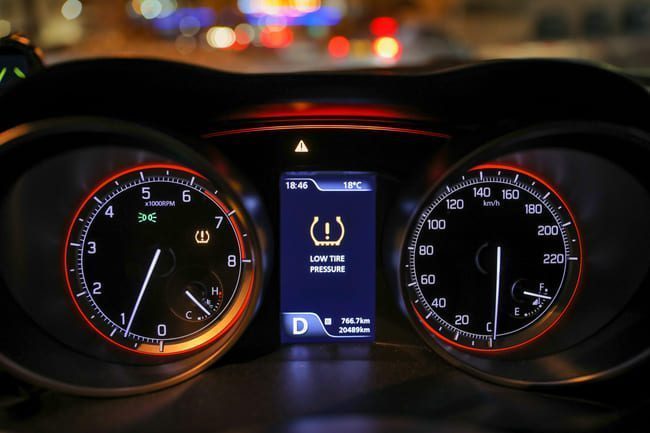
Tire pressure monitoring systems (or TPMS) are designed to primarily monitor the air pressure in a car’s tires. The system consists of sensors connected to each wheel and a display unit. If the system is integrated, the sensors will be connected to a light on your dashboard, normally a yellow symbol that is the cross-section of a tire with an exclamation point in the middle. If the system was installed after production, it will often come with a display unit that can sit on your dashboard and is connected to the sensors. In addition to pressure, it can also transmit information about the tire’s temperature, as well as give you important updates on the condition of the tires.
How do Tire Pressure Monitoring Systems Work
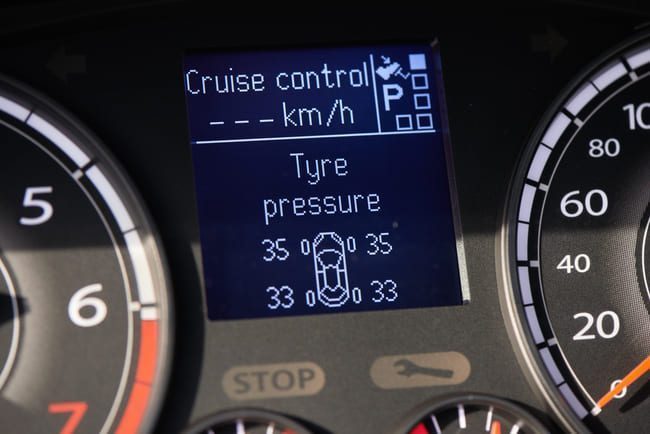
The basic principle of TPMS is that information about a vehicle’s tire pressure is collected (there are different ways to do this), then sent to the control unit on your dashboard. The system is programmed to monitor tire pressure levels and ensure they remain at an acceptable and safe pressure, often between 28 and 35 pounds per square inch (psi) of air in the tire for most passenger cars. If something is wrong, the light or alarm will let you know.
Some systems will allow you to access your tires’ temperature and pressure value at any time, allowing you to manage your tires. There are two main types of TPMS, direct and indirect, and they both collect this tire pressure data in different ways.
Direct Tire Pressure Monitoring

In direct tire pressure monitoring systems, individual sensors are located directly on the tires (and sometimes in a spare tire) and they transmit information to a central control module. These systems consist of a sensor mounted on the vehicle that communicates with the central control module. This information is most often gathered using a microelectrochemical system. At the control module level, it is analyzed, interpreted, and if the tire pressure is lower than it should be, or if the tires have been severely over-inflated, transmitted directly to your dashboard where the light comes on.
The information is most often sent wirelessly as a radio signal. Each sensor has a unique serial number, and the system can distinguish with these not only between different vehicles on the road but also between the different tires of the car. While some aftermarket systems are mounted on the outside of the tire, most manufacturers use a sensor mounted inside the tire. The battery life of one of these integrated sensors is about a decade, but for most systems, the battery is not repairable and the entire sensor must be changed.
Direct systems can be mounted in different ways. They can either be mounted on the back of a tire’s valve stem or secured using an adhesive or to a strap that is then tightly wrapped around the inner rim of the tire.
Indirect Tire Pressure Monitoring
Indirect tire pressure monitoring systems do not rely on tire pressure sensors to operate and make assessments about the tire. These systems gather and take into account data from wheel speed sensors (easily available through ABS or similar systems) to interpret a tire’s size and its rotation speed – a smaller tire would spin faster than a larger tire and an under-inflated tire would be smaller than one with the right amount of air. The system detects if a tire is moving faster than the others and can calculate that it is smaller and therefore possibly deflated. If this happens, it emits a warning light just like direct tire pressure monitoring systems.
One of the great advantages of this system is that it seems less fragile than direct sensors, but it needs to be reset more often. For example, if the tires are inflated before a long trip, an indirect system should be reset, as it would see the newly inflated tires as a possible danger. The system should always be at rest when the tires are inflated. In this case, if it is not reset, the system will see larger tires and may warn the driver of over-inflation. The TPMS must be recalibrated not only when the tires are restored to the correct pressure but also when the tires are swapped or completely replaced. This can often be performed from the car’s cabin via a recalibration button on the center console and takes about 30 minutes of driving to reset.
What are the Benefits of Tire Pressure Monitoring Systems
- Long-lasting Tires – Regularly checking your tire pressure and inflating them if necessary, with the help of TPMS, can significantly increase the longevity of your tires. If the tire pressure is incorrect, whether too low or too high, a tire’s lifespan can decrease by up to 45%. If the pressure is too low, the tire will overheat and the edges of the tire will wear out. If the pressure is too high, the center of the tire will bulge and wear out. All this means that you will be replacing tires much sooner than necessary to buy new ones.
- Improved Handling – As stated at the beginning, tires are extremely important and are the link between the road and the car. Your car’s handling depends almost entirely on your tire pressure. If the wrong amount of rubber is on the road, it can reduce traction and handling in corners. This can happen if the tire is over-inflated. If a tire is deflated, it also increases the risk of hydroplaning in rainy weather due to a lack of traction between the flat tires and the road surface.
- Improved Fuel Economy – The TPMS system can also impact a car’s fuel consumption. With the right amount of air in the tire, a car has less rolling resistance and therefore doesn’t need as much to roll on normal roads. But if there is less air in the tire, the tire’s surface is less firm and thus there is more rolling resistance because the tire drags more on the road. As there is more resistance, the car needs more energy to travel the same distance, and of course, it will take more fuel to go from A to B.
- Easier to Spot Problems – In addition to helping solve these more general problems, TPMS can also help you see a serious issue developing. If the system lets you know that a tire has much less pressure than the others, you might have a puncture or a slow leak, which, just by feel, can be very difficult to detect. If a tire is about to delaminate, separate, or blow out, all potentially serious issues, by indicating that the tire has low pressure, TPMS will let you know in advance. This makes it an essential safety feature for any vehicle.
Are there any Downsides to Tire Pressure Monitoring Systems
- Fragility – The vast majority of direct TPMS monitors are part of an assembly that includes the valve stem. When the valve stem is installed, the sensor is located inside the tire. The major problem with this is that the sensor and the attached stem are relatively fragile. Due to how the sensors are placed next to the wheel, removing the tire can be a very delicate process, as if the tire’s bead presses against the sensor, it could break it. They are known to be susceptible to damage, and as a result, most tire shops will not accept any responsibility for damage to the stems or sensors. Although they have become more robust, most OEM sensors are still dealer-only items that can cost between 60 and 120 euros each. Some aftermarket options are now available, but replacing a sensor remains an expensive undertaking.
- Lack of Standardization – Almost all car manufacturers have their own exclusive TPMS system, and since there is no standardization, most parts are dealer-only. Unless you are using an aftermarket system, which is unlikely on cars produced after 2014, it can be difficult to replace a faulty system. This also makes it harder for auto shops and garages to correct defects, as even they can find the systems used by each manufacturer confusing. In turn, this means that repairs or replacements are often best done at a dealership directly by the manufacturer, which will almost certainly be costly.
- The Need to Reset Sensors – TPMS computers often need to be reset after moving a wheel on the car, or if a sensor needs to be replaced, and the process of finding how to reset your car’s system can be exasperating. In the best case, your car may only need to be driven a certain distance or for a certain time (as is usually the case with indirect TPMS). In the worst case, there may be a complex way to reset the system using your car’s control buttons, which can be frustrating. They are sometimes so complicated that there are books and software with instructions on how to reprogram most systems, but even these can be incomplete, confusing, or directly conflicting with the instructions in the car’s manual.
- Inaccurate Readings – This can happen for various reasons, such as fitting larger or smaller tires and uneven wear with indirect TPMS. Direct TPMS should be better, but depending on where the sensor is installed and if it is poorly placed (they are very fragile), it could also provide readings that do not reflect the actual tire pressure.
Tire Pressure Monitoring Systems: The Last Word
So, TPMS is a complex system, but the benefits it can offer to motorists far outweigh the potential problems. Even if it seems expensive to replace some parts, correct tire pressure should save you much more in terms of fuel and in terms of safety as well. Many of these issues mentioned above could be resolved – and are being resolved – by improved indirect TPMS systems that use sensors in the ABS hardware to perform their magic. These types of systems are becoming more common and could make the entire TPMS repair process much easier.