
It’s darn hot in summer, and it’s darn frustrating when you turn on the air conditioning for a cool breeze but get nothing. The car air conditioner not blowing cold air at idle is a fairly common problem with your vehicle’s air conditioning system.
There are many reasons why the air conditioning only works when you’re driving but doesn’t blow cold air at idle. Read on to learn the most common reasons and how to fix the problem in each case.
The Basics of Car Air Conditioning
Before diving into the possible culprit that can prevent a car air conditioner from blowing cold air at idle, you need to understand the basics of how your car’s air conditioning unit works. This will make troubleshooting and solving the problem more straightforward.
Your car’s air conditioning system requires refrigerant to function and consists of a compressor, a condenser, an evaporator, an orifice tube, and an accumulator. The compressor compresses the refrigerant into a liquid.
As the gas is compressed, it heats up, and the high pressure forces the refrigerant through the system to the condenser. The condenser has a coil section over which cool outside air passes, thus transferring the heat from the compressed gas to the air.
The refrigerant then passes through the dryer to remove contaminants. Once purified, the compressed refrigerant passes through the expansion valve, where its pressure is released. After passing through the evaporator, the refrigerant is now super clean, dry, and cold.
To create the bursts of cold air coming from your car’s air conditioner, air is sent through this newly cold refrigerant in the compressor reservoir to cool down, then blown through the fans.
Car Air Conditioner Not Blowing Cold Air at Idle: The Top 5 Reasons
The problem occurs in most cars at some point in their life. Poor maintenance of the air conditioning unit is the main reason why the *air conditioner doesn’t blow cold air in the car.* Checking the system from time to time is crucial to keeping it in good condition. Let’s see what the likely reasons could be for the car air conditioner not blowing cold air at idle.
1. Faulty Condenser Fan
The cooling fan in the condenser is the first thing you should check to discover the reasons why a car air conditioner doesn’t blow cold air at idle. If the fan is damaged or cannot operate at full power, it cannot cool the heat coming from the freon (refrigerant) via the condenser.
When the car is moving at high speed, the condenser doesn’t need a fan to cool the freon because enough air passes through it. But when the car is stationary, the fan is the only tool for cooling the freon.
You need to check if the fan connections are loose, if it’s not properly placed in its location, or if there is any damage that could prevent its operation.
2. Low Freon Level
Freon wears out with the operation of the air conditioning. When its level drops below the acceptable level, you will face the problem of the car air conditioner not blowing cold air at idle.
The compressor can pump freon more easily when the car is moving at high speed on the highway, but it struggles when the car is idling. You can perform the recharge yourself if you know the procedure.
Another sign of a low freon level is if you don’t hear the clutch engage when you turn on your vehicle’s air conditioning. The clutch allows the compressor to pressurize the freon and operates by reading the freon levels. If it doesn’t activate, the reason would be that there isn’t enough freon.
Leaks
A possible reason for the low freon level is a leak in the AC condenser. The condenser’s seals and tubes are subject to normal wear and tear; they can crack or break.
Another possibility is damage from the physical impact of road debris or rocks, as the condenser is located near the front of a car. A leak in the condenser can lead to a low refrigerant charge and thus poor AC performance since the system depends on refrigerant for its operation.

Normally, you won’t be able to notice condenser leaks with the naked eye. If you look closely, all you’ll likely see is a slight outline of refrigerant oil.
Sometimes, for older cars, a bright green dye is added to the air conditioning system to easily detect condenser leaks (your vehicle runs on many fluids, and each has a distinct color, so don’t be mistaken).
If the condenser is leaking excessively, you will need to replace the entire condenser as it is not possible to replace cracked or broken seals or tubes. In this case, you will likely need a professional to find and fix the leak and restore the correct refrigerant level.
Leak Detection
Leaks most often occur at the O-rings, seals, and worn hoses of the air conditioning system, followed by leaks in a pinhole of the condenser and evaporator, and leaks in the compressor shaft seal.
To detect leaks, add refrigerant to restore it to the correct level, then turn on the air conditioner. The simplest but most effective method is to spray soapy water on the suspected areas and watch for bubbles.
If a leak occurs at the O-rings, seals, or hoses, simply replacing them will solve the problem. However, if the problem comes from a leak in the condenser or evaporator or the compressor shaft seal, the repair is costly and more tedious and should be done by a professional.
3. Clogged Condenser
If a foreign object or debris enters the condenser and clogs the fins, the cooling process will not work properly, especially when the car is idling.
Condensers are prone to clogging over time due to the buildup of residue in the refrigerant, which eventually turns into a sticky paste that hinders the heat transfer that can take place from the hot refrigerant to the cool ambient air blown over the condenser coil.
The second cause of a condenser malfunction is a blockage caused by debris. This is usually due to a worn-out compressor breaking apart and scattering internal metal parts throughout the system.
This means that if you are facing a blockage, you may need to replace not only the condenser but also the failing AC compressor, the hoses, and the receiver/drier or accumulator, as metal debris has contaminated the entire system.
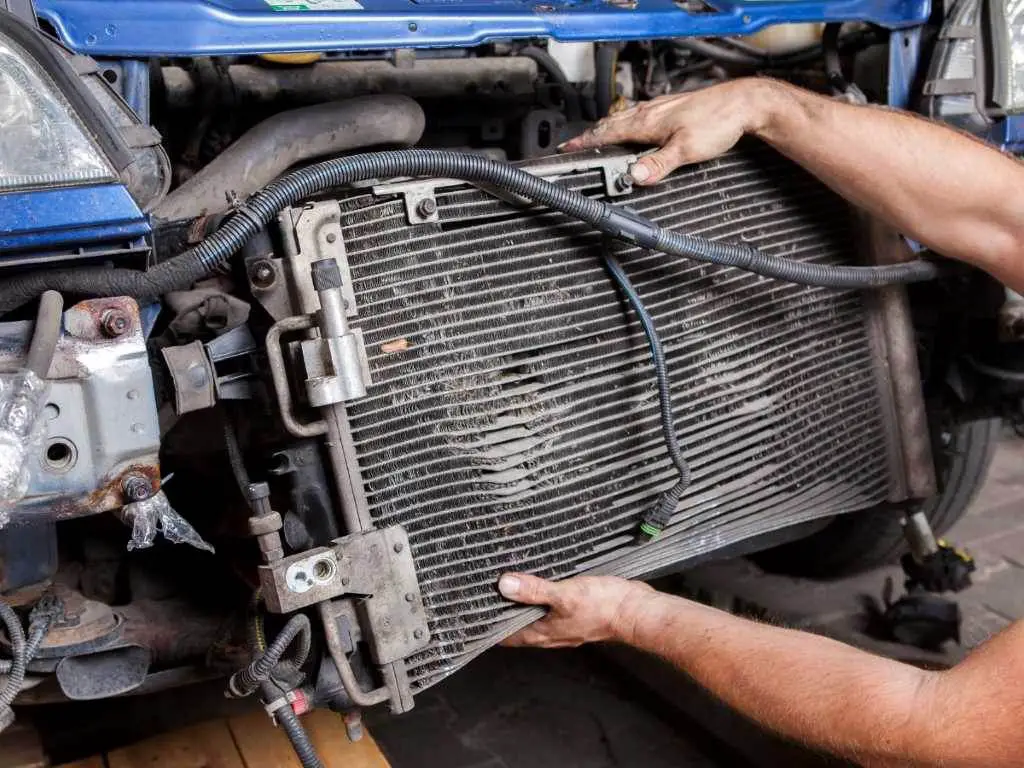
A blocked condenser can also cause a problem called short cycling, which turns the air conditioning unit on and off quickly and inefficiently instead of optimal operation.
This abnormal cycling will lead to increased wear on all components, so you may need to replace multiple parts at once or prematurely replace the entire air conditioning unit.
In this case, you simply need to clean the dirty parts to solve the problem of the air conditioner not blowing cold air:
- A dirty or clogged condenser: If your condenser is clogged with dirt or anything interfering with the unit, simply clean it thoroughly to restore the unit’s optimal performance.
- Dirty coil: The coil is the part over which the cool ambient air is blown, so over time, it is also likely to collect dust and other contaminants from the air. You simply need to clean the debris from the coil to restore the condenser’s capacity.
4. Broken or Worn Condenser Parts
The condenser itself consists of several parts: the coil, the motor, the fins, the condenser relay, the run capacitor, as well as the tubes and seals. If these parts become dirty or wear out with age, your condenser is at risk of losing its function.
Sometimes you can clean or replace the faulty part itself, sometimes you will need to replace the entire condenser or the entire air conditioning unit.
If you’re lucky, you can simply replace some faulty components as follows:
- Faulty motor: A faulty motor must be replaced. But note that you should consult your owner’s manual for the correct replacement motor to avoid causing even more damage to your air conditioning unit.
- Bad capacitor relay switch: Easy replacement
- Faulty capacitor: Easy replacement
But sometimes, one is less lucky. If you are facing these problems, you will need to replace the entire condenser itself, or worse, the entire air conditioning unit:
- Condenser blockages: A blockage caused by metal debris from a failing compressor is a major problem. Most of the time, you may need to replace more than the condenser itself or, worse, replace the entire air conditioning unit.
- Damaged coil: A damaged coil is very difficult, expensive, and time-consuming to repair, unless your coil is still under warranty. Otherwise, people usually replace the entire air conditioning system, which is faster and cheaper.
The average cost of replacing an air conditioning compressor is between $400 and $900 depending on the car in question. About half of that amount would be for labor costs and the rest for the price of parts.
5. Overheated Engine
Another common reason why a car’s air conditioner doesn’t blow cold air at idle is engine overheating. Most cars are equipped with two cooling fans, one for the condenser and the other for the radiator.
The AC system compressor moves heat from the radiator to the condenser. When the car is already overheating and the radiator and condenser fans are not working properly for some reason, the system cannot cool the heat with maximum efficiency.
6. Restricted System
Restrictions within the air conditioning system can also be the cause of poor cooling. A restriction chokes the refrigerant flow, often causing unintended variations in system pressures. As a result, cooling often suffers quite dramatically.
To diagnose and fix restricted system problems that prevent the car air conditioner from blowing cold air at idle, it is best to take your car to a professional mechanic.
7. Faulty Sensors
A complete air conditioning system always includes a few sensors, all of which provide important information for the effective operation of the car’s air conditioning system. The following sensors, along with their general use, are:
- Low-pressure switch: The low-pressure switch is designed to detect the relative loss of refrigerant as well as lubricating oil. The sensor will be deactivated to shut down the system’s compressor, thus minimizing the risk of damage.
- High-pressure switch: The high-pressure switch detects refrigerant overpressure.
- Ambient temperature sensor: This sensor is used in modern car air conditioning systems to communicate the cabin temperature in real time.
If any of the many sensors in an air conditioning system were to fail, its operation would be affected. The vehicle’s computer would face significant difficulties when trying to determine the correct compressor clutch service cycles.
And as with any technical or mechanical problem, which many drivers don’t have much experience with, it’s best to consult a qualified mechanic to resolve it.
Here is an approach and guide to the air conditioning compressor flow sensor for your reference. (Video: Know Your Parts)
FAQ on Car Air Conditioner Not Blowing Cold Air at Idle
1. Can you run the air conditioning at idle?
You can let your car idle with the air conditioning on as long as the engine is running and you don’t run out of fuel. However, you should avoid doing so with the engine off, as it could quickly drain the battery and require you to restart.
2. Does the air conditioning make the car idle rough?
When the additional load of your AC compressor is applied, the computer miscalculates and excessively increases the idle speed.
3. Does the car air conditioning get colder when idling or driving?
Car air conditioning uses a compressor to produce cold gas, which then cools the air. The engine rotation drives the compressor via a belt. So, the compressor will pump faster as the engine runs faster.
When you are idling, the car is running slowly, while the compressor works less, resulting in warmer air.
Conclusion
We’ve just gone through a few reasons why the car air conditioner doesn’t blow cold air at idle. I hope you find this article informative and see you soon with other car maintenance tips to improve your daily driving experience.