
How to Break In a New Engine (7 Tips to Extend Your Vehicle’s Lifespan)
Buying a new car is exciting. Nothing beats the smell of a new car and the ease of maintenance offered by a new engine.
If you’ve just bought a new car, chances are you want your new engine to last a good 20 years, or at least until you decide to upgrade it. The way you break in a new engine can impact its lifespan and health over time.
What Does “Breaking In” a New Engine Mean?
“Breaking in a new engine” refers to a process performed with a new or rebuilt engine to ensure all its components fit together properly and operate smoothly. During the break-in period, the engine’s moving parts, especially piston rings, cylinder walls, camshaft, bearings, and other components, wear in a controlled manner to create an effective, tight seal.
The break-in process typically involves running the engine under various loads and speeds for a certain mileage or period. Manufacturers often provide specific guidelines for this process.
The goal is to allow the engine components to mate and wear in a way that promotes longevity and performance. Proper break-in can help ensure the engine delivers its intended power, maintains good fuel efficiency, and reduces oil consumption and emissions throughout its life.

Tips for Breaking In a New Engine
Breaking in a new engine is quite simple. Here are some general tips to help your engine last longer than the vehicle itself.
1) Follow the Manufacturer’s Recommendations
No one knows your vehicle better than the engineers who designed it. When a manufacturer includes a break-in procedure in the owner’s manual, you should follow that procedure (even if it differs from this guide).
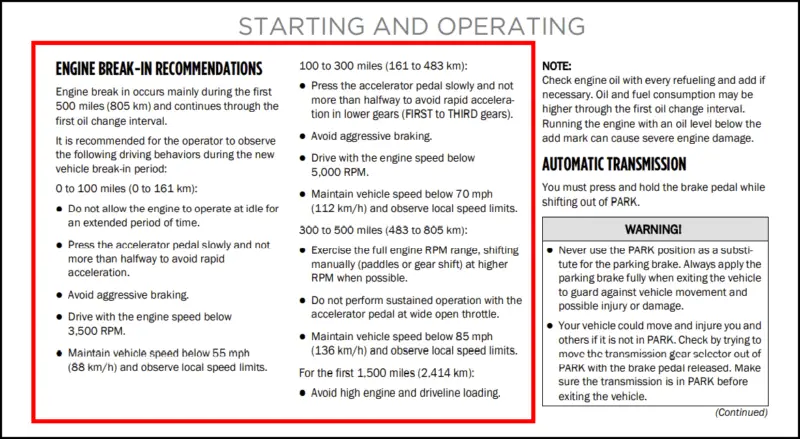
Many manufacturers include engine break-in guidelines that look like this: for the first 1,000 miles, vary the engine speed, avoid full throttle, and stay below 4,000 RPM.
Modern vehicles record telemetry data in the ECU. If you ever need to bring your vehicle in for warranty work, the technician may check the vehicle’s computer to see how fast you were going, what the maximum throttle percentage was, and what your maximum RPM was.
If you drove the vehicle hard before reaching the target break-in mileage, it could potentially cause issues with engine warranty work.
Example from the 2020 Dodge Charger owner’s manual (with 6.2L Hemi engine):
2) Avoid Redlining
When breaking in an engine, bearing surfaces and rotating components are mating. Small bits of metal wear off during the first few thousand miles on an engine. Once the engine is settled, wear will be minimal as long as you take care of it.
If you rev an engine very high before it’s broken in, you risk damaging it. This could damage bearing surfaces, cylinder walls, or piston rings. This is especially true if you rev the engine while it’s hot.
3) Avoid Full Throttle (At Least Initially)
For the same reasons you want to avoid redlining, you should also avoid full throttle if possible. Full throttle puts extra load on the engine, stressing components that may not be fully broken in.
An engine that hasn’t been broken in properly may experience increased blow-by and oil consumption as it ages. In extreme cases, you could even spin a bearing. A spun bearing will require a bottom-end engine rebuild.

4) Be Gentle with the Clutch
If your engine is new, chances are the rest of your car is too. This means other components need to be broken in up to 1,000 miles, like the clutch.
If your new vehicle has a manual transmission, it’s completely normal to smell a slight burnt clutch odor, even if you’re gentle with the clutch when driving. This smell should largely dissipate within the first few thousand miles.
5) Vary Engine Speed (Avoid Cruise Control)
When you vary engine speed during break-in, you help the piston rings seat evenly. While cruise control isn’t hard on the engine, using it for long distances during break-in could interfere with this process.
6) Avoid Idling
For the same reasons you want to avoid cruise control, you also want to avoid idling. Idling runs the engine at a single low RPM. You also want some load on the engine.
The engine will perform best at operating temperature while running under various loads. As you put miles on your new engine, you can gradually increase the maximum load you apply to the engine.
7) Drive in the City
Driving in the city is a simple way to naturally vary engine load. When you’re in stop-and-go traffic or driving from one traffic light to another, gentle intervals of acceleration and coasting are good for a new engine.
Engine Wear and Break-In
Engines will naturally see more contaminants in the oil early in their life due to the break-in process. If you perform used oil analysis, you’ll notice these extra contaminants start to thin out and disappear within the first 10,000 miles or so.
Some common elements you’ll notice on your oil report that are higher than average are copper, aluminum, and silicon. As you put miles on the vehicle, these values will likely drop to single-digit parts per million (PPM).