
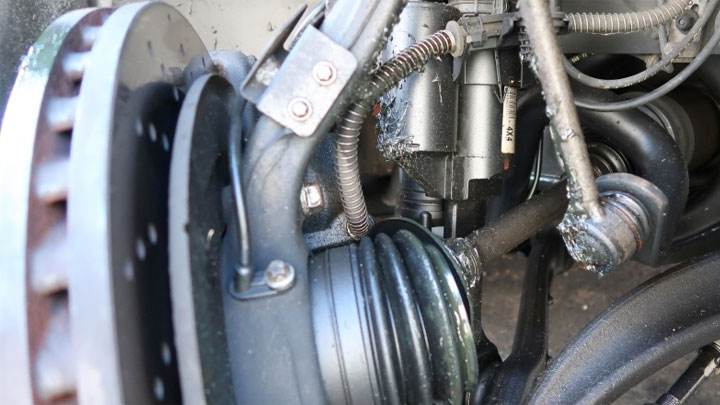
Today’s vehicles use many types of sensors, including those that measure engine speed (crankshaft/camshaft position), transmission speed, and wheel speed. Wheel speed sensors in particular are quite reliable but can still fail due to their location.
Let’s look at some of the most common symptoms of a faulty wheel speed sensor, whether it’s safe to continue driving, and how much it will cost to replace the speed sensor.

What is a Wheel Speed Sensor?
Whether you call it a wheel speed sensor (WSS) or an ABS sensor, this electrical device provides information about the rotational speed of a single wheel of a vehicle. These sensors should not be confused with a vehicle’s transmission speed sensor, which performs a totally different task.
Wheel speed sensors are typically magnetic in nature, which allows them to create measurable “pulses” when a tone ring mounted on the hub rotates past their probes.
The rate at which these pulses are created directly affects the detected speed of the wheel in question, as interpreted by the vehicle’s management software. The more pulses created in a specific time frame, the faster the recorded rotational speed of the wheel.
Wheel speed sensors are available in two individual configurations.
- The first is a passive sensor, analog in nature, which does not require a reference voltage to facilitate its operation.
- The second wheel speed sensor configuration is that of an active design. These sensors require an input voltage to operate and use an encoder-type tone ring.
Most recent vehicles use the latter of these two sensors, due to its inherent reliability.
A vehicle’s management software uses the feedback from a speed sensor to compare the feedback transmitted by all the other wheel speed sensors present on the same vehicle.
Through these means, this software can determine if any of a vehicle’s wheels are spinning faster than the others, indicating possible slipping or imminent brake lockup.
Where is it located?
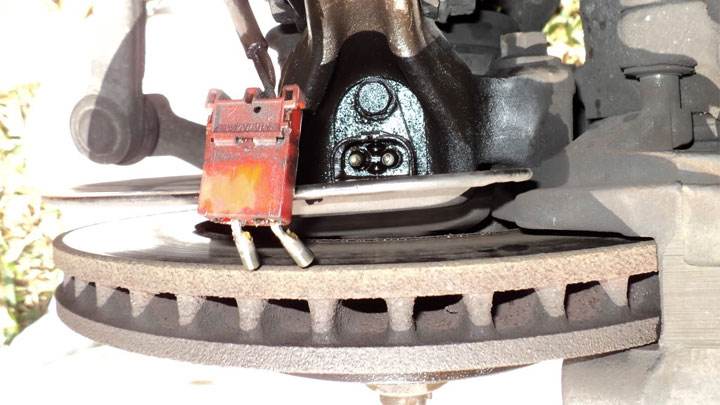
Wheel speed sensors can be found mounted in each of a vehicle’s four hubs. The exact location of such a sensor can be easily identified by tracing the electrical pigtail that terminates at its mounting point.
This wiring typically runs down along a vehicle’s chassis rail, before anchoring to the brake hoses or hub assembly of an individual wheel end.
The wheel speed sensor itself is embedded in its corresponding hub assembly, its outer face residing in immediate proximity to a hub-mounted tone ring. This positioning is essential, as a speed sensor would not function without being mounted in a way that allows it to interface with this embedded tone ring as intended.
Symptoms of a Faulty Wheel Speed Sensor
The presence of a faulty wheel speed sensor is often accompanied by several secondary symptoms, some of which tend to be more noticeable than others. Early recognition of these symptoms can prove invaluable when attempting to expedite the repair of the issue in question.
Here are some of the most common symptoms associated with a faulty wheel speed sensor.
#1 – ABS (or Stability Control) Light Illumination
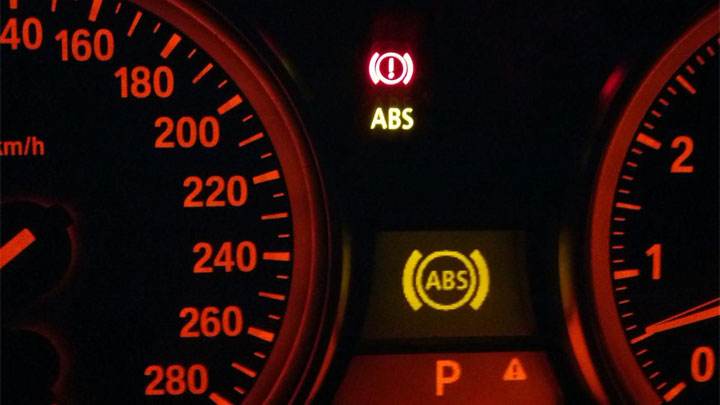
Most often, the detection of a faulty wheel speed sensor (ABS sensor) by a vehicle’s control software will result in the illumination of an ABS light. This is due to the storage of an ABS-related fault code.
In some cases, manufacturer-specific traction or stability control warnings (i.e., Service StabiliTrak or Service AdvanceTrac) will also signal their presence.
#2 – Lack of Active Safety System Functionality
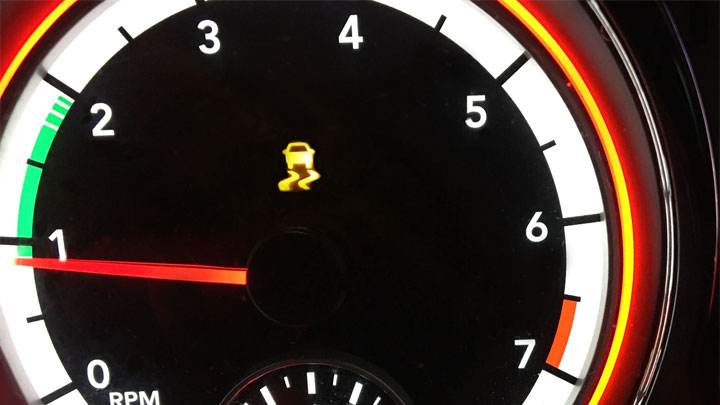
A vehicle’s anti-lock brakes, stability control, and traction control all rely on feedback from each of a vehicle’s wheel speed sensors. In most cases, these systems are locked out as soon as a wheel speed sensor malfunction is detected.
#3 – Brake Pedal Pulsation

In rare cases, a vehicle’s brake pedal may actively vibrate, as if ABS-modulated braking was being performed during simple on-road driving.
As mentioned, this is a rather rare symptom that is more likely to affect older vehicles than those of a more recent vintage.
#4 – Increased Stopping Distances

You may also notice that it takes longer to stop your vehicle after one or more wheel speed sensors fail, especially during an emergency stop or panic stop. This is largely due to the absence of ABS function resulting from the aforementioned automatic lockout.
What Causes a Wheel Speed Sensor to Fail?
A wheel speed sensor can fail for a number of reasons, some of which tend to be more common than others. For example, the sensor can be irreparably damaged by an impact with debris resulting from hitting solid material deposited on the roadway.
Alternatively, the signal from a wheel speed sensor can be hampered by the collection of metallic debris in or around its magnetic element.
In addition to this, a wheel speed sensor can also be compromised when its wiring is damaged or due to an excessive buildup of corrosion on its connector. Either of these conditions can cause excessive resistance in the speed sensor circuit itself, or even result in an open connection in the most severe cases.
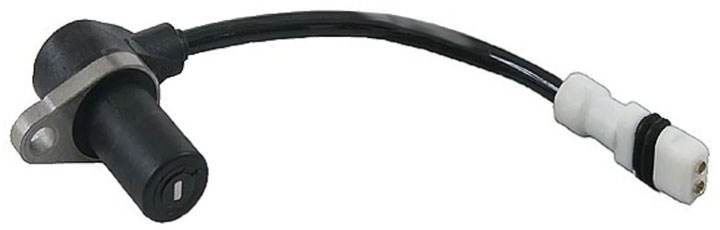
The exact cost of replacing a wheel speed sensor can vary from one vehicle make and model to another. In many cases, one manufacturer will charge significantly more for a speed sensor than others.
Alternatively, labor rates for replacing a particular speed sensor can be much higher on one vehicle model than on another.
On average, you can expect to pay between $150 and $300 to replace one of your vehicle’s wheel speed sensors.
Generally speaking, about 1/3 of this cost will be attributed to the purchase of the sensor itself, while about 2/3 will be related to the labor required for such a repair.
Is It Safe to Continue Driving?
Although you can continue driving with a compromised wheel speed sensor, it is not advisable. A number of active safety systems, such as anti-lock braking, stability control, and traction control, rely on the use of a vehicle’s speed sensors to facilitate their proper operation.
In most cases, these systems will be automatically disabled upon the failure of an individual sensor.
Knowingly operating a vehicle for an extended period with one or more safety systems disabled due to a mechanical failure poses multiple issues. The first of these issues concerns your safety, that of your passengers, and that of all other road users.
Furthermore, you could be forced to accept additional liability in the event that such negligence were to cause a collision.
In any case, the root cause of a vehicle’s wheel speed sensor fault should be carefully diagnosed and repaired as soon as possible. This simply constitutes best practice when seeking to maximize your safety.
If you are unsure of your ability to perform these repairs yourself, it is recommended to schedule an appointment with a reputable service center as soon as possible.
How a Mechanic Diagnoses a Faulty ABS Sensor
In most cases, a scan tool is used to identify the offending wheel speed sensor, including its individual location at the wheel end. From this point, an oscilloscope or a high-quality digital multimeter is used to analyze the return signal from the sensor in question, or the lack thereof.
Alternatively, a comprehensive bidirectional scan tool can often be used to monitor wheel speed sensor feedback in real-time.
Beyond these diagnostic practices, a mechanic is also likely to perform a thorough visual inspection of a suspected wheel speed sensor and all associated wiring. Sometimes, especially when debris impact occurs, the damage to the sensor in question is rather obvious and easy to spot.
It is also important for them to check the air gap between a speed sensor and its corresponding tone ring as well.