

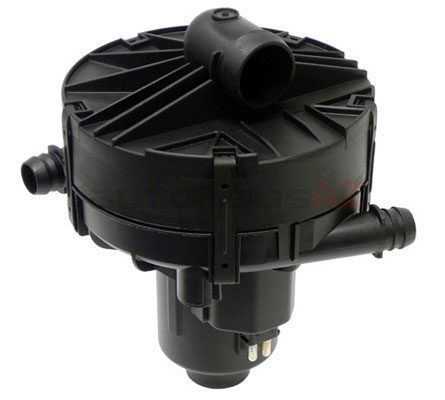
If you’re wondering what a secondary air injection pump is, you’re not alone. In this article, we will go over the purpose of the secondary pump as well as the symptoms you should watch for to indicate that the pump is failing.
What does a secondary air pump do?
The secondary air injection pump (also called a smog pump or SAI pump) is responsible for reducing the amount of carbon emissions coming out of a vehicle’s exhaust pipe. This is necessary because a vehicle engine is never 100% efficient in the combustion process.
The pump is located after the exhaust manifold and before the vehicle’s catalytic converter, and it can reduce carbon emissions by pumping fresh air from outside into the exhaust stream. By the time the fumes leave the exhaust pipe, there are fewer hydrocarbon pollutants in them. This promotes a safer environment by reducing air pollution outside.
If there is a problem with your secondary air injection pump, then more hydrocarbon pollutants will be in the fumes coming out of your exhaust pipe. You won’t realize it until you’ve had an emissions test.
Either that, or you will experience many unfortunate symptoms that will affect your engine. You won’t want both scenarios to happen. They can make your life quite difficult if you do.
Secondary air injection pump failure is easy to recognize if you know the symptoms to watch for. Below are the five most common symptoms of secondary air injection pump failure.
If you notice at least two of the symptoms occurring, there’s a good chance you’re dealing with a faulty secondary air injection pump and you should have it repaired immediately.
Check Engine Light
One of the first symptoms of a bad secondary air injection pump is that the engine warning light comes on. The engine control unit can automatically detect when the secondary air injection pump has a problem.
Since the air pump’s functionality impacts the engine, any issue with it will trigger the Check Engine warning light on the dashboard. To confirm the actual cause of the check engine light, you will need to use a car code reader to retrieve any error codes that have been stored.
Emissions Test Failure
The purpose of the secondary air injection pump is to reduce hydrocarbons in your emissions system. So, if you have a bad secondary air injection pump, it means your emissions system will allow too many hydrocarbons to be released into the atmosphere.
Not only does this cause problems for the environment, but it also causes problems whenever you get an emissions test. If you live in a state that requires emissions testing, you will fail the test if your secondary air injection pump is bad.
Poor Acceleration
A faulty secondary air injection pump will cause problems for the air/fuel ratio in your internal combustion engine. If this ratio is too lean (not enough fuel), your engine will struggle to generate speed whenever you press the accelerator pedal.
Poor acceleration could be caused by several mechanical issues, but a bad secondary air injection pump is certainly a possibility. A failed emissions test in conjunction with poor acceleration is a decent indicator that it’s the pump’s fault.
4) Engine Stalling
You might be driving normally and suddenly experience engine stalling or hesitation in your vehicle. A secondary air injection pump that is wearing out can cause inconsistent power fluctuations from the engine.
One minute, the power may be good, and the next, the RPM drops too low and the engine stalls. If the pump is not replaced, the engine may continue to stall at the worst possible times.
5) Low Idle
When your engine is idling, check the tachometer and see what the current RPM is. The normal RPM of an idling engine is between 600 and 1,000 RPM. But in situations where the secondary air injection pump is not working, you can expect the RPM to drop. This can cause the car to vibrate or even stall as mentioned above.
If you have already experienced engine stalling, poor acceleration, and a check engine light, you should have the secondary air injection pump checked immediately. If it turns out to be the problem, have it replaced by a certified mechanic.