
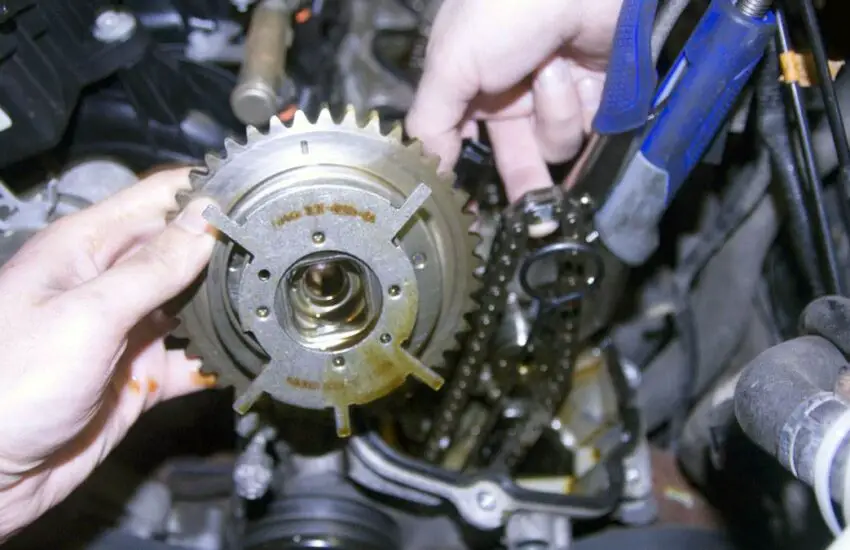
Modern engines use variable valve timing (VVT) for increased efficiency by adjusting the camshaft phase according to conditions. Although effective, VVT engines are prone to cam phaser failures, a specific component controlling cam timing.
Understanding the symptoms of a failing cam phaser and its causes gives you the necessary knowledge to address this issue before major engine damage occurs. Unfortunately, the cost of replacing the cam phaser will be high, but there is one thing you can do to reduce it.
What is a Cam Phaser?
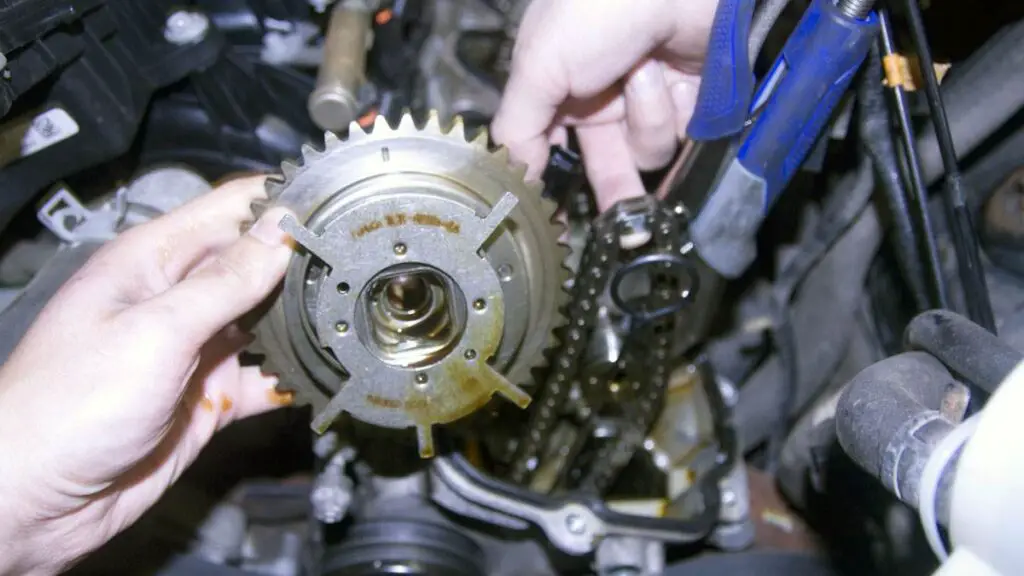
A cam phaser is an integral part of all engines using variable valve timing. The cam phaser itself is responsible for advancing or retarding the position of the engine’s camshaft(s) relative to the crankshaft, as commanded by the PCM/ECM.
This effectively varies the timing of each valve lift event compared to the standard static orientation.
Most cam phasers are hydraulically driven, by oil metered through the engine’s VVT oil control solenoid(s). These solenoids themselves are electrical rather than hydraulic in nature and are controlled via an electrical signal sent by the vehicle’s control module.
Simply put, cam phasing is initiated by the vehicle’s computer but carried out by individual cam phasers, with the oil control solenoids acting as intermediaries.
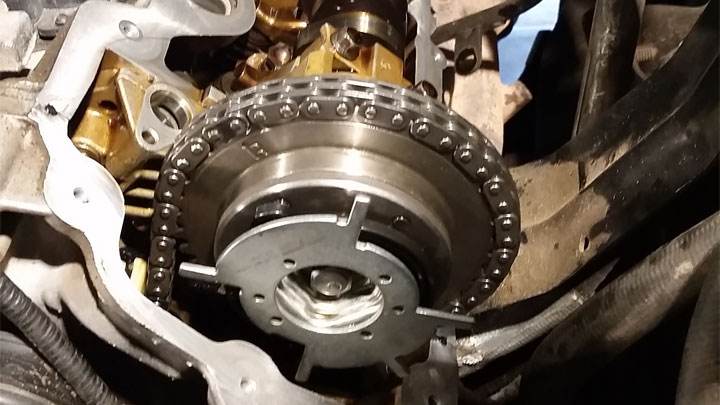
When an engine’s operating software determines that a certain degree of cam phasing would be more efficient under the circumstances, power/ground is directed to the engine’s oil control solenoids, causing them to open, allowing pressurized oil flow to their respective cam phasers.
This hydraulic pressure then causes the phasers to index, in turn mechanically rotating the engine’s camshaft(s).
Even when everything is fine and working as intended, cam phasers tend to be a high-failure item in VVT engines. This places increased importance on recognizing the symptoms of cam phaser failure.
Symptoms of a Bad Cam Phaser
The failure of a cam phaser is often accompanied by one or more secondary symptoms. By learning to recognize these symptoms, you can minimize excessive downtime and avoid further engine damage.
Here are some of the most common signs associated with cam phaser failure.
#1 – Check Engine Light

An engine’s management software is quite adept at detecting ongoing cam phasing issues and can quickly detect feedback anomalies from one or more sensors that would indicate a lack of desired cam phasing.
In almost all cases, this will result in the illumination of the check engine light.
#2 – Cam Phaser “Click”
Most often, a failing cam phaser will begin to make an audible clicking noise, unlike anything most motorists have heard. This noise occurs when the cam phasers fail to lock into the desired position as they otherwise should, causing some degree of play.
#3 – Reduced Engine Performance
When a cam phaser fails, you may also notice that your vehicle’s performance begins to suffer. This lack of operational efficiency is due to an engine’s inability to actuate its camshafts as desired.
As a result, engine performance suffers as a whole, particularly under certain operating criteria.
#4 – Reduced Fuel Economy
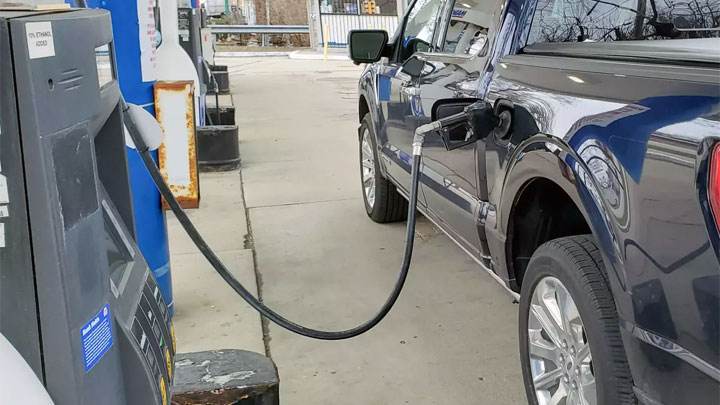
You may also notice that your vehicle’s fuel economy suffers in the presence of a faulty cam phaser. This, again, stems from an engine’s inability to actuate its cams as commanded by the vehicle’s operating software.
This in turn leads to reduced combustion efficiency and less-than-optimal fuel consumption.
#5 – Rough or Erratic Idle
It is also possible for a vehicle’s engine to exhibit a rough or erratic idle if one or both cam phasers are failing. This is yet another product of suboptimal performance due to incorrect or inadequate camshaft indexing or phasing.
One might find that this issue is more evident at certain operating temperatures.
What Causes Cam Phaser Failure?
As mentioned above, cam phasers tend to be a high-failure-rate item in VVT engines. But why is that?
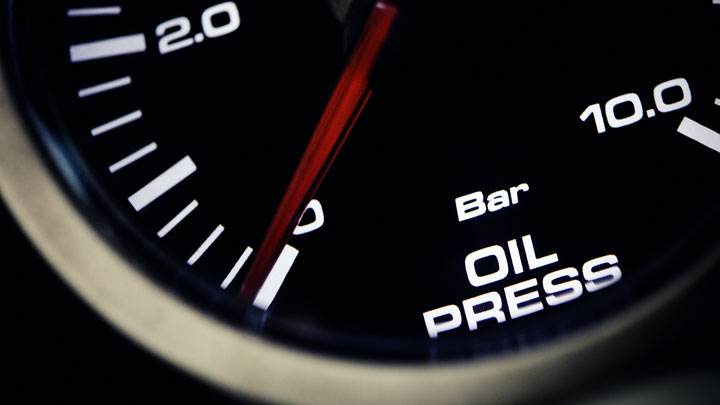
One of the most common causes of premature cam phaser failure is slightly low engine oil pressure. Cam phasers require adequate oil pressure not only for operation but also for lubrication. A lack of adequate oil pressure caused by oil degradation or a worn-out oil pump can quickly damage an engine’s cam phasers.
However, it is also important to remember that cam phasers can also fail due to normal wear and tear. As with any mechanical component, time and continued use will eventually take their toll. After all, an engine’s cam phasers are actuated numerous times during every driving event, making wear inevitable.
What to Do If You Suspect a Bad Cam Phaser
If you believe your vehicle’s cam phaser is failing, you should act quickly to find an appropriate solution that does not unnecessarily prolong the repair process. As detailed above, there are a multitude of secondary symptoms that often accompany a faulty cam phaser, many of which negatively impact a vehicle’s drivability.
While it is possible to drive a vehicle with a faulty cam phaser, it is not advisable to do so for an extended period, as the vehicle’s overall performance will suffer.
Furthermore, the presence of a bad cam phaser will certainly negatively impact a vehicle’s fuel economy, causing unnecessary pain at the pump (especially with today’s gas prices). This stems from the fact that a VVT engine is only capable of achieving maximum efficiency when the desired cam phasing is achieved.
In any case, the exact cause of a vehicle’s cam phasing failure should be diagnosed and repaired as soon as possible. This will mitigate any further risk of additional engine damage and restore engine performance to a state of increased efficiency.
If you do not feel comfortable performing such repairs yourself, schedule an appointment with a trusted service center as soon as possible.
Cam Phaser Replacement Cost
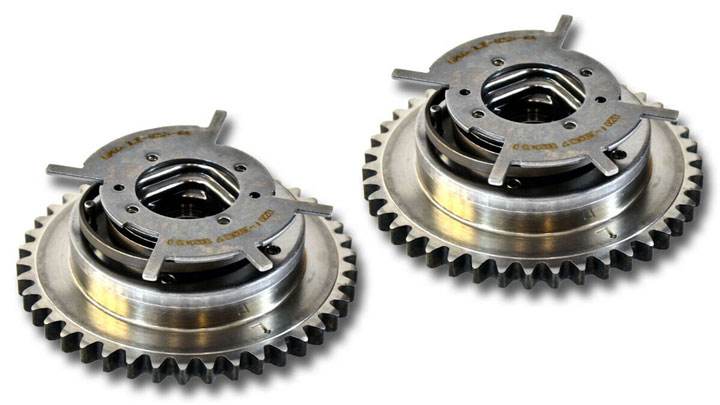
The cost associated with replacing a cam phaser can vary significantly from one vehicle model to another. This is due to variations in parts and labor between different makes and models. Nevertheless, repairs of this nature tend to fall within a somewhat rough price range.
On average, one can expect to pay between $800 and $2,500 to replace their engine’s cam phasers. Of this total price, approximately $100 to $400 can be attributed to parts cost, while the remaining $400 to $2,000 comes from the many hours of labor required to perform such a repair.
You can likely reduce costs by having the cam phaser repaired at a good independent repair shop rather than a dealership, but when several hours of labor are required, it won’t be cheap.
Which Vehicles Are Most Likely to Have Cam Phaser Failure?
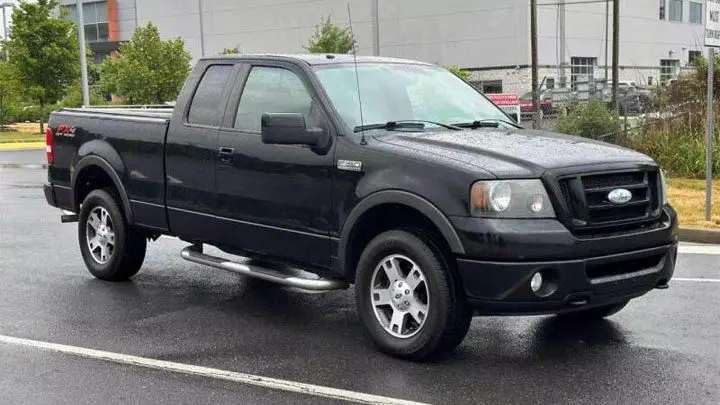
Although cam phaser failure tends to be relatively common in most vehicles equipped with VVT engines, certain makes and models are more prone to such difficulties than others. In fact, several vehicles have even been subject to recalls to varying degrees for such issues in recent years, further highlighting the severity of cam phaser failure.
Over the past two decades, the Ford F-150 has experienced a wide range of cam phaser failures. This issue is relatively widespread and spans several model years.
Additionally, a multitude of associated Ford SUVs that share a common powertrain with the F-150, such as the Lincoln Navigator and Ford Expedition, have also experienced their share of cam phaser failures.
What is a Cam Phaser Lockout Kit For?
A cam phaser lockout kit is a popular modification that can be applied to most VVT engines. Kits of this nature prevent the actuation or phasing of an engine’s camshaft, thereby eliminating variable valve timing capabilities altogether.
This avoids repeated failures of cam phasers and other VVT-specific components, which tends to be both frustrating and costly. Lockouts are also commonly used by those experiencing cam phaser “rattle.”
However, using a cam phaser lockout or delete kit has some drawbacks. Car owners may notice that their vehicle’s performance is partially hindered under certain circumstances due to a lack of phasing capability. One might also notice a reduction in fuel economy.