
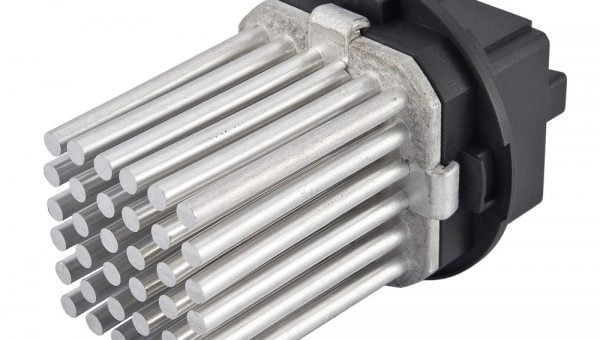

When your car’s heating or air conditioning is activated, the fan turns on and blows air out of the car’s vents. The motor that spins the fan is called the blower motor.
It is located in the dashboard, usually on the opposite side of the steering wheel or inside the engine compartment on the firewall.
The fan speed can be adjusted in almost all modern cars. Some cars have fans with 4 to 5 fixed speed settings that can be selected, but in this case, the blower motor speed is controlled by a blower motor resistor.
Signs of a Bad Heater Blower Motor Resistor
1. No Air Flowing from the Vehicle’s Vents
If the fan does not turn on at all when the air conditioner or heater is running, it is usually not the fan itself but the resistor. Since the blower resistor is directly responsible for transferring energy from the battery to the blower itself, a symptom of a faulty blower motor resistor is that no air comes out of the vehicle’s vent. The blower motor resistor is responsible for directly powering the blower motor. Therefore, if major problems in the heating and air conditioning system fail, such as if the motor’s power is completely cut off due to overheating or corrosion, the motor simply will not work, rendering the entire heating and air conditioning system unusable, as no air will flow from the vehicle’s vents.
2. Blower Motor Only Works on High Speed
A common symptom of a faulty blower motor resistor is when the heater and air conditioning fan only works on high speed and cannot be adjusted to low speed. This happens because the faulty blower motor resistor is unable to control the current flow. It may be that the resistor is somehow bypassed and the current is directly supplied by the switch. Excessive current can overheat the blower motor resistor and permanently damage it.
In this case, the heating and air conditioning system can still function normally by pushing cold or hot air out of the outlet in line with the speed. The resistor must be replaced with a new one to restore its function.
3. Blower Motor Only Works on Low Speed
Another common symptom of a faulty blower motor resistor is that the blower motor only works on low speed. This may be due to bad wiring between the blower motor resistor and the blower motor itself.
4. Blower Motor Does Not Work in Certain Settings
Another symptom of a faulty blower motor resistor is that the blower motor cannot operate in certain settings. This will cause the blower motor to operate incorrectly or not at all in one or more settings. It is very likely that the blower motor switch will no longer work. Proper diagnosis is highly recommended if you are not certain of the problem.
5. Smoke Coming from the Vents
If you notice smoke or a burning smell from your vents, it could be due to the blower motor resistor overheating, which may have burned wires inside the dashboard. It is best to stop the car immediately to investigate further damage and let it cool down.
What is a Blower Motor Resistor?
Heater Blower Resistor
A blower motor resistor is an adjustable resistor. This electrical component is used to control a vehicle’s air conditioning system. It is the part that controls the speed of the blower motor fan according to settings that can be changed by turning the knob left or right, thereby increasing or decreasing the resistance of the electrical current flowing to the rotating blower motor connected to the fan.
As part of our comfort and luxury, the fan speed is one of the most adjusted settings in a car, and thus the blower motor resistor is constantly powered on, which can eventually lead to motor failure; too much humidity in the atmosphere can lead to increased resistance. For this reason, the blower motor resistor can cause problems with the entire heating and air conditioning system.
Although it is unusual for this motor resistor to deteriorate, with a few exceptions, almost all components fail at one time or another, after which they must be repaired or completely replaced. Fortunately, in this case, the motor resistor is not a high-tech electronic component and can be replaced relatively easily and inexpensively. In fact, even diagnosing a faulty blower motor resistor is actually simple and does not require any special skills or even basic knowledge, as the resistor has only one purpose: to limit the fan to different speed settings. A faulty blower motor resistor will usually cause easily identifiable symptoms.
Solutions and Tests
You cannot do much to repair a bad blower resistor, as it is better to replace it completely. If you feel comfortable replacing the resistor yourself, you can find out where the component is located and how to test it.
Steps to Check/Test the Resistor:
Locate the blower resistor and disconnect it from the rest of the circuit. Once the resistor is disconnected, it is often possible to determine if the resistor has blown or not based on its condition. A blown resistor must be replaced with the correct alternative.
If the appearance is normal, it is necessary to check the resistance of each individual resistor. The resistors are all connected to a single common point. Set the multimeter to resistance measurement mode, connect one probe of the multimeter to the common point, and use the other probe to check the resistors at other points. If any of these resistors has an open circuit, the blower resistor must be replaced.