
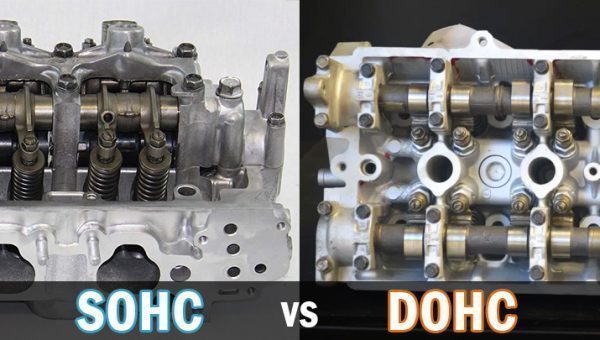

Single and double overhead camshafts have been part of automotive, marine, motorcycle, and aircraft engines since the early 20th century.
Some of the earliest cars with a single overhead camshaft (SOHC) were the 1902 British-designed Maudsley and the 1903 American Marr Autocar.
Double overhead camshafts (DOHC) appeared in a French Peugeot that won the 1912 French Grand Prix.
Overhead cam engines graced a number of military aircraft from World War I. Many of these engine models used shafts to drive the cams. Modern chain-driven overhead camshafts followed in popular automobiles of the 1920s.
DOHC engines gained popularity for many automotive brands after World War II, including Fiat and Alfa Romeo. Today, single and double overhead cam designs proliferate in our domestic and foreign-built cars. Read on to see how SOHC and DOHC engines compare as well as the cam-in-block engine.
The Purpose of the Camshaft
Today’s automotive piston engines use one or more camshafts to operate the intake and exhaust valves. The camshaft is driven by the engine’s crankshaft using a chain or belt that coordinates the timing of the intake and exhaust valves.
These valves admit air and fuel into the combustion chambers and allow the burned mixture to be expelled to the exhaust system.
What is a SOHC Engine?
First, both SOHC and DOHC engine models are overhead valve configurations.
A single overhead camshaft engine uses one camshaft located above each bank of cylinders. For a “V” design engine such as a V6 or V8, there would be two such camshafts, one above each cylinder bank. The camshaft would be driven by a timing chain or toothed timing belt.
At the engine designer’s choice, a number of methods could be used to operate the valves from this single camshaft. If, for example, all valves were aligned parallel to the length of the cylinder head, the cam could operate them all directly. For other valve arrangements, rocker arms or sometimes very short pushrods may be used.
SOHC Advantages
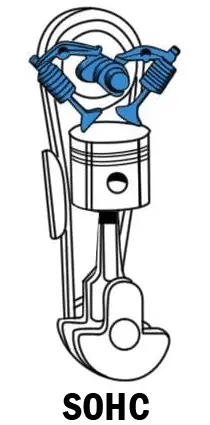
The SOHC design offers several advantages over the cam-in-block design:
- Valves can be positioned for an optimal combustion chamber design. Multiple valves can be used; up to five per combustion chamber are possible. Dual spark plugs can also be used. These improvements can enhance air-fuel flow and combustion capabilities, offering increased power and better fuel economy.
- Passages through the engine block and cylinder head for pushrods are not needed. Both areas can thus use additional (or larger) coolant passages improving cooling efficiency. Improved cooling, particularly in cylinder head areas, can allow for higher compression ratios. This benefits both power and fuel economy.
- The mechanism actuated by the camshaft to open the valves can be both simpler and lighter. This reduces the possibility of valve float making much higher engine speeds possible. Higher engine speeds in general improve power output.
- Access to all valve system components, especially the camshaft, is simpler. Repairs to this critical engine area would then be less costly.
SOHC Disadvantages
SOHC engines have some disadvantages compared to cam-in-block designs as well as DOHC designs:
- Engine complexity is increased. This adds to design and manufacturing cost. There may also be an overall increase in engine weight compared to cam-in-block designs. Camshaft drives using a chain or belt can introduce reliability and maintenance considerations that are not common to cam-in-block engines.
- The engine may become larger and require increased hood height for clearance. Due to the increased engine size, weight may also increase.
- Variable valve timing is largely limited to timing changes for the intake and exhaust valves simultaneously. This is the same timing issue that exists for cam-in-block engines.
What is a DOHC Engine?
A double overhead camshaft engine will have two camshafts located above each row of cylinders. A “V” design engine such as a V6 or V8 would have a total of four camshafts. As with the SOHC engine design, the DOHC would use timing chains or a toothed timing belt to drive the camshafts.
In most cases, with a DOHC (or dual cam) engine, each cam would directly actuate its associated valves.
DOHC Advantages
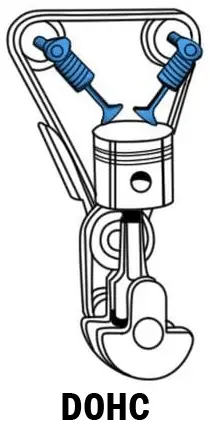
DOHC engines share the same advantages as SOHC designs. These include:
- Valves can be positioned for an optimal combustion chamber layout. Optimizing the valve layout can benefit power and fuel economy.
- The cooling efficiency of the engine block and cylinder head is improved with DOHC designs. Increased compression ratios offer increased power and energy efficiency.
- DOHC designs offer the most direct valve operation. Peak engine speeds of 8,500 or more are possible for street cars. Racing vehicles can achieve even higher engine speeds with advanced DOHC systems.
- Maintenance access to the camshafts and lifters is easier. This can help reduce overall maintenance and repair costs.
- DOHC engines offer the best of VVT benefits. Variable valve timing can operate independently for each camshaft, providing optimal valve timing for both intake and exhaust valves.
DOHC Disadvantages
As with SOHC engines, DOHC designs share the same fundamental disadvantages.
- Engine complexity and weight are increased compared to cam-in-block designs. Design and manufacturing costs are also higher. Compared to SOHC designs, DOHC engines have a more complex chain or belt drive system. This decreases overall reliability and increases maintenance expenses.
- As with SOHC designs, the DOHC engine height is increased and the total weight also tends to be higher.
What is a Cam-in-Block Engine?
The majority of engines in American cars built just after World War II were cam-in-block models. These used a single camshaft located inside the engine block. This camshaft directly actuated the valves of several popular flathead engines.
For high-performance overhead valve (OHV) engines (engines with valves located above the combustion chambers), the camshaft actuated each valve via a system of pushrods and levers called rocker arms.
Cam-in-Block Advantages
The main advantages of cam-in-block valve systems are:
- Such systems were simple and economical to design and manufacture.
- They proved to be very reliable.
- Cam-in-block engines have a relatively low overall height. This allows for lower hood profiles which can be a boon for sleek body designs.
Cam-in-Block Disadvantages
Cam-in-block designs have some disadvantages, particularly for OHV engines:
- Space allowances for pushrods through the engine block and for rocker arms on top of the cylinder head can dictate or crowd the location of other components.
- The geometry of the pushrod and rocker arm can force inefficient cylinder head combustion chamber shapes and sizes.
- The mass (or weight) of the mechanism between the camshaft and each valve introduces inertia effects that limit valve operating speed. At very high engine speeds, for example above 7,000 revolutions per minute (RPM), the valves may not close completely. This is called valve float which will always limit engine power.
- Pushrods require passages upward through the engine block and cylinder heads. Such passages can restrict the size of cooling areas in the engine block and cylinder heads, tending to degrade cooling efficiency.
- Independent variable valve timing (VVT) that can enhance performance and fuel economy would be difficult to provide for both intake and exhaust valves.
Some of today’s very high-performance engines remain cam-in-block designs. These designs may include some form of variable valve timing. However, cam timing variations would be simultaneous for intake and exhaust valves since these engines have only a single camshaft.
How Can You Tell If You Have SOHC or DOHC?
Generally, you can simply open your car’s hood and examine the top of the engine. A narrow but tall engine top with a distinct bump at the front for the cam drive sprocket usually indicates an SOHC is hidden underneath.
A wide engine and/or a two-humped top will reveal the presence of a DOHC configuration. If in doubt, an online search for your car’s make, model, year, and engine displacement should provide clarification in this regard.
Can You Change SOHC to DOHC?
Making such a change would, in general, be extremely costly. However, some car makes and models have similar engine choices in both SOHC and DOHC configurations. Some Honda models fit this mold.
For specific models, an SOHC cylinder head may be replaced with a DOHC cylinder head. And with proper reprogramming of the engine control unit (ECU) and changes to auxiliary engine systems (as well as good DIY skills), such a transition is certainly possible.