
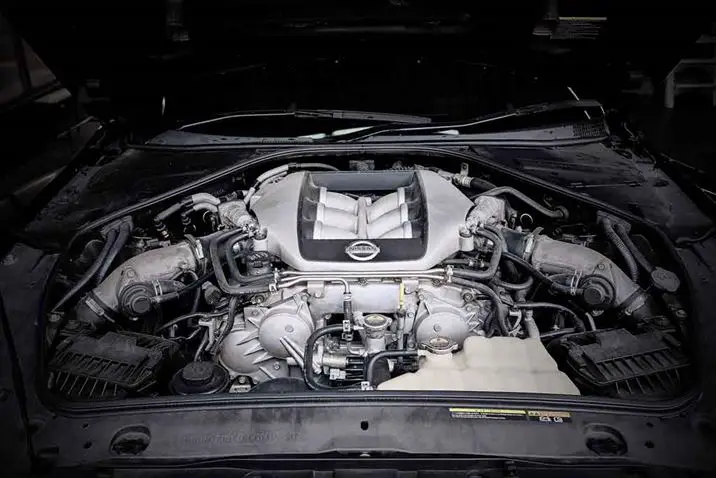
The Nissan Motor Company’s VQ engine series is used in the automaker’s sedans, trucks, SUVs, and crossover utility vehicles. The VQ series engine is also used in some Infiniti vehicles. If you haven’t heard of this engine series or only have a superficial understanding of it, you’ll be interested to know that this series is the successor to the original Nissan VG engines.
Do some research on the Nissan VQ engine series and you’ll find it ranks among the industry’s best for good reason. In fact, the engine series has been highlighted for its merits by Ward’s popular 10 Best Engines list nearly every year of its existence. It is the only engine series to appear on the list every year the award has been given. Let’s take a closer look at what the VQ series engines actually are.
The Basics of the VQ
Nissan’s VQ engines are piston engines and feature six cylinders. The engine consists of an aluminum block highlighted by aluminum cylinder heads and 4-valve engineering. These engines originally contained the automaker’s MPFI system, an acronym for Multi-Point Fuel Injection. This system is of sequential design. The engine series later transitioned to a version with variable valve timing, including direct fuel injection instead of MPFI. Examples of Nissan vehicles equipped with the VQ series engines include the company’s luxurious Maxima, the affordable Altima sedan, the highly popular 350Z sports roadster, the Quest minivan, and the Murano utility vehicle.
The Road to Success for the VQ Series
It’s no secret that competition in the automotive industry is an endless race to compete with other automakers equipped with the latest technologies and engineering feats. This fierce competition largely explains why Nissan’s VQ series engines took a backseat to the competition after several strong years. In fact, the automaker’s engineers took an eight-year hiatus from the VQ series after the engine range failed to compete in terms of fuel economy and refinement.
The very first Nissan VQ engine arrived on the market in 1994. Originally present in the Nissan Maxima as well as the Infiniti i30, this fully aluminum V6 engine was available with displacements of 2.0 liters, 2.5 liters, and 3.0 liters. The 3.0-liter displacement VQ provided 205 lb-ft of torque and 190 horsepower. The compact engine was easily transported thanks to its lightweight components, bidirectional cooling design, molybdenum pistons, and micro-finished crankshaft.
The return of the Nissan VQ series engine was met with great fanfare. The reborn VQ engines are even more efficient in terms of engine operation as well as fuel economy. The engine series now adheres to emissions regulations, including the Mobile Source Air Toxics standards, or MSAT for short. The Noise, Vibration, and Harshness (NVH) of the series engine is revered throughout the industry. An added bonus: the 300 horsepower of the engines. This improvement was achieved without any reduction in the quality or performance of the engine components. The engine’s NVH is superior to that of the 2016 Maxima as well as the 290 horsepower VQ 6-cylinder used in the 2015 model. In short, the Nissan VQ series engine is back and better than ever.
Breaking Down the VQ Series Engine
Drive around town in a Nissan equipped with a VQ series engine and you’ll find it is smooth, quiet, and performs better than expected. The refreshed VQ series engine features a fully revised intake manifold, highlighted by shorter and thicker channels. The superior flow in the cylinder head/combustion chambers offers higher output and reduced vibration thanks to its reinforced oil pan.
The reduction in friction combined with the mid-lock cam phasing improves combustion. The engines’ exhaust valves prevent heat from compromising the combustion chambers. The result is responsive yet lightweight power, perfect for continuously variable transmissions. The engine’s superior mid-range ensures top performance even when reaching over 6,600 RPM.
The Smooth and Silky Engine Every Gearhead Appreciates
As any gearhead knows, engine performance is at the heart of automotive functionality and on-road performance. Nissan’s VQ engines are revered throughout the industry for their smoothness, elite balance, and seamless functionality, regardless of external conditions. The underlying engineering of the engine is the source of its success. Designed with a displacement between 2.0 liters and 4.0 liters, the VQ engines have been modernized to provide additional power in all the different types of Nissan vehicles. Nissan engineers have mastered the delicate balance between efficiency and performance without sacrificing NVH levels.
Only the most knowledgeable automotive expert knows that Nissan engineers went so far as to precisely optimize the shape of the VQ series engine’s cylinder head ports to increase tumble flow while simultaneously reducing flow restriction. The automaker’s engineers accomplished this impressive feat by implementing complex fluid dynamics. In addition to an exhaust cam phaser with a widened event angle as well as a low-restriction exhaust catalyst, the engines’ valve timing has also been precisely tuned.
Now that you have an insight into the Nissan VQ series engines, it’s time to start your drive and imagine the inner workings of your Nissan VQ series engine while cruising around town.