
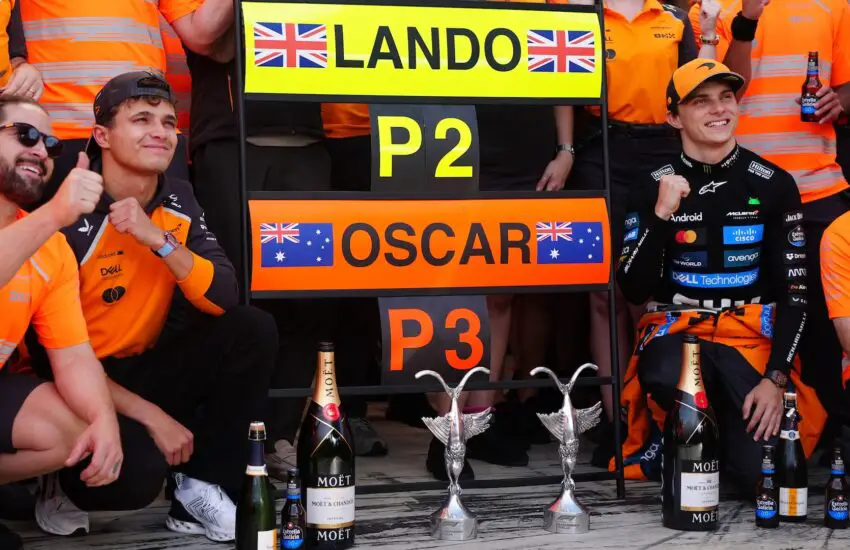
The quest for justice between its two hungry drivers is, at best, messy. In Formula 1, despite all its equations and data points, unknown variables often outweigh certainties. A sudden downpour during a race, a technical failure, or, as for Lando Norris this Sunday at Monza, a faulty wheel gun: all are unpredictable situations that complicate the search for fairness.
The Controversial Team Order at the Italian Grand Prix
Late in the race, the two papaya arrows pitted to fit new tires. Oscar Piastri, the championship leader, docked in 1.9 seconds. But for Norris, a problem with the left wheel gun turned the stop into an agonizing 5.9 seconds. As the Australian found himself in second place, a clear radio message came through: “Oscar, it’s a bit like Hungary last year. We pitted in this order for team reasons. Let Lando pass, then you can race.” Piastri complied immediately, yielding his position to his teammate.
McLaren’s Recurring Dilemma in 2024
The British team has been navigating troubled waters since the start of the season, torn between two elite drivers competing for the same title. Last year, the “papaya rules” often seemed to favor Norris in his battle against Max Verstappen. McLaren had promised that 2025 would be different, with clear expectations. Yet, the reality on the ground and the need for quick decisions have seen last year’s debates resurface, as at Silverstone where Piastri was denied a position swap.
A Divisive Decision: Fairness or Manipulation?
As the title battle tightens – Piastri leading Norris by 34 points before Monza – team orders become more controversial. Norris assured that this procedure had been discussed and was “the fairest thing.” Piastri, though complying, questioned the logic: “We had said that a slow stop was part of racing.” Even Verstappen, the race winner, mocked: “Just because he had a slow stop?”
The Impact on the Show and Sporting Ethics
Beyond the internal dilemma, this practice opens a dangerous cycle of “rebalancing” and risks altering the fan experience. As commentator David Coulthard summarized: “As fans, we don’t want to feel there’s manipulation beyond the normal gods of racing.” Spectators want strategy, but also an organic, hard-fought, and deserved race.
The Solution: Consistency or Laissez-Faire?
The answer to McLaren’s puzzle may lie in consistency, a quality the team has shown on track this year, but not yet over the radio in split-second decisions. The lesson from Monza might be to allow a less “manufactured” race. Whether the team chooses to intervene or stay silent in the future, it defines what justice means in F1: in love, war, and the fight for the title, all is fair.