
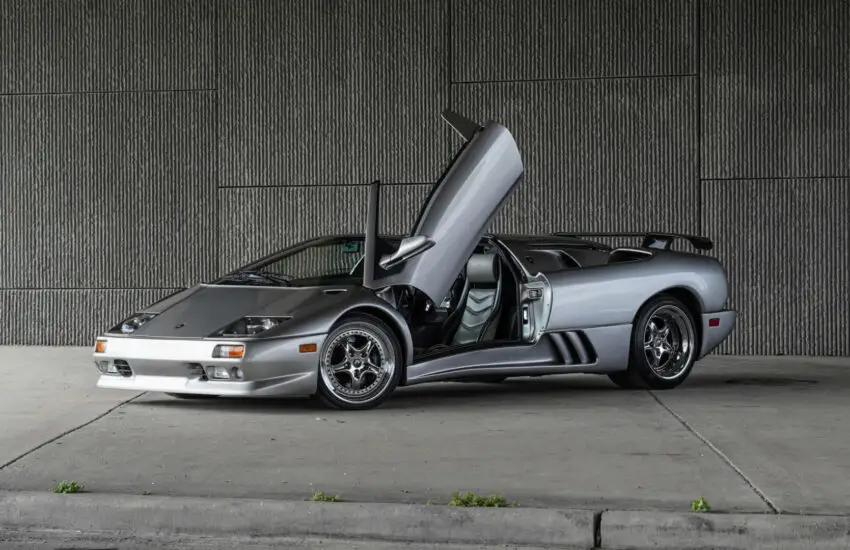
Do you miss the Diablo? I do. It used to sit on my wall, alongside Viper, Ferris Bueller, and depending on the space, at least one Boondock Saint. If you’re from Generation X or an older Millennial, maybe that resonates with you. And if you’re wealthy, you might be hoping to acquire your own poster-worthy performance machine. But where is its equivalent today?
Lamborghini’s Answer: Current Technology
We asked Rouven Mohr, Lamborghini’s technical director, and Mitja Borkert, head of design. Their answer is simple: it’s here, in the showroom.
“Sometimes there’s this debate in the automotive world that new technology is bad and boring. That the old is cool and exciting. That’s not true, to be honest,” says Mohr.
80s and 90s Supercars: Spaceships of Their Time
The hero supercars of the 1980s and 1990s may seem archaic and analog by today’s standards, but for their time, they were at the forefront of automotive technology.
“When the Diablo was state of the art, it was like a spaceship,” explains Mohr. “And our job is to define the next level of spaceships.”
Nostalgia and Tribute at Lamborghini
This doesn’t mean nostalgia has no place at Lamborghini, or that classic design codes won’t be referenced in their modern cars. But expect tributes rather than recreations.
Borkert explains his philosophy by comparing it to music: “I like to explain our design language as the songs of an artist who has stayed at the top of the charts for 62 years. A good concert builds steadily towards a climax. I always play a different song from the previous one. Artists who constantly play the same thing disappear. I like artists who have lasted for decades.”
Depeche Mode and Lamborghini DNA
“I’m a child of the 80s,” continues Borkert. “My band is Depeche Mode. To me, they’re a band that has kept its DNA for 40 years, but always offered a new interpretation. They’ve constantly redefined themselves.”
Mohr and Borkert believe the Fenomeno embodies this philosophy.
Building Tomorrow’s Icons
“Those old cars represented the pinnacle of technology of their time,” says Mohr. “So, to appreciate what they were, we need to create current cars that aim for excellence, so that in 50 years, we can look back and appreciate them.”
“Even though I love the old models privately, and I own many of them, technology progresses, as does the world. It’s a playground where, for now, we’re operating in the 1%, maybe less.”
And he concludes: “Trust the engineers, and there will be really cool stuff.”