
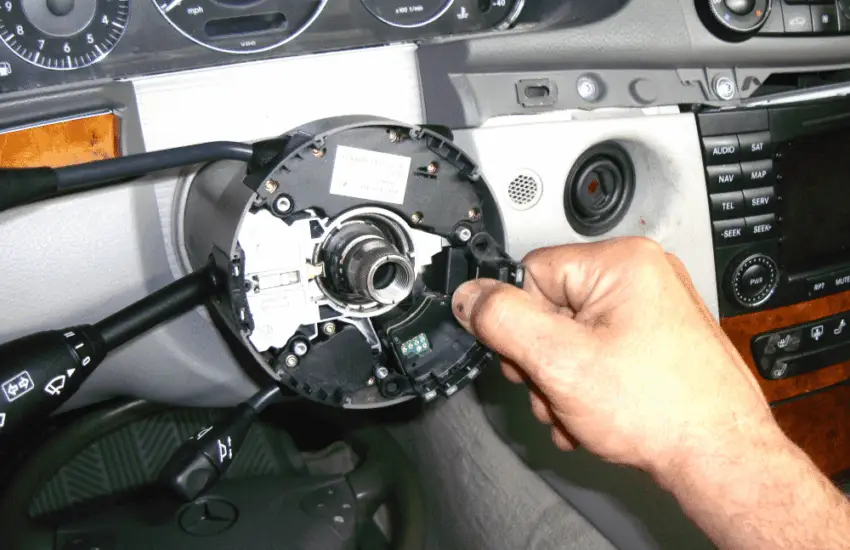
If you find yourself in a situation where you need to reset the steering angle sensor but don’t have a scanner, don’t worry! In this guide, we will walk you through a step-by-step process to guide you on how to reset the steering angle sensor without a scanner?
What is a Steering Angle Sensor?
The steering angle sensor (SAS) is responsible for providing information about the steering wheel’s rotation speed, sending signals to the car’s control system to determine the steering direction.
The steering angle sensor uses different voltages to obtain information about the angle and direction of rotation, then sends this signal to the ECU so the system knows which direction the driver wants the car to move. At this point, the ECU uses an algorithm to align the steering wheel with the wheels, thus ensuring precise steering angle and direction. This principle helps the vehicle avoid unexpected obstacles and achieve balance in dangerous turning situations.
Regarding the operating principle, as we mentioned, the SAS is an electronic device that measures the steering angle and sends a voltage signal to the Electronic Stability Control (ESC). When the system receives information from the sensor, an automatic algorithm calculates the gear ratio between the steering angles to ensure that the steering angle control works normally.
It is clear that the steering angle sensor (SAS) plays a crucial role in modern vehicles, providing important data to various safety systems such as Electronic Stability Control (ESC) and Anti-lock Braking Systems (ABS). So what will happen to your car if this sensor is damaged:

What Happens When a Steering Angle Sensor Fails?
Although it is manufactured using modern technology and installed in a location less exposed to dust, the steering angle sensor (SAS) can still suffer damage. Therefore, it is essential for car owners to be attentive to some signs that may indicate the need for prompt intervention:
- Electronic Stability Control Light On
One of the main functions of the SAS is to provide data to the vehicle’s stability control system. The ESC system uses information sent by the steering angle sensors, speed sensors, and acceleration sensors to detect steering wheel movements, thus helping the vehicle move in the correct direction.
Therefore, when the steering angle sensor is faulty or no longer able to collect information, the signal sent to the computer will be inaccurate. At this point, error codes will be sent directly to the engine control module, and the warning light will immediately illuminate to alert the operator.
- Inaccurate Steering Wheel Alignment
A faulty SAS can cause poor steering wheel alignment even when driving straight. You may notice that the steering wheel is off-center or tilted to one side when driving in a straight line.
- Unresponsive and Strange Steering
A bad steering angle sensor can lead to awkward or unpredictable steering behavior. You might experience sudden changes in steering response or find it difficult to maintain a stable course while driving.
- Warning Lights on the Car’s Dashboard
In some cases, a faulty SAS can trigger warning lights on the dashboard, such as the Check Engine light or the airbag warning light. These lights may indicate a broader issue related to the vehicle’s electronic systems but can be influenced by the SAS malfunction.
- Lack of Power Steering
Limited functionality of driver assistance systems: The SAS is crucial for various driver assistance systems, including lane departure warning, adaptive cruise control, and collision avoidance. If the steering angle sensor malfunctions, these systems may not function correctly or may not engage at all.

How to Reset the Steering Angle Sensor Without a Scanner?
Generally, the steering angle sensor needs to be reset or calibrated after the steering system components have been aligned or replaced. For example: the steering wheel, airbag spring, steering column, etc. Or in other situations like a malfunction of the stability and traction control system or after steering-related repairs. So if you want to save money on this process, let’s learn how to reset your steering angle sensor without a scanner with our easy DIY guide in this part:
Step 1: Turn off the engine and remove the key from the ignition.
Step 2: Locate the steering angle sensor. It is usually located near the steering column or integrated into the steering rack.
Step 3: Disconnect the battery cables. Start by disconnecting the negative (black) cable, followed by the positive (red) cable. This step is important to ensure safety and avoid any electrical issues.
Step 5: Wait at least 15 minutes to allow the vehicle’s electrical system to fully discharge. Meanwhile, turn the steering wheel fully to the left and hold it for a few seconds, then turn it fully to the right and hold it for a few seconds. This action helps recalibrate the sensor’s neutral position.
Step 6: After the waiting period, reconnect the battery cables. Start by connecting the positive (red) cable, followed by the negative (black) cable.
Step 7: Start the engine and turn the steering wheel from lock to lock several times. This action helps the vehicle system recognize the new position of the steering angle sensor. Once the adjustment process is complete, the vehicle should remain stationary on a flat surface for 5 seconds or more.
Step 8: Take the vehicle for a road test. Pay attention to the steering response and stability. If the steering does not function properly or if warning lights remain on the dashboard, it is recommended to have the vehicle inspected by a professional mechanic.
Watch more:
Can You Drive with a Bad Steering Angle Sensor?
When the steering angle sensor is not functioning correctly, it can affect the accuracy of these systems, potentially compromising the overall stability and safety of your vehicle. The sensor provides crucial information about the steering wheel’s position and angle, which are used by the vehicle’s electronic systems to make necessary adjustments and interventions.
Driving with a bad steering angle sensor can lead to unpredictable handling, reduced stability, and potentially compromised braking performance. It can also cause other safety devices, such as the stability control system, which relies on accurate steering angle data, to malfunction. Therefore, it is recommended to reset or replace this sensor in a timely manner to avoid undesirable risks.
In Conclusion
To conclude this topic, we wish to affirm that if your steering angle sensor encounters problems, besides taking the car to a mechanic or repair center, resetting the sensor is one of the cases where the car owner can do it themselves proactively. You can now hit the road hassle-free!