

Wind noise… If only you could enjoy this ride in complete tranquility. You could hear yourself think. You could propose new ideas. You might even be alone with your thoughts, but who would want that?
The fact that you’re in a 90s sedan with mismatched tires, a loud exhaust system, a roof rack, and gaps between your window and frame doesn’t help matters.
Of course, you could buy a new car, but that would spoil the fun and cost money. Instead, here’s why you hear so much wind noise and what you can do to reduce it!
Understanding Wind Noise
“To defeat your enemy, you must first understand them.”
I believe Napoleon was the first to make this remark, during his last voyage before discovering the new world. It applies here, as we’re trying to destroy wind noise, so we need to learn a bit more about it.
While you’re driving down the road, imagine your car pushing aside all the little molecules of hydrogen, nitrogen, oxygen, uranium, and plutonium. That’s what air is, and it’s constantly attacking your whip like a late-night taco bell on the next morning’s toilet bowl.
Now, when the air hits your car and flows over all the imperfections (there are many) on your vehicle’s surface – we’re talking about window seals, side mirrors, hood vents, door handles – it makes noise.
Just think back to the last time you rode a bike and went down a hill at high speed. Remember the sound of the wind rushing past your ears?
That’s the air hitting your bike helmet, flowing around your face, and then, as it passes over your ears, it makes noise.
Locating the Source of Wind Noise

Drive (or be a passenger) without music. No podcast. No, Joe Rogan. Just you, maybe your partner – if they’re relaxed – and the open road. Listen to the wind noise.
Be the car. Use your ears. And try to figure out where it’s coming from. Is it the doors? Is it the windows? Maybe the sunroof? Pay attention.
You might want to try slightly opening and closing each window one by one to help identify the cause of the noise.
Still can’t find the source? Stop the car and inspect the door and window seals (look for small gaps, cracks, or damage). Look for gaps and small openings around the trunk, side mirrors, door locks, and door handles.
Check under the car. Modern cars come with all sorts of plastic underbody panels, and when properly in place, they actually help reduce wind noise. But if one of them is damaged or slightly dislodged, wind noise can result.
How to Reduce Wind Noise in a Car
Step 1 – Inspect Weatherstripping
Open each of the doors. Inspect the weatherstripping for any cracks or if the adhesive is cracking and falling off. Use a bit of weatherstrip adhesive (3M is the best) to repair them.
Step 2 – Check Doors and Sunroof
Next, inspect your doors for any dents or damage that might prevent them from closing completely. If they don’t close fully, wind will get in.
Check your sunroof. If it’s slightly open, it can let in wind noise. Do you have a wind deflector on your sunroof? You can try removing it if you’re not really a sunroof enthusiast and see if the wind noise decreases.
Step 3 – Check Body Damage
Inspect your car for any surface damage that could let wind into your vehicle. Rust spots? Look at those.
Step 4 – Add Sound Deadening
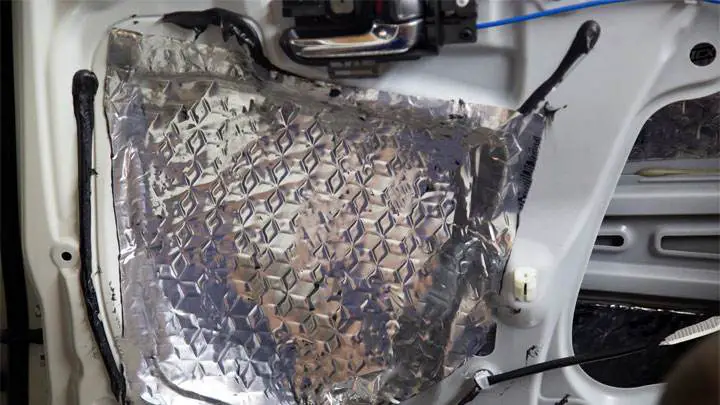
Get some sound-deadening mats like Dynamat. You can place them under your floor and behind the door panels of your doors to reduce outside noise (including wind).
Impact of Atmospheric Pressure
When you’re driving down the road, the air pressure outside your car is lower than inside your car. This is because you have a constant volume (more or less) of air particles inside your vehicle, so it has constant pressure.
The air outside your car has much more space to move around, and the air pressure is constantly changing, but overall, it’s lower.
Most vehicles are equipped with vents to equalize the pressure between the inside and outside of your vehicle. These vents are one of the causes of wind noise because to equalize the air pressure, air has to pass through these vents.
Acoustic or Non-Acoustic Windshield
Well, I learned something new today: acoustic glass exists.
According to Custom Glass Solutions:
“Acoustic glass is made by laminating two pieces of glass with a sound-deadening PVB (Polyvinyl Butyral) membrane. The membrane absorbs high-frequency sound waves so they are not transmitted through the glass into the vehicle’s cabin.”
It’s an interesting upgrade you could make to your car and might yield impressive results, but let’s dig a bit deeper, okay?
I found this from Windshield Experts:
“A recent advance in glass technology significantly reduces the amount of noise that reaches occupants. The acoustic windshield uses a specially developed acoustic vinyl sheet, sandwiched between two layers of glass. It reduces noise levels by 6 dB at specific frequencies and by 2 to 3 dB overall.”
These are fairly significant soundproofing benefits, and in real terms, that’s the difference between a motorcycle engine running loudly and a motorcycle engine running quietly.
Given that the average sound level inside your car is between 70 and 80 dB at highway speed, a saving of over 5 dB could have a considerable impact on your stress levels as well as your hearing loss on long trips.
This is from my own research from several different sources, so not just the sources above, as they also mentioned that acoustic glass could have ‘massive’ benefits for your fuel economy – which is by no means true.
A Note on Aerodynamics and Drag
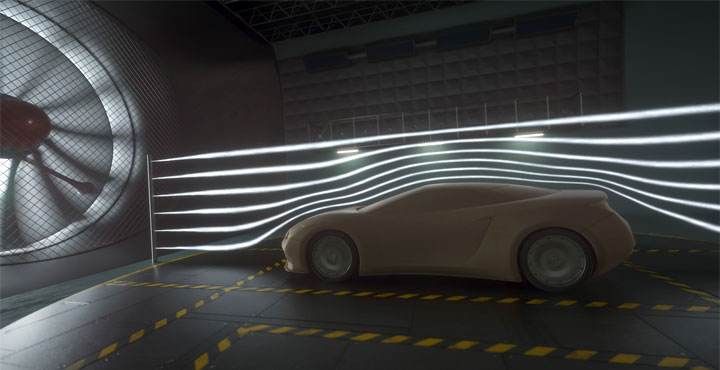
A sleek, smooth vehicle will move through the air better than a brick-like Volvo. If your car moves through the air with less resistance, it will cause less noise from the air having to change course as it moves around your car. So, if a quiet vehicle is one of your goals, be sure to check its ‘drag coefficient.’
For example, a driver’s 1984 Volvo 240 DL sedan has a frontal area of 22.0 ft^2 and a drag coefficient of 0.35 at 60 mph. Look at that. It’s a brick.
The 2023 Toyota Prius has a drag coefficient of 0.27. A Formula 1 car has a drag coefficient between 0.07 and 0.1. A motorcycle can go as low as 0.05.
This simply illustrates that, given the same test parameters (ignoring the motorcycle and open-cockpit F1 car), some cars move through the air better than others. This means if you choose a normal passenger car with a lower drag coefficient, it should be quieter than others.
The End?
Hey man, you wanted to learn more about wind noise in your vehicle. But if you’ve reached the end of this article and just want to feel something, know that I understand. You are loved.