
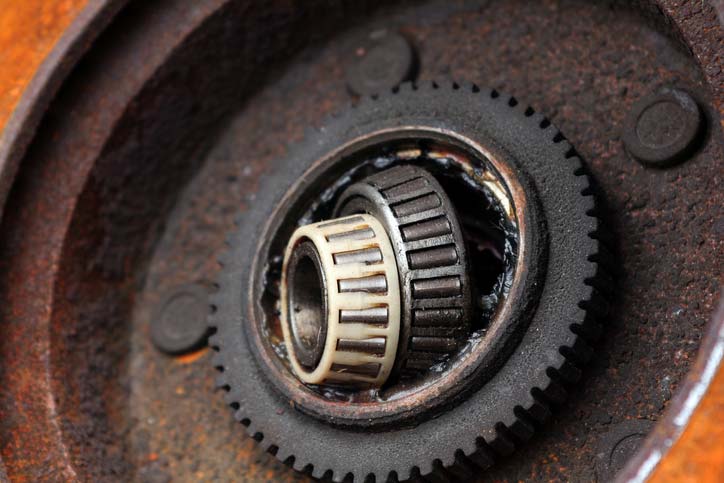
Wheel bearings are essential for the wheels to function harmoniously with the hub and tires. There is one bearing per wheel, and it is rare for all of them to fail at the same time. How to tell which wheel bearing is faulty?
Well, we will discuss how to discover the faulty one and what they actually do to keep the wheel assembly together.
What is a wheel bearing?
Before delving into the symptoms of a bad bearing and ways to identify which one is defective, you need to know what it is and its functions.
A wheel bearing is a metal ring housing a number of steel balls. The ring, called a race, fits into a hub, which is a hollow metal piece at the center of the wheels.
The hub rolls on a metal axle shaft to reduce friction when the wheels rotate. These ball bearings are the most common type in today’s vehicles. There are also ball bearings and precision roller bearings.
Wheel bearings support the entire weight of a vehicle and do not have a constant source of lubrication. For these reasons, they endure a lot of abuse and wear out over time.

How to tell which wheel bearing is faulty?
Every system in an automobile consists of several small components that must function and be integrated together for the car to run smoothly.
But like everything else, these parts are subject to abuse and show warning signs when they are about to fail.
Wheel bearings also exhibit certain symptoms when they cannot function fully and are about to fail. But how to tell which wheel bearing is faulty: front or rear?
All types of wheel bearings show similar symptoms when failing. Here is how to tell which wheel bearing is faulty:
Pay attention to noises
A grinding noise coming from the tires indicates overused bearings that do not have enough lubrication to prevent the grinding friction between metal parts.
The noise intensifies when the vehicle accelerates and it comes from either the front or the rear, indicating the position of the bad bearing.
Sometimes it can be a rumbling when you drive on a straight road and it intensifies once you make a turn. Here is how to tell which wheel bearing is faulty when turning, as the opposite side of the turn is the affected area.
A click also requires attention, as it likely comes from a broken bearing in the hub.
If a bearing is the cause, the noise rotates faster with acceleration. To identify which bearing is responsible, slow down the car and gently sway it.
If the click is muffled when you move to the left, it is likely that the right wheel bearing is broken.
Check the tires.
The condition of the tires is another simple way to tell if there is a problem with the bearings. If a tire wears unevenly, it is probably because the wheel bearing attached to it is damaged.
Tires will show signs of wear over time. It is completely normal for all of them to deteriorate at the same rate.
Wobbly wheels
Another symptom related to damaged bearings is a wobbly wheel. In this case, the car feels loose or you find the steering less responsive, to be precise, while driving.
When this happens, check each wheel by lifting the vehicle. If the wheel assembly moves back and forth, the wheel bearing attached to it is definitely damaged.
Unstable wheels can also be the result of other problems, such as broken suspension or a misaligned chassis. A mechanic can identify the exact reason by performing a road test.
Stiff wheels
Just like loose wheels, stiff wheels are another safety issue and indicate bad bearings. To find out which bearings are responsible, you need to lift the car with a jack and check the front and rear wheels.
Simply grab the tires and spin the wheels. A rotation without effort means they are fine, but if one of them is stiff, its bearing must be broken.
Pulling to one side when braking
Besides a faulty bearing, this problem can result from a number of faulty components, including damaged brakes, a worn rotor, a faulty equalizer, or a broken rotor.
However, if the cause is a broken bearing, it will eventually lead to loose brakes. Whenever you brake, the car acts as if it has a mind of its own and pulls in a specific direction. Examine the bearings on the side towards which the vehicle pulls.
FAQ
- Can a bad wheel bearing cause other problems if not replaced?
Yes, a bad wheel bearing can lead to bigger problems if not replaced promptly. These include:
- Damage to the wheel hub assembly.
- Uneven tire wear, which can affect handling and traction.
- Increased stress on other suspension components.
- Safety issues as it can lead to loss of control in extreme cases.
- Is it difficult to replace a wheel bearing?
Replacing a wheel bearing can vary in difficulty depending on the make and model of your vehicle. Some bearings are relatively easy to replace, while others may require specialized tools and knowledge.
It is recommended to entrust the job to a qualified mechanic if you are not sure about your DIY skills.
- Are there maintenance tips to avoid wheel bearing problems?
- Even though wheel bearings wear out over time, you can extend their lifespan by:
- Keeping your wheels properly aligned and balanced.
- Regularly inspecting and lubricating the wheel bearings according to your vehicle’s maintenance schedule.
- Avoiding overloading your vehicle beyond its weight capacity.
- How much does it cost to replace a wheel bearing?
The cost of replacing a wheel bearing varies depending on factors such as the vehicle’s make and model, labor costs in your area, and whether you use original or aftermarket parts. On average, it can cost between $100 and $600 per wheel.
- Can I drive with a bad wheel bearing?
It is not recommended to drive with a bad wheel bearing. Continuing to drive with a faulty wheel bearing can lead to safety risks, further damage to your vehicle, and more expensive repairs.
- How long does a wheel bearing typically last?
The lifespan of a wheel bearing varies, but it typically lasts between 85,000 and 100,000 miles (137,000 to 161,000 kilometers) or more under normal conditions. However, factors such as driving habits and road conditions can affect their longevity.
- Can I replace just one wheel bearing if it’s faulty, or should I replace both sides?
While it is not mandatory to replace both wheel bearings at the same time, it is often recommended to do so. If one wheel bearing is faulty, the other may not be far behind in terms of wear. Replacing both can help ensure uniform performance and safety.
Remember that if you suspect a bad wheel bearing, it is essential to have it inspected and replaced by a qualified mechanic to maintain your vehicle’s safety and performance.
I hope you now know how to tell which wheel bearing is faulty. Just detect the symptom and perform a simple task to find out which bearing is at fault.