

Is it possible to grease your car’s CV joint without removing the boots? And if it is possible, what are the steps to follow to grease CV joints without removing the boots? In this article, I will address all the following questions:
How to add grease to a CV joint? Can you over-grease a CV joint?
What kills CV joints? Can you use white lithium grease on CV joints? Why do CV joints need special greases? What is lithium complex grease for CV joints? Is white lithium grease better than silicone grease? And finally, where should you not use lithium grease?
Overview of the CV Joint.
The CV joint of your vehicle serves as a crucial interaction center between its transmission and the drive wheels of your vehicle, which is an indispensable link. Each drive wheel has its own pair of CV joints: the outer CV joints provide strong connections between the wheel and the axle, while the inner joints establish reliable communications between the transmission and the axle, ensuring that your speed remains unchanged even in response to unexpected potholes!
An elegant rubber boot is normally used to cover the CV joints, thus helping to provide additional protection to these critical joints.
Note that CV joints involve metal-on-metal contact, and it will be useful to keep things smooth by greasing them regularly, which is essential for maintaining their groove smoothly and reducing friction and wear.
What is a CV joint and its function?
By definition, a CV joint, which is the abbreviated form of constant velocity joint, is what ensures a constant speed for your vehicle. They connect the drive wheels to the transmissions, with two such joints on each axle: an inner joint connecting the transmission to the axle, while another connects the axle and the wheel.
CV joints play an essential role in maintaining constant wheel speeds when you encounter uneven terrain or obstacles such as potholes, by ensuring the linkage between two rotating shafts so that they work together rather than against each other due to poor lubrication.
How to grease a CV joint without removing them
So, steps to grease the CV joints without detaching or removing the bolt.
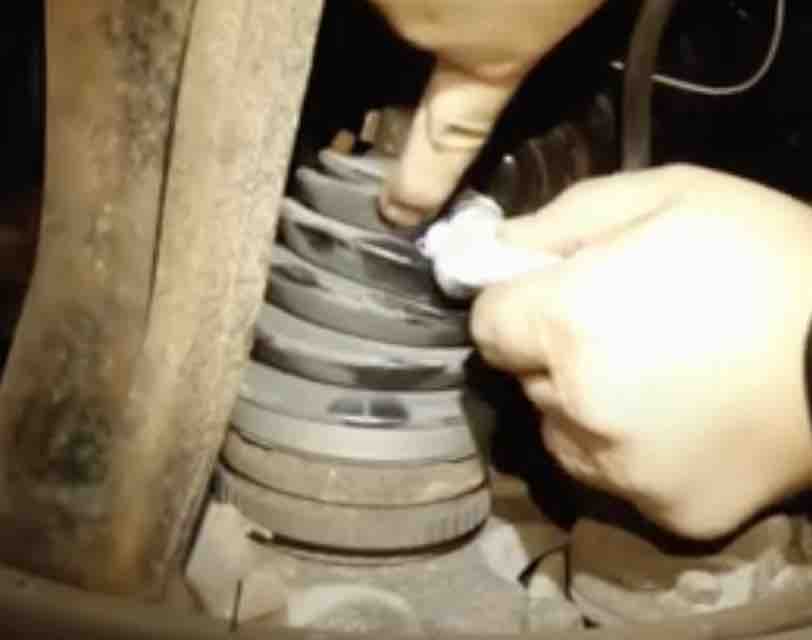
To add grease to a CV joint without disassembling its boot, you generally need to use a grease needle or a needle adapter that pierces and drills a hole in its housing.
First and foremost, you need to buy a grease needle, and you can buy a grease needle at almost any auto parts store at relatively affordable prices, designed to attach directly to standard grease guns. or you can get it here
Steps to grease a CV joint without removing the boot
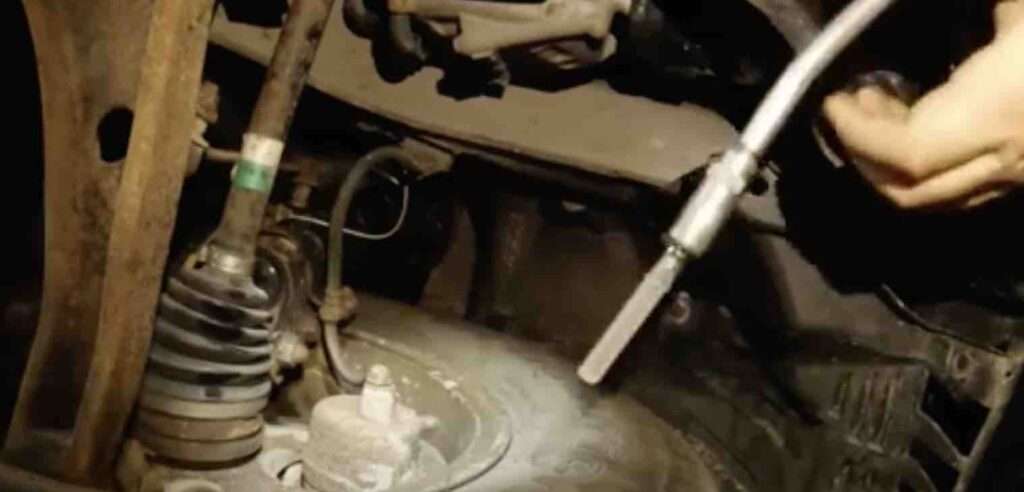
Your safety must always come first, which means lifting the vehicle sufficiently on two jacks to leave enough space underneath for you to pass without any obstruction.
Now here are the steps to grease a CV joint
- Start by unbolting and removing the tire, leaving only its hub intact.
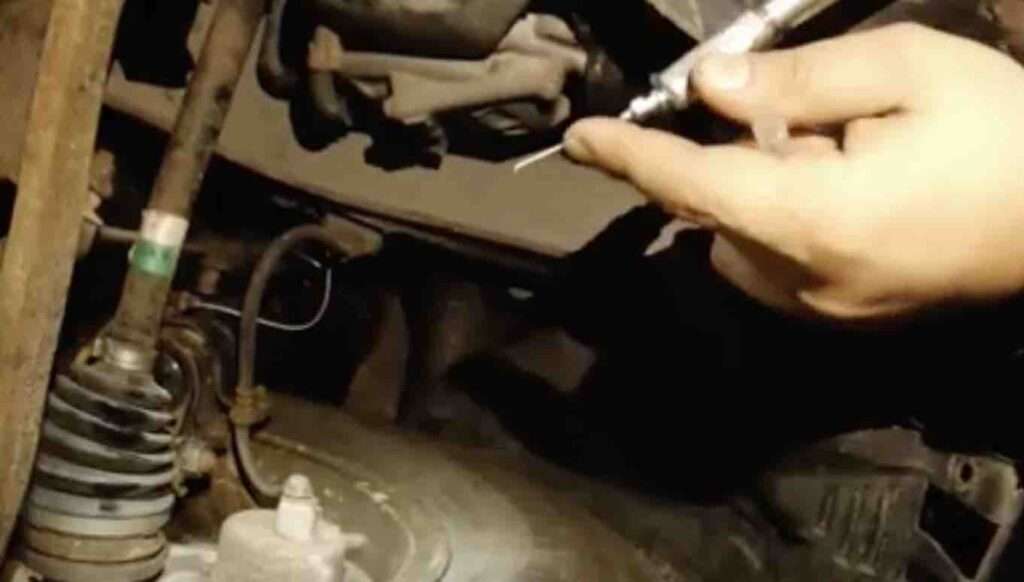
- Next, you need to move the steering wheel away from the steering system, which is outward, to reveal your car’s CV joint.
- Now, you need to get a grease gun with a pointed or narrow tip. Drill a starting hole in the CV joint using the grease gun before injecting grease into the joint.
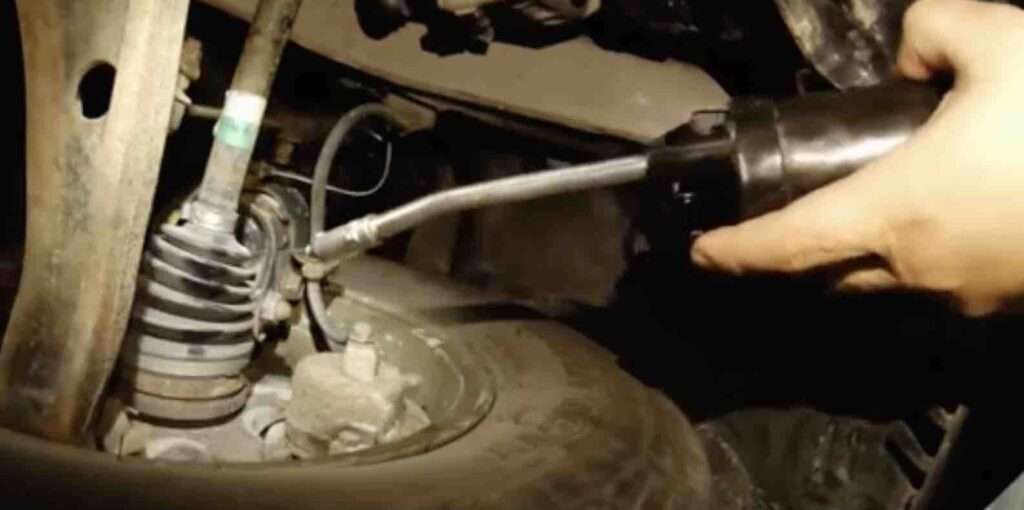
- Locate and seal all holes caused by the grease gun with super glue after applying the appropriate amount of grease to the CV joint.
- Reassemble all remaining parts of the vehicle’s wheel and clean them thoroughly with soapy water.
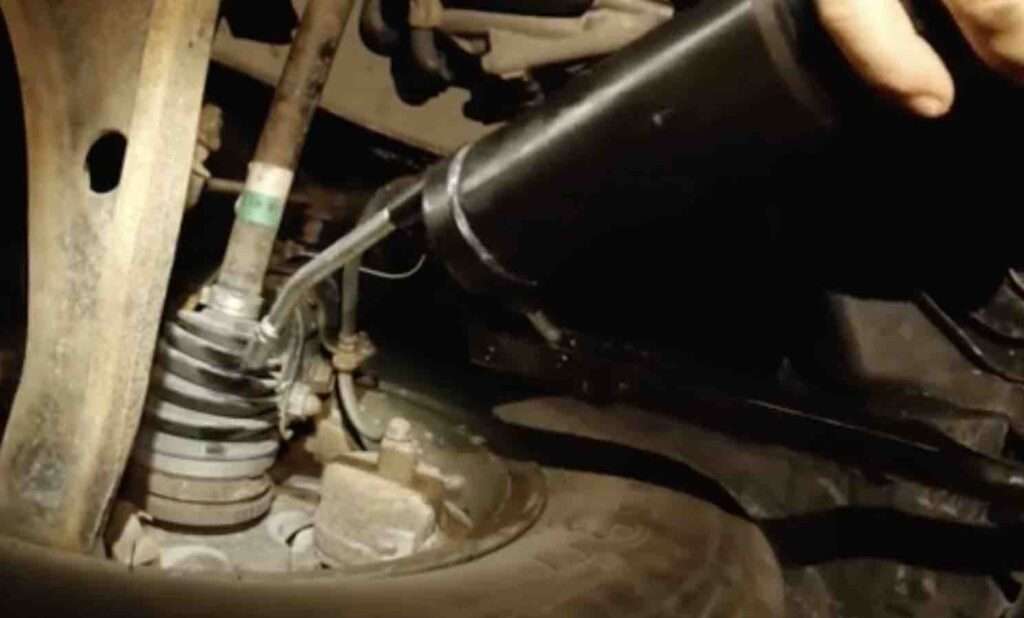
- Repeat steps 2 to 6 with all remaining drive wheels.
- Reattach the tires and lower the jacks.
So, basically, that’s how you grease a CV joint without removing the boot.
And now, what about CV joints depleted of grease? What happens if CV joints lack grease?
What happens if CV joints lack grease?
Without enough grease in their CV joints, the rotating shafts start rubbing against each other while accelerating wear of all kinds and noise levels. You may notice increasing wear on tires and brake pads, leading to the dislodging of moving wheels, making the car unusable and requiring either towing services or immediate on-site repair.
However, before the CV joints reach this critical phase, CV joints usually emit warning signals, such as an audible click every time you turn your steering wheel.
Cover your battery terminals with dielectric grease:
Applying dielectric grease is an ideal way to combat corrosion on battery terminals. Dielectric grease does not conduct electricity and remains pliable over an extended period, and its incredibly high melting point ensures that even small amounts applied will last over time.
Placing dielectric grease on battery terminals: Before covering the battery terminals with dielectric grease, make sure their wires are connected. Dielectric grease acts as a vapor barrier between the dielectric grease and your terminals and corrosion. Petroleum jelly can be an acceptable substitute. But most types of grease also protect against corrosion.
Replacing silicone grease with dielectric grease: Yes, silicone grease is an excellent alternative for battery terminals due to its extremely high melting point. It remains stable under high temperatures or summer heat without running – its temperature range extends from -40°F to 400°F!
Ordinary grease as an alternative to dielectric? Even though conventional grease like petroleum jelly can work very well as an alternative dielectric material, its low melting point requires frequent applications as a preventive measure.
Dielectric grease and silicone grease, what is the difference?
Dielectric and silicone greases vary considerably in several aspects. Formally speaking, their forms differ considerably; dielectric grease is translucent to seal electrical conductors while protecting them from dirt, sand, dust, debris, etc. In contrast, silicone grease, produced by mixing thickeners with silicone oils, offers ideal water resistance for protecting rubber parts from dirt.
Dielectric grease tends to be more expensive than silicone grease due to its wide range of applications. Although both are non-conductive, dielectric remains flexible while silicone eventually hardens.
Silicone grease is significantly thicker than dielectric grease; both varieties have high melting points.
FAQ
Can you over-grease a CV joint?
Yes, over-greasing CV joints can increase pressure, thus causing the CV joint boot to rupture and release grease into the joint from external sources; allowing contaminants and dirt particles to enter and damage it further.
What grease is best for CV joints?
Greases enriched with molybdenum disulfide (moly) tend to be the preferred choice when selecting the best grease for CV joints due to their superior resistance to high temperatures and extreme pressure, making them essential components in CV joint environments.
What kills CV joints?
What causes damage to CV joints? CV joints can be compromised by a lack of lubrication due to torn starting parts, by contamination from dirt and debris, or by a lack of regular maintenance, ultimately leading to wear and possible joint failure.
Can you use white lithium grease on CV joints?
White lithium grease is generally not recommended as an ideal lubricant for CV joints due to its inefficient performance in high-pressure environments; Moly-enriched grease specifically designed to withstand CV joint environments is usually best.
Why do CV joints need special greases?
CV joints require special grease because they operate under high pressure and high temperature. The special grease, such as moly-enriched grease, is designed to withstand these extreme conditions, ensuring proper lubrication and extending the life of the CV joints.
What is lithium complex grease for CV joints?
Lithium complex grease is a high-quality, versatile grease known for its tolerance to high temperatures and excellent water resistance. Although it can be used for various applications, it is generally not the first choice for CV joints.
Is white lithium grease better than silicone grease?
White lithium grease and silicone grease serve different purposes. Lithium grease is excellent for metal-on-metal applications due to its high performance. In contrast, silicone grease is ideal for plastic and rubber components as it does not cause swelling or deformation.
Where should you not use lithium grease?
Avoid using lithium grease on components that come into contact with rubber and certain plastics, as it could cause them to swell or deform. Always refer to the manufacturer’s instructions for specific applications.
To lubricate a CV joint, first lift your vehicle using a jack, remove its tire, turn outward and easily access its joint, make a hole using the pointed tool in the rubber boot, then inject grease through it directly into the joint, then seal the hole with super glue.