
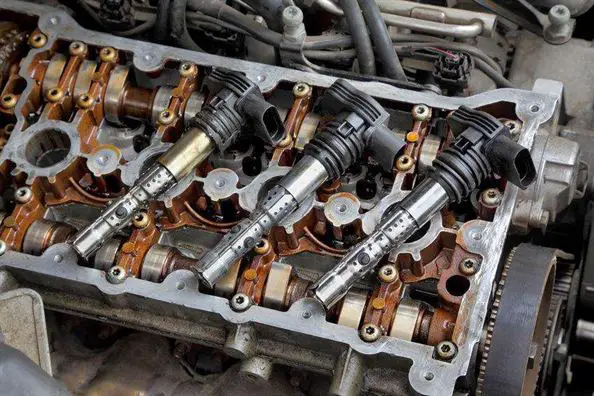
The ignition coil pack plays a major role in starting the car and keeps the engine running without any problems. The engine spark plug requires high voltage to create a spark and start the combustion process. The coil pack does the job of producing the required high voltage. The engine will not start and your car will not run properly if there is a problem with this component. Therefore, you must be aware of the bad ignition coil pack symptoms, as any problem will lead to engine performance issues.
What is a Coil Pack?
A coil pack is an electronic device integrated into the ignition system. This electronically controlled pack consists of ignition coils controlled by the car’s main computer. The main function of the coil pack is to increase and build the necessary energy, and then release the voltage through the spark plug wires. When the energy reaches the spark plugs, it starts the combustion process.

Reading here, many drivers will ask the question: Are ignition coils and coil packs the same thing? “ Our answer is “No.” Coil packs and ignition coils are not the same thing in a car, although they serve a similar purpose.
An ignition coil is a component of the ignition system that transforms the low voltage from the battery into the high voltage needed to create an electrical spark in the spark plugs. Typically, a vehicle with a traditional distributor-based ignition system will have one ignition coil, which generates the high voltage for all the spark plugs.
On the other hand, a coil pack (also known as an ignition coil module) is a component found in vehicles equipped with a Distributorless Ignition System (DIS) or a Coil-On-Plug (COP) system. In these systems, each cylinder has its own ignition coil, and the coil packs are usually mounted directly on or near the spark plugs. This configuration eliminates the need for a distributor and allows for more precise control of ignition timing.
In newer car models. The coil pack replaces the distributor. This is generally because the coil pack is more reliable and consistent than the distributor. Furthermore, the coil pack provides a better spark, which leads to more efficient and faster combustion, as well as higher power.
Symptoms of a Bad Coil Pack That You Should Not Ignore
Your car will not run properly if there is a problem with the coil pack. The usual signs of a bad coil pack are the answer to the question of whether the coil pack is bad.
- The car engine makes louder noises than usual
- The engine idles roughly
- Flames coming from the carburetor
- Backfire
- Flashing check engine light
- A drop in RPM during acceleration
- Gasoline smell blowing from the exhaust
- The check engine light comes on
- The car won’t start
1. Engine Misfires
Engine misfires are one of the symptoms of a bad coil pack. Trying to start the engine of such a vehicle will result in engine misfires that sound like a coughing and sputtering noise. When driving at high speed, shaking and sputtering will be visible in the vehicle’s behavior. A vehicle with a faulty ignition coil will also cause vibrations when idling at a stop sign or traffic light.

2. The Engine Idles Roughly
Another symptom of a weak coil pack is rough engine idling. You feel like your vehicle is lacking power when you are driving. Rough idling is what happens when the coil pack deteriorates, so you should repair it right after finding this symptom.
3. Backfire
Backfires caused by your vehicle can indicate the symptoms of a failing ignition coil in its early stages. A car backfire occurs when unused fuel in the engine’s combustion cylinders escapes through the exhaust pipe. If this issue is not checked and resolved, costly repairs can result. If your car backfires, you will notice black smoke being emitted from the exhaust pipe.
4. Exhaust Smoke Comes Out
Symptoms of a bad coil pack can also be determined by the exhaust smoke that escapes when the vehicle is running. The smoke comes out intermittently instead of a regular, normal flow.
5. A Drop in RPM During Acceleration
If you have a faulty coil pack, a drop in RPM during acceleration can occur. It can be determined by watching the RPM gauge while driving. During acceleration, the check engine light comes on intermittently or flashes.
6. Reduced Fuel Economy
If your ignition coil is not delivering enough power to your car’s spark plugs, your vehicle will have to burn and use extra fuel. This is the only way for the vehicle to keep running: by burning the extra and residual fuel. If your car has very low and well below normal gas mileage, you might have coil problems.
7. The Check Engine Light Comes On
So, how to check for a bad coil pack? You can check the check engine light! Usually, the check engine light comes on on your dashboard and the engine code is P0351 when scanned using a car diagnostic tool. The easiest way to detect ignition coil pack symptoms is to scan the error code. So, by seeing the error code, you can check the check engine light and determine what the coil pack problem is.
8. The Car Won’t Start
The car not starting is also one of the symptoms of a bad coil pack. If you try to start your car and it doesn’t seem to start, it’s possible that your car has a problem with the coil pack.
How to Diagnose a Faulty Coil Pack
Ignition coils are reliable but they can fail for various reasons such as vibrations and extreme heat. However, voltage overload caused by faulty spark plug wires or spark plugs is the most common reason for their failure.
If you notice any of the symptoms of a bad coil pack, you need to diagnose them to see if they have problems. A few methods for testing a coil pack have been described below:
Use an Ohmmeter
You need to measure the primary and secondary resistance of the coil to know if it is fully functional, and you need to use an ohmmeter to do this.
Connect the ohmmeter to the high voltage output terminal and the positive (+) terminal to measure the secondary resistance. A reading between 6,000 and 8,000 ohms is normal if the coil is new, while some coils may read over 15,000 ohms.
Measure the secondary resistance by connecting the ohmmeter to the high voltage output terminal and the positive (+) terminal. A reading between 6,000 and 8,000 ohms is normal if the coil is new, while some coils may read over 15,000 ohms.
Two other ways to test resistance are to use either an inexpensive spark tester available at most auto parts stores, or an ignition coil bench tester available at auto repair shops.
Whichever method you apply, never try to remove the high voltage output wire or a spark plug wire to test for a spark. An open wire is risky as it can cause a severe shock. Furthermore, suddenly disconnecting the wire can damage the coil by increasing the voltage demand. So, when you detect symptoms of a bad coil pack, follow a proper method to test the coil’s resistance.
Summary
The 8 symptoms above are the symptoms of a bad coil pack. You can check your car; if your car exhibits one or more symptoms, your car may have a faulty coil pack. Take your car to a mechanic to diagnose your car and perform the repair if necessary.