
You just bought a Tesla car. Congratulations! You are now the happy owner of one of the most efficient and reliable electric cars on the market today. But you have also entered the exclusive club of car owners who need to recharge their vehicle. How much does it cost to charge a Tesla?
The answer is not as simple as one might think! Many factors contribute to the cost of charging an electric car, and they vary depending on the type of charger you use, the car you drive, how often you drive your car, and other factors.
Key Factors for Charging a Tesla
You want to charge your Tesla, but you don’t know how much it will cost you? Well, worry no more! Here is a breakdown of the factors that contribute to the total charging price.
Types of Chargers
First, what type of charger are you using? There are three different types: Level 1 AC charging (the universal charging option), Level 2 AC charging (found in homes), and a Tesla Supercharger.
A Level 1 charging station with a standard outlet uses a 110 to 120 V power supply and provides between 7.5 amps and 15 amps of electrical juice to your car. This type of charging is the slowest way to recharge your Tesla. The average time for a full charge with this method can take even a few days if you are charging a long-range car like the Tesla Model 3. Charging time can vary depending on the distance driven each day.
A Level 2 AC charge involves plugging into an outlet at your home or office that uses 220-240 V of electrical charge and offers about 40 to 50 amps of power. This is the most common type of charging and can take from 7 to 12 hours, depending on how much you drive/recharge each day.
Finally, there are Tesla Superchargers, which use a huge electrical power of 480 V or more. However, they also provide electrical power about ten times that of the Level 1 charger. With an output of over 100 amps, it is possible to refill 200 miles (about 322 km) in 15 minutes.
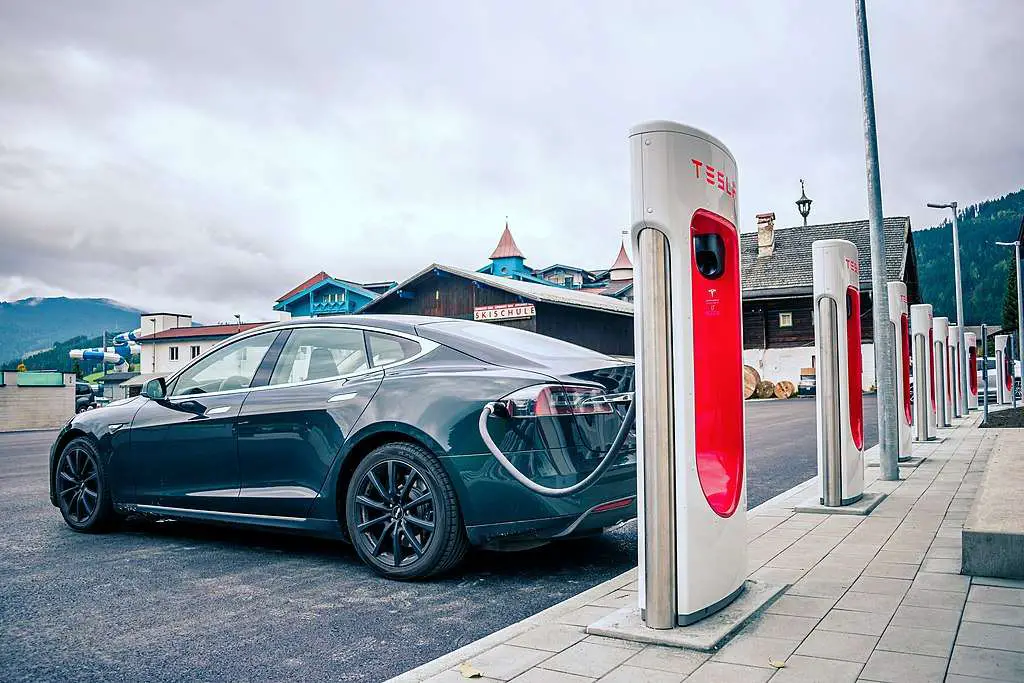
For daily charging, the Level 2 charging option is the most suitable as you can perform a full charge by leaving the car plugged in overnight. Superchargers are recommended only for a quick boost when you are taking a long car trip.
Some Other Factors
How much does it cost to charge a Tesla? Well, it will also depend on whether you are going to recharge the battery from 0 to 100%. It will take much more energy to recharge a completely discharged battery. Additionally, the battery tends to consume more energy as it approaches its full capacity.
AC chargers are less efficient than DC chargers. For this reason, Superchargers cost less than Level 1 and 2 charging stations.
How Much Does It Cost to Charge a Tesla Car?
Let’s find out the estimated charging cost of your Tesla car for different types of chargers. We will discuss charging costs with an AC and DC charger.
Home or Residential Chargers
The cost of residential energy in the United States is $0.1399/kWh, but we will round it to $0.14 for easier calculation.
The Model S has a 100 kWh battery, so it will cost $14 to fully charge the battery from 0 to 100%, right? Well, the calculation is not that simple. No AC charging station, whether Level 1 or Level 2, offers 100% efficiency. So, if the average efficiency of these chargers is 85%, you need to add 15% additional energy cost to this price.
The total cost for a full battery charge will be about $16.47. However, the original cost will be a bit lower because it is unlikely that you will charge the battery from 0 to 100%.
The Model S has two versions: Plaid and Long Range, which have an estimated range of 396 miles and 405 miles, respectively. So, you need to pay $0.042 per mile for the Plaid and $0.041 per mile for the Long Range.
Tesla Superchargers
How much does it cost to charge a Tesla with a Supercharger? In the United States, the price of commercial energy is cheaper than household prices. But Tesla charges more than this rate for its Supercharger network.
By adding an extra $0.10/kWh to the country’s average energy price (based on EIA data), the estimated unit price in the network becomes $0.216. For easier calculation, we will round it to $0.22 per kWh.
Superchargers do not lose much energy during the process of transferring from the source to the battery. Their estimated efficiency is about 95%, so there will not be much additional energy cost.
For a Model S car, you need to spend $22 for a full charge. However, it will be $23.10 by adding the 5% energy loss cost. For the Plaid version, $0.058 and $0.057 for the Long Range version per mile.
Conclusion
How much does it cost to charge a Tesla? It is not difficult to know if you are aware of the energy rate, battery capacity, state of charge, and a few other factors.