
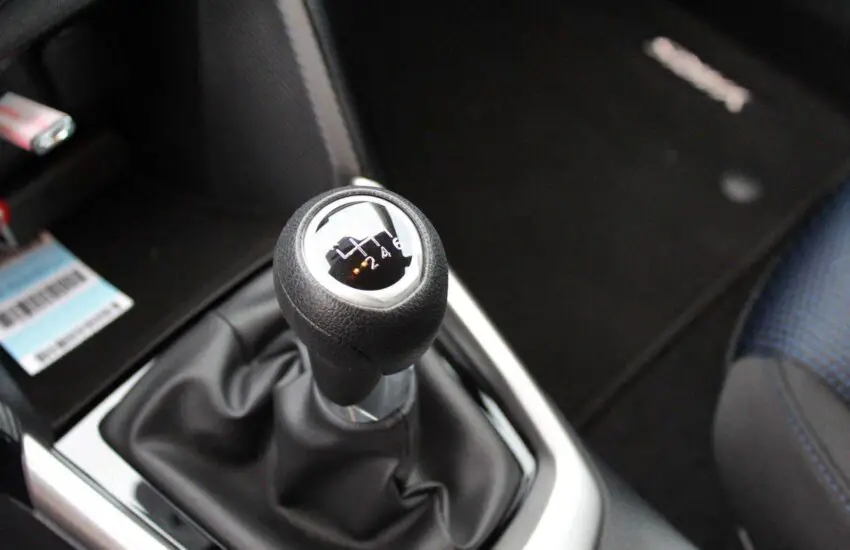
If you drive a manual transmission car, many questions will come to mind, such as “How does a manual transmission work?”, “What moves inside the manual transmission when you shift the gear lever?”.
In this article, we will answer all questions related to the manual transmission and give you a basic knowledge of every essential component of your car’s transmission. Let’s go!
What is a Manual Transmission? (Gear Shift Lever)
Before discovering the answer to the question “How does a manual transmission work?“, you need to understand what a manual transmission is.
The manual transmission, a gear lever or manual gearbox or standard transmission, is a type of transmission where the driver uses a lever to change gears literally.
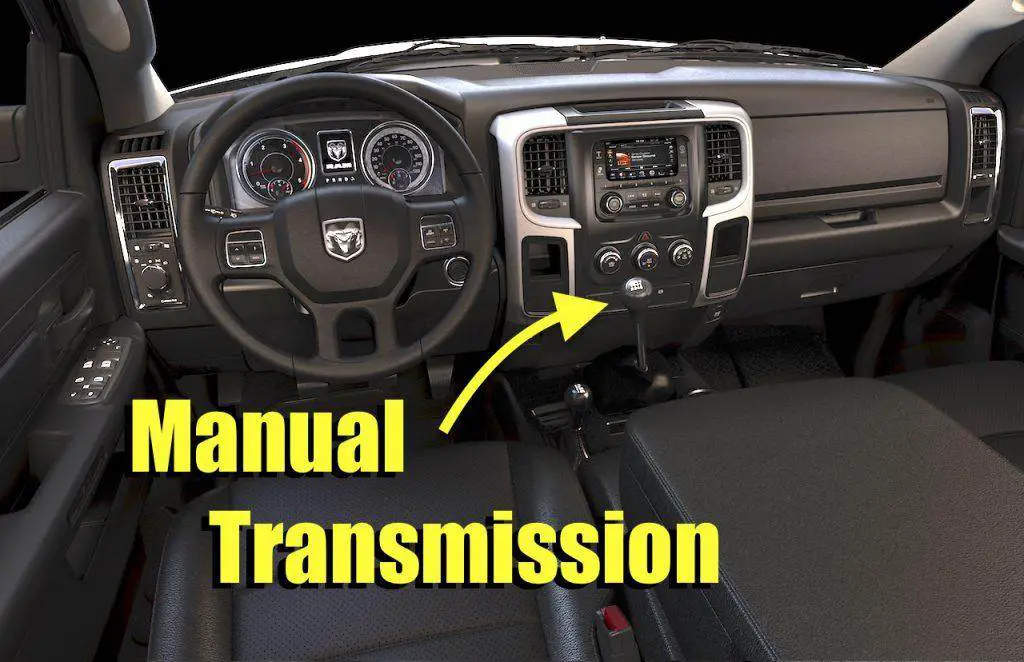
In the past, manual cars were often equipped with a gear lever or a steering column mounted on the dashboard, but nowadays, in modern vehicles, the gear lever is mounted vertically in the center console and connected to the transmission via linkage.
Shifting gears requires disengaging the clutch disc (which is located between the transmission and the engine) via a third pedal located to the left of the brake. Then release the clutch, select the desired gear, and engage the clutch again.
When stopped, the disc will wear out prematurely if the driver engages the clutch too slowly. And if the driver engages the clutch too quickly, the engine will stall.
Learning how to drive a manual car takes more time than learning how to drive an automatic car, but it’s more fun and easier than it seems.
When you drive a manual transmission car, you will feel that there is a connection between you and your car that is too difficult to replicate with an automatic transmission car.
And another interesting thing is that if you can use a manual transmission, you will be able to drive any type of vehicle. Normally, a basic vehicle is equipped with a 5-speed manual transmission. In more expensive vehicles, a 6-speed transmission is equipped instead.
Various Parts of the Manual Transmission
These brief descriptions of the parts of a manual transmission will help you understand its complex operation.
1. Clutch and Clutch Pedal
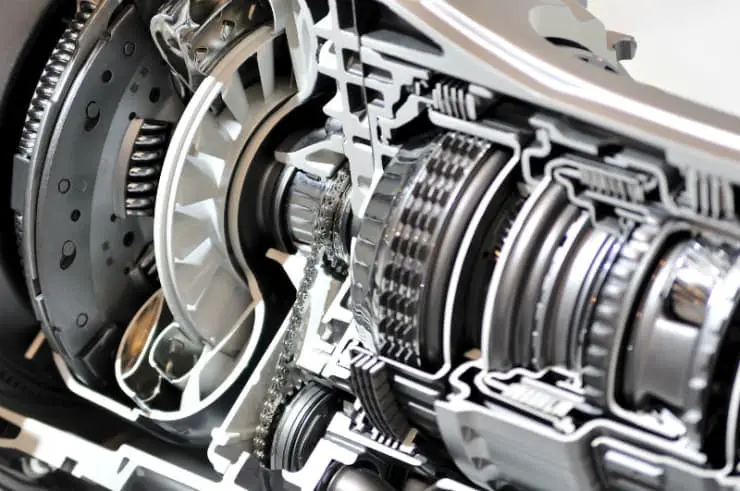
Composed of various small components, the clutch transmits engine torque to the transmission. The clutch pedal is a hydraulically operated gear that disengages the clutch when you press it.
2. Flywheel
The circular mass sends engine torque to the clutch disc which interacts with a smooth surface of the wheel.
3. Selector Fork and Collar
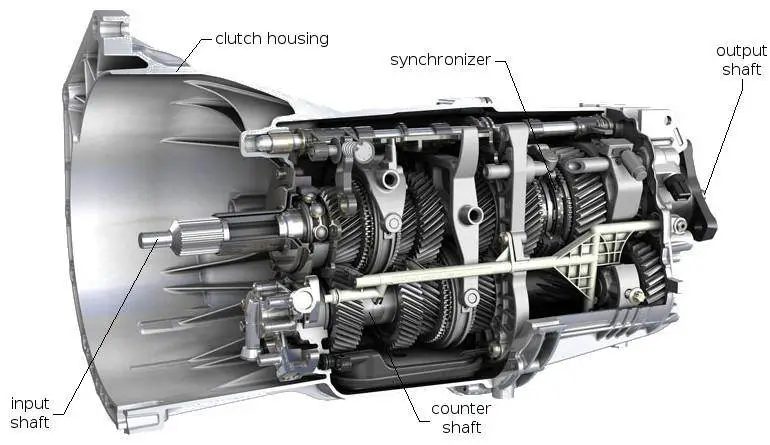
This is an arm-shaped gear that helps move the collars along the output shaft. On the other hand, you can select different gears with the collar by locking it onto a particular gear, resulting in the transmission of torque to the output shaft from the countershaft.
4. Synchronizers
These help the gear and the collar to engage with each other and match their speed if there is a difference.
5. Countershaft and Output Shaft
The gears on the countershaft mesh with the gears on the output shaft when the former receives power from the engine.
6. Gears
You will find gears of different sizes in a manual gearbox. The larger ones have more teeth and provide more torque to reduce the car’s speed, while the smaller ones produce less torque so your vehicle can travel at high speed.
How Does a Manual Transmission Work?
So, with all your new knowledge, let’s find out what happens when you shift gears in your manual car and see how the manual transmission works.
- You must press the clutch pedal to disengage before turning the vehicle key to start. This will cut the power between the transmission and the engine’s input shaft. As a result, the engine will be alive without powering the entire vehicle.
- Move the gear lever to first gear, which is located on the output shaft, so that the shift fork moves forward towards the latter. The first gear is connected to a countershaft gear. The countershaft, meanwhile, is connected to the engine’s input shaft via another gear.
- There is a synchronizer collar attached to the shift fork. This helps the driving gear carry power to the output shaft and synchronize their speeds if there is a difference. You engage the vehicle when this collar locks with the first gear, which is securely fixed to the output shaft.
- Now, apply light pressure to the accelerator pedal and remove your foot from the clutch. It will reconnect the engine to the gearbox. Then the vehicle will start moving forward.
- Shift to second gear after pressing the clutch to go faster. This will disconnect the power between the engine and the gearbox. You just need to repeat this process to change gears in order to slow down or speed up the car.
Watch the video below to better understand how a manual transmission works!
Car Manual Transmission System FAQ
- How long do manual transmissions last?
You should expect the manual transmission components to last for more than 120,000 miles with good driving, proper use, and maintenance.
You can extend the life of your transmission by monitoring for transmission leaks and operating the clutch and gears correctly.
- How often should a manual gearbox be replaced?
Manual transmissions can fail much earlier, especially if basic maintenance is neglected.
If your gearbox has over 80,000 miles, it may be in your financial interest to replace it rather than pay hundreds of dollars in repairs every few months.
- What are the disadvantages of a manual transmission?
- In heavy traffic, a manual can become tiring.
- The learning curve is really steep.
- On slopes, careful control is needed to avoid stalling or rolling back.
- It can be difficult to find a manual for higher trim levels.
- Are manuals cheaper to maintain?
Manual transmissions are less expensive to maintain. With all the additional equipment that goes into an automatic gearbox, it can end up costing you a lot just to keep it running properly.
Manual transmission automobiles require extremely less maintenance, and maintenance and repairs are often much less expensive.
- Is it cheaper to buy a manual or an automatic?
Due to their basic mechanism, manual transmission automobiles are cheaper initially. It takes more complex technology and parts for an automated car to shift gears by itself.
In conclusion, I hope that through this article, you know the answer to the question “How does a manual transmission work?“.