
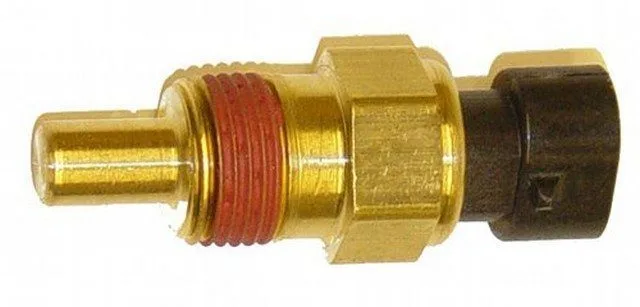
ECT Sensor (Coolant Temperature): Operation and Troubleshooting
The ECT sensor (Engine Coolant Temperature), or coolant temperature sensor, is a key component of the engine management system. Installed in the engine block or cylinder head, it measures the coolant temperature in real time. This data is essential for optimizing engine performance, emissions, and safety.
ECT Sensor Operation
The ECT sensor is a thermistor, meaning an electrical resistor whose value varies with temperature:
- High temperature (hot engine) → Low resistance.
- Low temperature (cold engine) → High resistance.
The engine control module (PCM/ECM) sends a 5-volt reference voltage to the sensor. The sensor’s resistance then modifies the voltage returned to the PCM, which interprets it to:
- Adjust the air-fuel mixture.
- Activate the cooling fan.
- Control anti-pollution systems.
- Manage idle speed.
Examples of measured voltages (indicative values):
- Cold engine: < 0.5 V.
- Hot engine: ~ 4 V.
For precise values, consult the vehicle manual.
Technical Characteristics
- Wiring: Typically 2 wires (5V supply and signal return).
- Location: Near the cooling circuit (cylinder head, thermostat, etc.).
Difference Between ECT Sensor and Temperature Sender
The ECT sensor transmits data to the PCM/ECM, while the temperature sender (or sender unit) directly powers the dashboard gauge. These two components are distinct and should not be confused.
Common Failures and Error Codes
A malfunction of the ECT sensor or its circuit can trigger diagnostic trouble codes (DTCs), including:
- P0115: Faulty circuit.
- P0116/P0117/P0118: Value out of range (too low/high).
- P0119: Erratic signal.
- P0125 to P0128: Issues with temperature rise or calibration.
These faults can lead to:
- Over-fueling or under-fueling.
- Intermittent cooling fan activation.
- Increased pollutant emissions.
Notes
- Checking with an ohmmeter or multimeter is recommended to test the thermistor.
- Replacement often requires partial draining of the coolant.
- Always prioritize parts compatible with your vehicle model.
For accurate diagnostics, always refer to manufacturer-specific procedures and values.