

Internal combustion engines, as you well know, need fuel and air to operate. Fuel is stored in the fuel tank and must be replenished regularly. Air is abundantly supplied by the atmosphere around us and reaches us at sea level pressure of 14.7 lb/in².
This works very well, but that’s all the pressure you’ll get to push air into your engine. You’ll get even less (accompanied by equally reduced power) when climbing the Continental Divide over a high mountain pass in one of the many Western states.
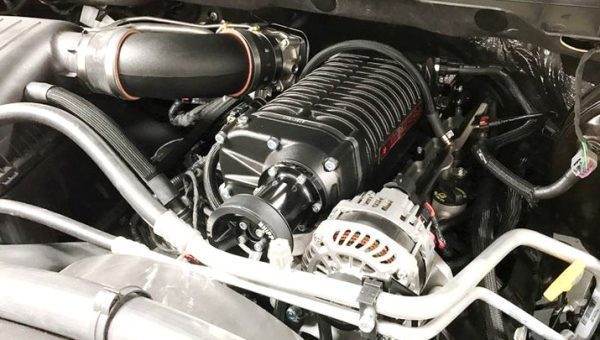
If only we could increase this pressure. If only we could cram more air into our vehicle’s engine along with more fuel. Ahhh. . . the supercharger. These remarkable devices can compress more air into your car’s engine intake system and, with the right amount of fuel, will thus increase engine power by 50 to 75 percent.
What is a supercharger? How did the supercharger (sometimes called a blower or compressor) come about? How many types of superchargers are there? Let’s answer these questions.
What Is a Supercharger?
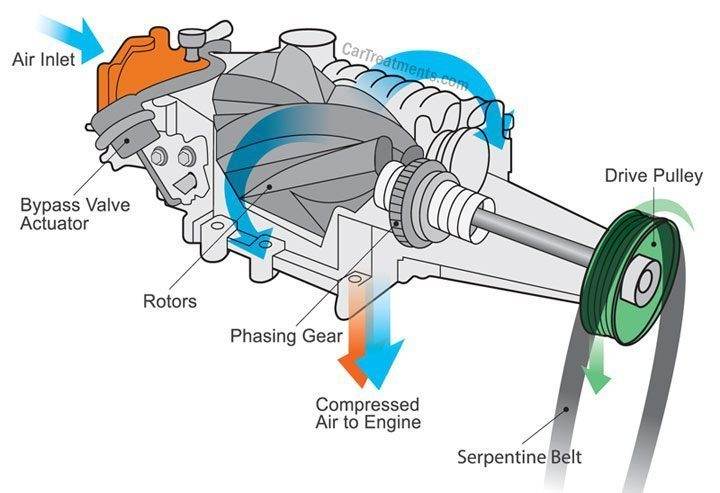
A supercharger is a device powered by an engine (or an electric motor) that increases the airflow to the engine, thereby increasing that engine’s power. Since the early stages of internal combustion engine development for powering automobiles, trucks, and yes, airplanes, superchargers have been part of the story.
The reason is quite obvious. Supercharging is a relatively simple way to significantly increase the power of almost any internal combustion engine design, whether they are two-stroke or four-stroke, gasoline or diesel. What practical engineer or enthusiastic car owner could resist such a temptation?
Let’s take a look at the types of superchargers, how they came about, and how they work to greatly increase airflow to an engine.
Types of Superchargers
#1 – Roots Blower
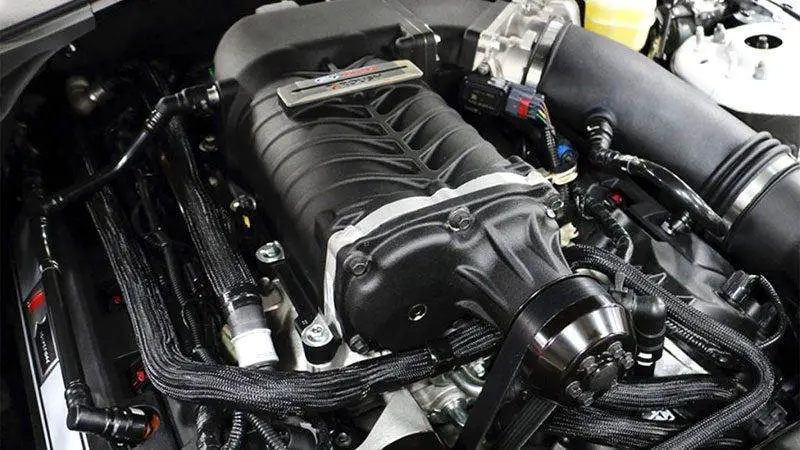
Let’s go back in history to a time when most people’s means of transportation required large four-legged animals for power. In 1860, the Roots brothers designed and patented a mechanical ventilation device intended for blast furnaces and several other applications. This was one of the first attempts to build a relatively efficient positive displacement blower.
It used two meshing three-lobed rotors mounted on a parallel shaft. It proved very effective at moving large volumes of air.
The Roots blower progressed rapidly and first appeared in an engine design patented by Gottlieb Daimler around 1885. Its use in production automobiles first occurred around 1921 with German luxury cars manufactured by Mercedes.
These early superchargers proved capable of adding up to 30 to 40% increase in engine power with few other changes to the engines of that era.
Daimler’s designs quickly became popular for street and racing vehicles. Mercedes, Alfa Romeo, and Bugatti come to mind for racing successes using this technology.
The Roots blower design was improved by General Motors (Detroit Diesel) primarily for two-stroke diesel truck engines in the late 1930s. These blowers were later often applied to automobile racing engines.
Such applications are still widespread today. At the drag strip, for example, it’s common to see dragsters using Roots-type superchargers perched on huge engines.
#2 – Screw Compressor
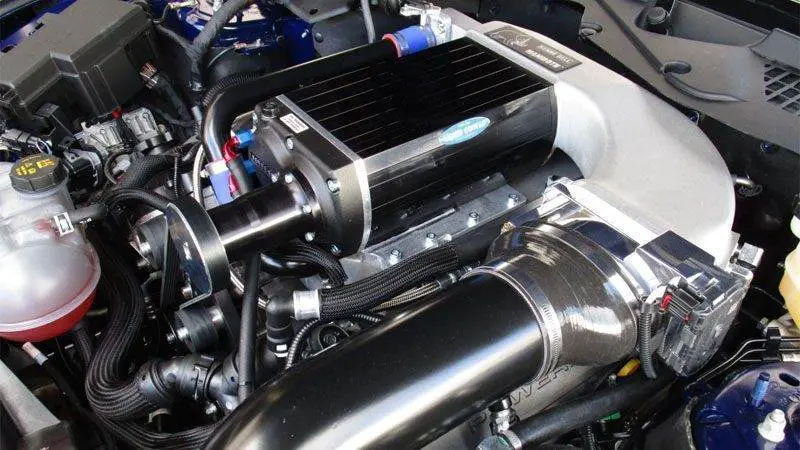
Following the path laid out by the Roots brothers, in 1878, German designer Heinrich Krigar patented the screw compressor. Similar to the Roots blower, it used two parallel shafts but was capable of producing a much higher pressure increase due to the screw shape of its rotors.
However, manufacturing complexity delayed its widespread industrial and automotive use for several decades.
A Swedish engineer, Alf Lysholm, in the mid-1930s, brought key manufacturing technologies that reduced the cost of the screw design. This type of compressor quickly found a niche in the air conditioning world and in other industries where highly efficient high-pressure outputs were required.
In the automotive world, screw compressors are sometimes referred to today as twin-screw superchargers.
#3 – Centrifugal Supercharger
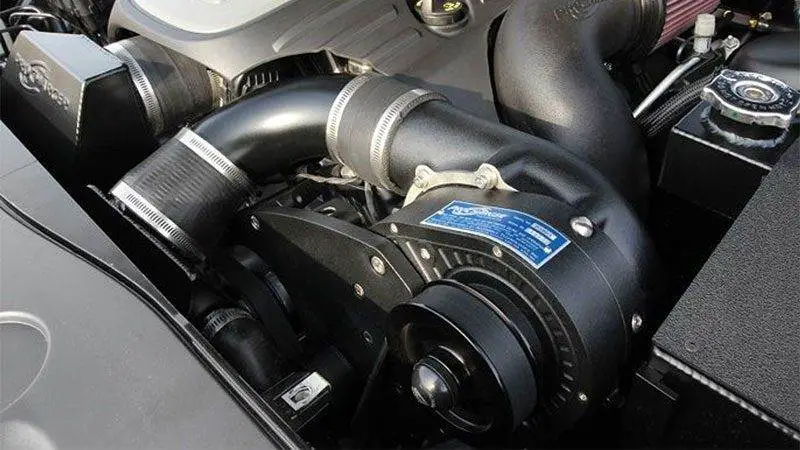
The third type of supercharger is the centrifugal. In the early 1900s, French designer Louis Renault patented the first centrifugal supercharger for automotive use. Within about three years, American race car builder Lee Chadwick took Renault’s design, stacked three stages (three rotors), and began a successful career racing powerful hill climb race cars.
Today’s centrifugal superchargers use only a single impeller with complex curved blades mounted inside a volute-shaped housing. Air enters the impeller near the center of the housing. The rotating impeller slings it to the outer passage of the housing while increasing the air’s velocity.
The air is then routed through a diffuser of increasing diameter which slows the flow and increases the pressure. This high-pressure air is then forced through the induction system to the engine.
A major advantage of this type of supercharger is its relative simplicity. It essentially has one moving part, the impeller. The impeller spins inside a housing with relatively large clearances, making its manufacturing cost reasonably low.
All these types of superchargers are directly driven by the engine. Using a gear drive system or a much simpler belt drive allows the supercharger speed and thus the boost to increase proportionally with the engine’s rising speed.
The output pressure to the engine can vary according to the driver’s power needs through the use of a bypass valve that opens when excess boost pressure needs to be vented. The airflow outputs of these superchargers are modulated in concert with the fuel injection flow by the vehicle’s Powertrain Control Module (PCM).
Production automobiles that have benefited from supercharging technology include historic Studebakers from the early 50s using Paxton blowers, Ford Shelby Mustangs, and popular front-engine Dodge automobiles.
Using compact screw superchargers, some of the Dodge street vehicles easily produce over 800 BHP. A careful right foot is in order with one of these amazing cars.
#4 – Electrically Driven Supercharger
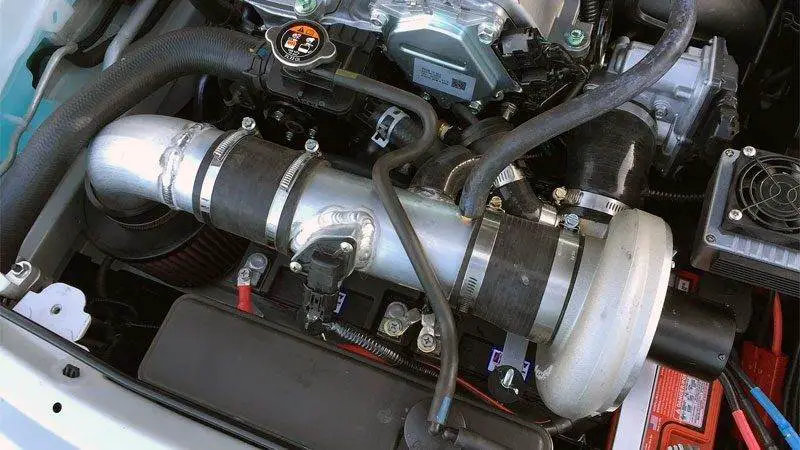
A fourth type of supercharger making its appearance is electrically driven. Each of the three blower configurations described above can be driven by a highly efficient permanent magnet DC motor. This arrangement allows supercharger speeds to be continuously adjusted to the engine’s air needs by the vehicle’s PCM.
An electric motor to spin the internal parts of the supercharger is a much simpler drive system than the complex belts or gears used in mechanical drives. This could potentially be a cost reduction and a reliability improvement over older mechanically driven superchargers.
How Supercharging Benefitted the Aircraft Industry
Although costly in dollars and tragic in terms of horrible human losses, wars have been the testing ground for many technological advances. This is also true with supercharging.
World War II saw the growing need for aircraft capable of reaching high altitudes. Normally aspirated piston-engine aircraft could not operate effectively in the thin air well above 20,000 feet.
Superchargers became common in these wartime fighters and bombers allowing altitudes up to 50,000 feet. With such altitudes, the speed and range of aircraft were also greatly improved.
The Engines Beneath the Superchargers
Supercharging can increase combustion pressures and power outputs of many different engine types. These pressure and power increases will always be accompanied by significantly higher engine temperatures and internal structural loads.
Designers had to compensate for this with improved engine cooling and lubrication, improved metallurgy for engine blocks and internal parts as well as higher quality fuels. These technological advancements have been passed down to the cars and trucks we drive today.