

The ECM (Engine Control Module) is an integral part of every vehicle to ensure that the car’s engine operates at optimal performance. There are many cases where your car has problems and cannot start due to a faulty ECM. Therefore, it is important for car owners to know the symptoms of a bad ECM and find solutions to address them in a timely manner. Let’s roll up our sleeves and find out:
What is the ECM in a car and how does it work?
The ECM is an electronic control unit that manages only the engine. What is the purpose of an ECM? Encompassing the actuators, sensors, and associated fuel injection… The ECM manages all engine requirements, prioritizes them, and then implements them. Examples of requirements include the accelerator pedal position and exhaust system requirements for mixture composition. Torques are a key criterion for the implementation of all requirements.
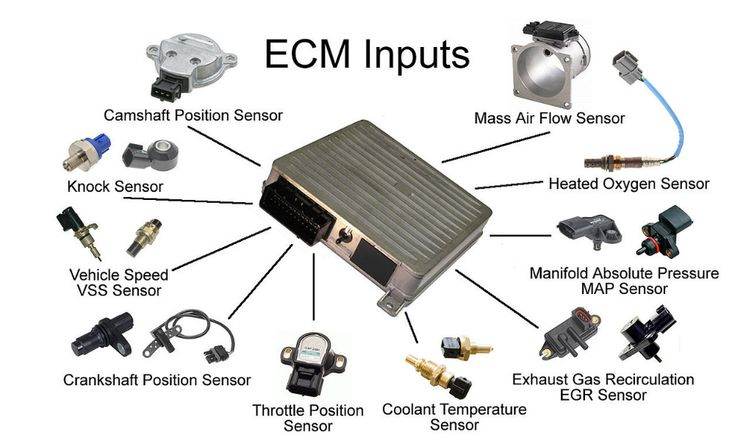
Generally speaking, the ECM is considered “the brain” behind your car’s muscles and it is an onboard computer that literally controls everything your engine does and optimizes the air/fuel ratio. Receiving information from various sensors on the vehicle, then analyzing and adjusting engine operation and fuel consumption, ensuring optimal efficiency and power. Typically, the ECM operates in 3 specific steps as follows:
- Input: The ECM updates information from sensors, including the intake air flow sensor, speed sensor, temperature sensor… and on/off signals, as well as modules.
- Processing: After collecting data, the ECM will determine technical parameters, calculate, and make decisions to direct in detail the specific activities for each part.
- Output: The ECM controls and manages all engine operations
After understanding the concept of the ECM, you might ask the question “Are the ECM and PCM different in a car? Our answer is “Yes.” The PCM (Powertrain Control Module) is a powertrain system that includes: the engine, clutch, and transmission. So PCM controls the engine and gearbox. Whereas the ECM, as we mentioned above, is designed to control and optimize the engine.
Simply put, the (PCM) includes an engine (ECM) + transmission (TCM) +… so: PCM = ECM + TCM. Now that you have the basic knowledge related to the ECM, let’s move on to the next part to learn more about the symptoms of ECM failure.
4 Symptoms of a Bad ECM You Need to Be Aware Of
The ECM plays an essential role in modern vehicles. Thus, when the ECM encounters problems, it can cause all sorts of issues with the vehicle and, in some cases, even prevent your car from running. A bad ECM can produce one of the following 5 symptoms to alert the driver of a potential problem:
1. Check Engine Light
If there are problems with the circuit or sensors, the Check Engine light will come on. However, sometimes there is no error but the light stays on due to confusion at the ECM level. Therefore, to determine the exact cause, the driver should entrust the car to a repair center to help scan the fault code according to the manufacturer’s instructions.

2. Having Engine Problems
Unusual engine operation indicates that the engine control module is faulty. The consequences are that your engine may not run or shut off abruptly. Over time, if not corrected in time, the symptoms will become more severe and could eventually lead to electronic system malfunction.
3. Having Difficulty Starting
When the ECM fails completely, the vehicle will be difficult to start, or even unable to operate. You should immediately contact repair and maintenance centers for prompt assistance.
4. Consumes a Lot of Fuel
The ECM performs the task of circulating the exact level of fuel to ensure the combustion process by monitoring movement conditions such as throttle position, current engine load, etc. Therefore, if the engine control module fails, the vehicle will consume more fuel. To reduce fuel consumption during operation, drivers should regularly check the above parts.
To fix this issue, technicians will perform repairs according to the following steps:
Step 1 – Check whether the crankshaft (camshaft) sensor is working properly or not.
Step 2 – Check if the sensor connector and wire are in good condition or damaged.
Step 3 – Check the condition of the crankshaft signal disc. Good, dirty, or broken.
Step 4 – Check if the wires of the crankshaft sensor and phase sensor are in good condition.
Step 5 – After checking, if a part is found to be faulty. Technicians will disassemble, repair, and reassemble them to their original condition.
Watch more:
What are the reasons for a bad ECM?
To know the exact causes of a faulty ECM, you need experienced technicians and engineers, with the help of modern equipment, it is possible to accurately determine the cause of damage to the ECM. However, according to statistics, the ECM is often due to the following common causes:
– Voltage overload – This is due to a short circuit of the actuator or solenoid.
– Environmental factors such as air humidity, oxidation… cause the jack pins to rot and become damp.
The vehicle often has to travel on bad roads, causing strong vibrations to the ECM. The details of this part undergo many physical impacts leading to damage.
Wrap Up
The car’s ECM is an important component that directly affects engine performance. Parts such as the camshaft, braking force, fuel pump, ignition,… all must comply with the engine control module’s decision. Therefore, drivers should regularly take their vehicles to maintenance centers to receive assistance for periodic inspections, early detection, and treatment of damage to ensure safety when driving the vehicle and to resolve ECM issues in a timely manner.