
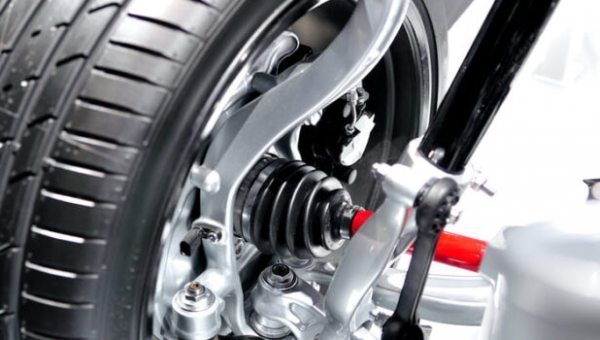

Modern automobiles often prioritize comfort and luxury alongside speed and performance. People tend to think that heated seats or cruise control systems add comfort to a journey, but the most important factor in ensuring every trip is as smooth as possible? Suspension. A car’s suspension system is undoubtedly the most important factor for having comfortable and stable performance and allowing the driver to truly control their car. But what is the purpose of the system, besides comfort, and how does it work?
THE FUNCTION OF SUSPENSION SYSTEMS
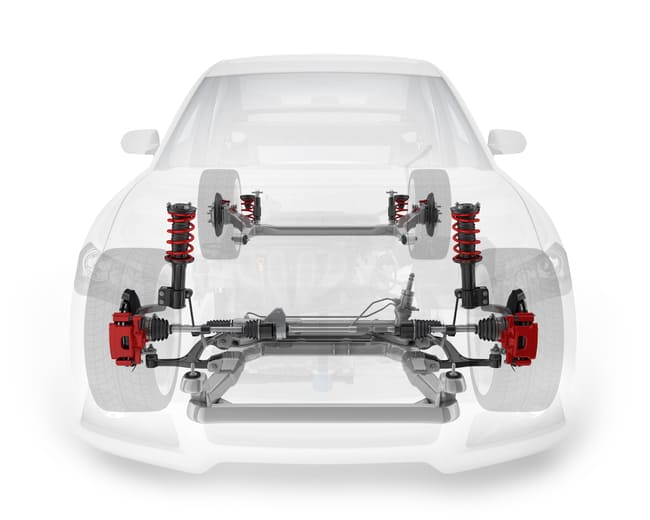
The main job of a car suspension system is to ensure that there is maximum friction between the tires and the road surface, to ensure steering stability with good handling and to ensure passenger comfort. It is intended to absorb vibrations, gravity, and impact forces from the road.
If every road were completely flat, without bumps, potholes, or irregularities, suspension systems would not be necessary. But unfortunately, this is not the case anywhere in the world. Even freshly paved streets have tiny imperfections that can interfere with a car’s wheels and its operation. These imperfections exert a force on the car, pushing it upward. The magnitude of the force, of course, depends on the size of the imperfection that was hit. In any case, the car’s wheel experiences vertical acceleration when it passes over an imperfection. It is the job of the suspension system to handle these upward forces and ensure that the wheels remain on the road at all times.
If it works correctly and the wheels are constantly in contact with the road surface, then there is maximum friction and the risk of rolling or overturning the car is minimized and this helps ensure that power is transmitted to the wheels, where it is most needed. The tires absorb all shocks and vibrations, as well as other road imperfections, and in conjunction with the car’s shock absorber mechanism being part of the suspension, the effects of these shock forces can be effectively dampened. It is technically the spring mechanism of modern suspension systems that pushes the tires into the ground so that we have maximum friction and the best possible ride. Thus, when a tire hits a bump or is forced upward because of something on the road,
COMPONENTS OF A SUSPENSION SYSTEM
Before looking at the different types of suspension and how they work, it is important to have a basic understanding of the key elements of almost all suspension systems.
The key components of a suspension system are the springs, the shock absorbers, and the anti-roll bars. To bring it back to basics, the springs absorb the force of the impact, the shock absorbers then work to dissipate this energy, and the stabilizer or anti-roll bars are used alongside the shock absorbers to give the automobile extra stability when driving. An anti-roll bar is a metal rod that spans the entire axle and connects each side of the suspension together.
SPRINGS
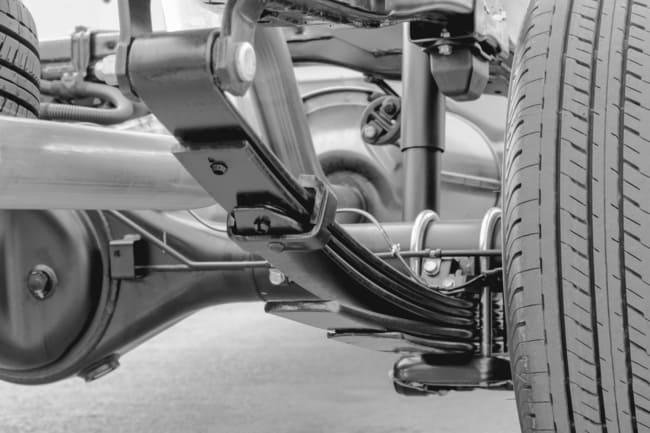
There are, of course, several types of springs, shock absorbers, or stabilizer bars. Leaf springs are one of the oldest forms of suspension springs. These springs are essentially several layers of metal bound together to act as a single thin, arc-shaped unit. They are attached to the axle and when the car hits a bump or road irregularity, the layers compress to absorb the shock. Although these are much less common for cars nowadays, they can still be found on heavy vehicles and trucks in the United States.
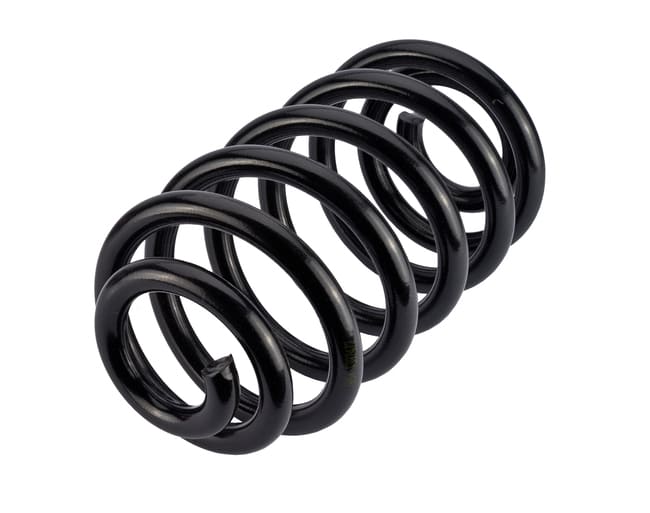
Coil springs are the most common spring component of a suspension system. A coil spring is a robust torsion bar wound around an axis. The stiffness of the spring affects the reaction of the sprung mass (everything located above the springs and thus supported by the springs) when the car is driven. If there is very little tension in the spring, it is “softly sprung,” it’s probably a very smooth ride. Luxury cars, for example, are often softly sprung. However, they can be prone to diving and squatting during braking and acceleration and have more body roll or sway in corners. Tightly sprung cars, on the other hand, give less when hitting bumps, which can be uncomfortable, but minimize body movements so they can take corners aggressively, ideal for a sports car.
A common feature of European vehicles is a system involving a suspension arm or an “A” control arm. This one consists of a torsion bar attached to a “triangular” arm (so called because it has the shape of the V-shaped “wishbone” from a turkey’s neck) and to the vehicle’s chassis. The wishbone acts as a lever that moves perpendicularly to the torsion bar; when the wheel hits a bump, the vertical movements are transferred to the wishbone or control arm, then through lever action to the torsion bar. The torsion bar then twists along its axis to provide the spring force.
SHOCK ABSORBERS
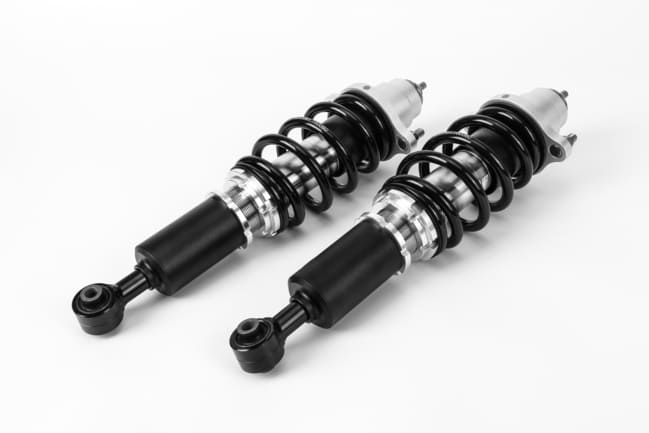
When the springs absorb the force and energy from the uneven road surfaces, this energy must dissipate in one way or another. That is the job of the shock absorbers. Shock absorbers are therefore a type of damper. They slow down and reduce the amplitude of vibratory motion by converting kinetic energy into thermal energy to be dissipated by the hydraulic fluid. Shock absorbers are speed-sensitive; the faster the suspension moves, the more resistance the shock absorber provides. They can adapt to road conditions and control all unwanted movements, including bounce, sway, brake dive, and acceleration squat.
Struts are a more advanced form of shock absorber and are essentially a shock absorber mounted inside a coil spring. It works simultaneously as a damper like a shock absorber and structurally supports the vehicle’s suspension – they do more than shock absorbers because they support the vehicle’s weight to some extent. Struts are very common in the front suspension of front-wheel-drive vehicles.
TYPES OF SUSPENSION
Different combinations of spring systems and shock absorbers can be found in different vehicles and the type of suspension used can even vary within vehicles – the front suspension system is likely to differ from the rear suspension system.
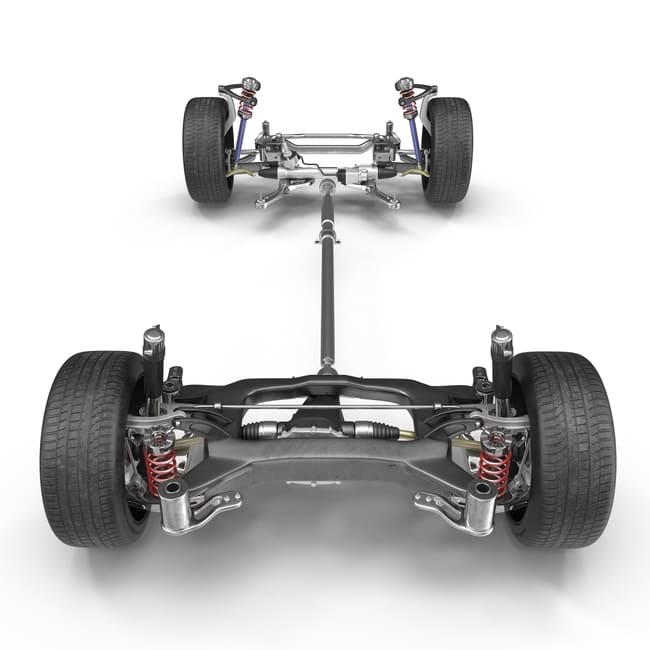
A suspension system can be dependent and independent. In a dependent suspension system, a rigid axle links two wheels together, while in an independent system, the wheels are allowed to move independently and are not connected to each other. Older cars tended to favor dependent suspension systems, often in conjunction with leaf springs, but more modern cars prefer independent suspension systems, especially for the front suspension. Dependent systems are robust and simple, but since there is no camber adjustment in corners, there is a risk of the wheels lifting off the road surface. As for independent suspension systems, shock loads from the road surface are isolated to the side where they are encountered, which is extremely advantageous. Of course,
Often, the front and rear suspensions of cars will be different. Front suspension systems must be integrated with the steering and can therefore be quite complex and they are also the first to come into contact with foreign objects or uneven surfaces on the road. Rear suspension systems can often be simple because steering does not need to be taken into account. This means they are often dependent systems (see below for an explanation), based on a leaf spring or a coil spring. If all our wheels have individually mounted suspension, the car can be considered to have four-wheel independent suspension.
DOUBLE WISHBONE SUSPENSION
Double wishbone suspension consists of two triangular-shaped arms (A-shaped or V-shaped) positioned one on top of the other. They are hinged at the top and bottom of the vehicle’s steering knuckle to ensure the vehicle’s steering and balance the steering wheel. Shock absorbers are often attached to each control arm and this type of suspension gives more control over the wheel’s camber angle to minimize roll and sway and provide a more consistent steering feel. These are popular on the front wheels of larger cars, which can be heavier and prone to rolling or swaying in corners. Although it is lightweight and has many advantages, it is also more expensive than solid beam (dependent) suspension systems.
SHORT/LONG ARM SUSPENSION (SLA)
Short/long arm suspension is a modification of double wishbone suspension that can be used on both the front and rear wheels of motor vehicles. In double wishbone suspension, both arms are of equal length. In a short/long arm (SLA) suspension, the two arms are of unequal length; the upper arm is shorter than the lower arm. This design allows for camber control and limits tire edge wear during cornering. The length of the upper arm is shortened so that, in corners, with centrifugal force tending to roll the vehicle and put the tires on their edges, this suspension system acts to bring the contact patch back to the center of the tire for both wheels. This effect occurs up to full jump, making it an ideal suspension for performance vehicles.
MACPHERSON STRUT SUSPENSION
This system includes a single control arm in a strut assembly that allows the tire and wheel to move up and down. This reduces unsprung mass and increases ride comfort. It is small, relatively inexpensive, and not too complicated, meaning it is a popular strut choice. On some of the same vehicles, a strut is also used in the rear suspension system. It is similar to the front strut but does not have an anti-friction bearing at the top because it is on a non-steering wheel.
ADJUSTABLE AND HYDRAULIC SUSPENSION
Besides all the basic types of suspension systems that manufacturers offer as standard, many drivers opt for adjustable suspension systems that they can install, adjust, and maintain themselves. These can also be provided by some manufacturers as standard in new cars. Some suspensions allow adjustment by the driver or automatically by the car itself and these can help deal with certain conditions. Indeed, a car with adjustable suspension can take on the function of two or more slightly different suspensions, depending on the situation.
Two main settings can be adjusted with adjustable suspension systems: ride height and roll stiffness. High-end cars can sometimes be equipped with the ability to raise and lower their body depending on the situation. The Tesla Model S is a good example as it automatically lifts when driven into entrances like parking lots or driveways. Some SUVs can be set to a lower suspension height on smooth roads, for more stability and economy, or higher in off-road driving, for increased ground clearance.
Ride height adjustment normally uses airbags integrated into the springs; changes in the amount of lift correspond to any change in air pressure. Other manufacturers use hydraulic systems to accomplish the same thing, with pumps providing hydraulic pressure to help lift the vehicle.
Some vehicles offer active suspensions that automatically stiffen the ride when a driver maneuvers at high speed; they do this using a pneumatic (air) or hydraulic (fluid) reservoir with variable pressure. Roll stiffness adjustment is built into aftermarket systems that feature adjustable spring rates and/or shock absorber performance. Most of the time, making adjustments like these means physically getting under the car and changing something manually, most often a dial on the shock absorber that changes the shock absorber’s tendency to dampen movement. Systems that can be adjusted from inside the car are much less common.
Dedicated race cars go even further than these two systems, allowing adjustment of almost every aspect of the suspension. A qualified race mechanic can tailor a race car to each individual track.
Nowadays, adjustable height suspension is increasingly offered by the manufacturer, as concerns about fuel economy increase. When cars are lower, they become more aerodynamic and thus more fuel-efficient. The other types of adjustable suspensions listed above are found mainly in aftermarket systems (to be added after the manufacturing process), especially in adjustable shock absorbers and “coilovers” (systems comprising a coil spring and an associated adjustable shock absorber or strut). But in all cases, the intention of a suspension adjustment is the same: to incorporate a change to help adapt to different needs or conditions.