

How to test an ABS sensor with a multimeter? If you have thought about the question, what are the causes of wheel speed sensor failure? “Can the ABS sensor cause transmission problems? or how to fix ABS sensor problems, then you are on the right track by reading this article. However, the failure or malfunction of any vehicle component will likely affect the entire system and could cause serious problems in the system. It is important to note that ABS brakes are one of the most essential braking systems in automobiles.
The ABS are located in the brake assembly monitor and measure the wheel rotation speed while transmitting the information to the ECM before relaying it to the hydraulic control unit. However, most vehicles are equipped with one sensor per wheel for anti-lock braking, not for the car’s traction.
If the ABS sensors become faulty, the entire braking system (all 4 wheels) will also fail. Similarly, when the ABS is faulty, you will see an ABS sensor light on your vehicle’s dashboard. This notification indicates that a problem has occurred with one of the sensors.
Nevertheless, this article will elevate your knowledge level on the following content such as: what can a faulty ABS sensor cause, can the ABS sensor cause transmission problems, how to repair the ABS sensor, ABS sensor location, ABS sensor price, can a faulty ABS sensor cause vibrations, what are the causes of wheel speed sensor failure, how to know which ABS sensor is bad without a scanner and many others.
Let’s get started immediately! * symptoms, repair and reset guide

What can a faulty ABS sensor cause?
A faulty ABS sensor can cause the following:
- Loss of stability during acceleration.
- Incorrect gear shifting.
- TCS or ABS light coming on.
- Skidding during braking.
Can the ABS sensor cause transmission problems?
Essentially, there is a link between the ABS and the transmission; if the ABS is bad, the transmission will be affected. The wheel speed sensors work to keep an eye on the wheel speed and transmit the information to the ABS in all vehicles.
Similarly, the ABS transmits data to the traction control system while the ECU controls their functions. Essentially, the ABS controls and manages the retrieval of information from the vehicle’s ECU, which triggers the speed information in certain situations.
So, suppose the ABS sensors can provide inaccurate data to the ECU if they malfunction. In that case, your transmission system could receive incorrect signals about the sensors being faulty, thus causing transmission problems.
ABS sensors are vital but prone to transmission problems; you must entrust your vehicle to a professional if the ABS warning appears on your dashboard. However, this light could be a troubleshooting indicator, and you need to use a multimeter to diagnose ABS troubleshooting.
ABS Sensor Location
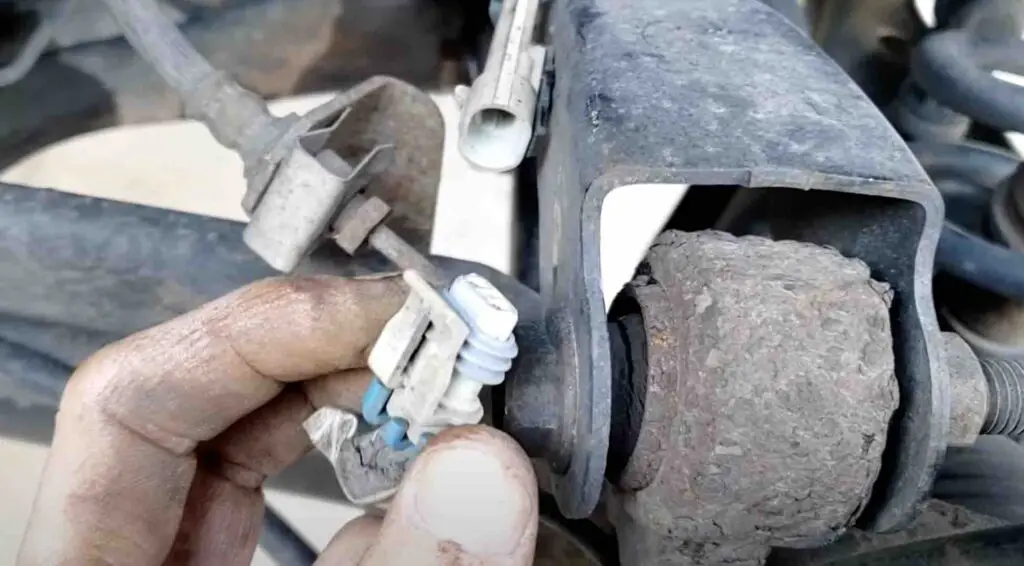
The ABS sensor location is on the inner side of the wheel hub as it mounts on the axle or steering knuckle in various vehicles. The ABS sensor is accessible or found when you lift your car’s wheel or turn your tire in one direction.
How to Repair the ABS Sensor
It is very important to remove/repair/fix the ABS sensor if it is faulty or defective, and this requires the following procedures below:
Removing the Bad ABS Sensor
- Lift the vehicle using a jack while you remove the wheels to easily access the wheel hub.
- Loosen your tire’s lug nuts and remove the wheel from the vehicle with a wrench.
- Access the sensor by locating it along the wheel hub body.
- Loosen the bolt holding the ABS sensor while you disassemble the sensor with an Allen key.
- Using a pair of pliers, wiggle the sensor while
- Remove any dirt from the sensor housing while you blow canned air into its housing, or gently use a wire brush to remove rust.
Installing a New ABS Sensor
- Push a new sensor into the lodge while positioning it securely.
- Connect the wiring to the new sensor.
- Replace and turn the bolt while securely fastening the sensor using a wrench.
- Reposition the wheels and make sure to screw the lug nuts back in place.
- You must repeat the process on each wheel until the ABS light stops.
ABS Sensor Price
Each sensor costs between $200 and $400 in any auto parts store, while your mechanic or technician might charge you around $150 to $200 for labor as it is time-consuming. Perhaps ABS sensors should be replaced every 30,000 to 50,000 miles.
Although you are competent and experienced, you can do it yourself. Make sure to use the manufacturer’s guide!
Can a Bad ABS Sensor Cause Vibrations?
Of course, yes! A bad ABS sensor can cause vibrations. If the ABS fails, an ABS light will appear on the dashboard, and if it stays on when starting the vehicle.
The vehicle’s speed and acceleration will drop very low since the ABS function monitors and measures the vehicle’s speed and relays the information to the computer, the ECU.
A bad ABS will set the vehicle’s acceleration once it fails and cause it to vibrate. Thus, you can install a new ABS sensor; the Powertrain Control Module (PCM) will reset. You can use the scan tool to retrieve the PCM’s memory to perform proper diagnostics.
What are the Causes of Wheel Speed Sensor Failure?
However, many damages occur to the hub or wheel bearing component of the internal wheel speed sensor and the external sensors of your vehicle.
However, the causes of wheel speed sensor failure are as follows:
- Metal debris particles are attached to your wheel speed sensor’s magnetic encoder ring.
- Corrosion weakens the sensor’s signal strength due to the air gap spacing.
- Excessive bearing end play in your wheel bearing.
- A mechanical problem results from the sensors’ inability to read back due to road debris.
How to Know Which ABS Sensor is Faulty Without a Scanner
Indeed, the quickest way to know which is the faulty ABS sensor is with a digital multimeter, but you can use an ohmmeter for testing without the multimeter.
Essentially, to perform this test, you will remove the sensors from the vehicle and connect each to the ohmmeter. Once connected, check the resistance of such a sensor. Therefore, such a sensor is bad if the reading is very high or low.
Symptoms of a Bad ABS Wheel Speed Sensor or Signs of a Bad ABS Sensor
Different ABS sensors will be used on different cars. Some older vehicles may only have one or two sensors, while newer cars will have one at each wheel. Although individual sensors on each wheel provide more accurate readings and operations, this can make the system more vulnerable to problems. An ABS sensor that is failing will usually give you a few warning signs, and here are the signs of a bad ABS sensor or the symptoms of a bad ABS wheel speed sensor.
1. ABS Light is Now On
The ABS light will illuminate as the most obvious sign of a problem. The ABS Light is a version of the Check Engine Light but only for the ABS. The ABS light comes on when the ABS has a problem.
2. Brakes Take Longer to Stop a Car
The ABS system should activate automatically to slow down the vehicle under intense braking conditions. Loss of traction and skidding should also be minimized. It is important to avoid over-braking. However, if the vehicle takes longer to stop under sudden braking conditions or in case of loss of traction, it could indicate a problem with the ABS system. The ABS typically consists of only a few components, the module and the sensors. A problem with its operation can stem from either the module or the sensor.
3. Wet or Icy Driving Conditions Can Harm Stability
Most drivers will soon become comfortable with the vehicle in different conditions. A properly functioning ABS system will reduce any loss of traction, especially in wet or icy conditions. The ABS system may not be working correctly if you notice tire skidding or loss of traction while driving on wet or icy roads. This is usually due to a problem in the module or, more likely, a problem with the sensors.
How to Test an ABS Sensor with a Multimeter
Test an ABS Sensor: Get Your Readings
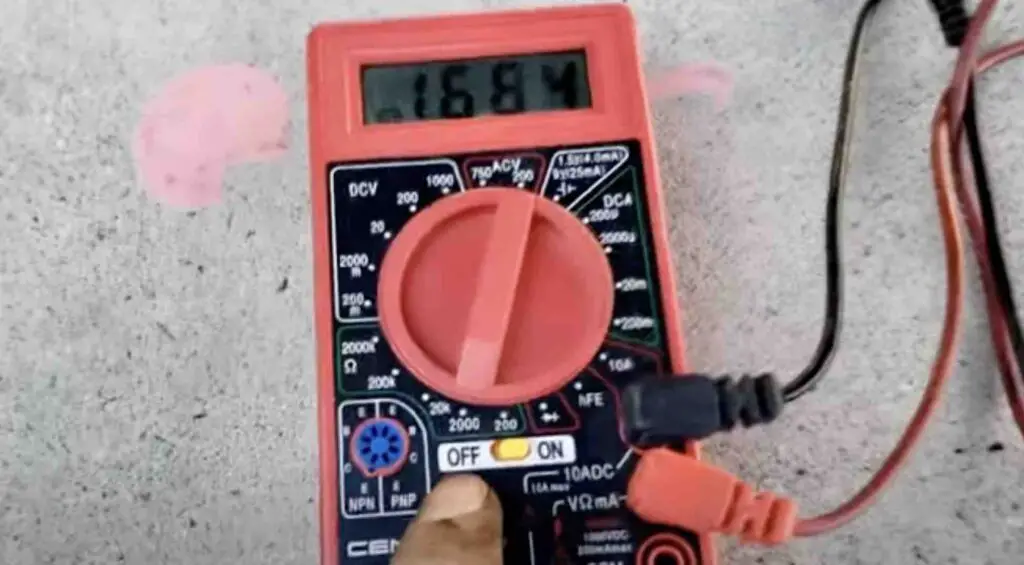
The display, selection button, and ports are the three main components of a multimeter. Displays often show 4 digits but can also show negative readings.
To select the unit you want to measure, turn the button. It can be voltage, current, or resistance.
Two probes are plugged into the ports of a multimeter, and they are labeled MAV and COM.
The COM is usually black and connected to the circuit ground.
The current reading can be connected to the MAV resistance probe, which could be red.
These simple steps will help you test ABS sensors with a multimeter. Read the manual and check that all ABS sensors are present on your vehicle.
Take note of their standard Ohm values.
Here are the steps:
- Before turning off your engine, park your car in “park” or neutral mode. Then, activate your emergency brakes.
- The jack can be used to lift the wheel near the sensor you want to test. It’s a good idea to place a mat on the ground under the car so you can easily perform repair work. Make sure you have your safety equipment.
- Remove the ABS sensor cover and connect it to the wires using brake cleaning fluid. The sensor looks like a cartridge with connecting wires.
- Set the multimeter to Ohms. Gently adjust the knob to adjust the Ohms setting. An “O” symbol denotes resistance or Ohm.
- Regularly turn the zero adjustment knob to set your multimeter’s display.
- Place the probe wires on the ABS sensor pins. It doesn’t matter where you place each probe because resistance is not directional.
- To get the correct reading, move them as far apart as possible. You will get a consistent reading if you wait.
- Take note of the Ohm readings. Compare this with the standard Ohm value for your sensor in the manual. The difference should not exceed 10%. You must replace the ABS sensor.
Alternatively, you can also set your multimeter to AC mode (voltage reading).
Connect the probes to the ABS sensors and spin the wheel to get a voltage reading.
ABS Sensor FAQ
Can You Drive with a Bad ABS Sensor?
No! As a certified mechanic, I recommend that you do not drive with a faulty/defective ABS sensor, as it can prevent you from controlling your vehicle. Do not assume to follow the advice of an uncertified mechanic who tells you to drive if the ABS system fails. Indeed, a failing ABS sensor is a dangerous long-term threat!
Can a Faulty ABS Sensor Cause Brake Locking?
Yes, of course! Since a bad ABS sensor can behave erratically, causing your brakes to lock even under standard braking. The random rattling noise produced by the brakes is a reality to justify the failure of the ABS sensors. It is paramount that the function of the ABS is to prevent the wheels of your vehicle from locking. If this locking occurs, then an ABS is failing.
Is It Possible to Drive with a Faulty ABS Sensor?
Your car’s ABS sensor may be faulty. This means your Anti-lock Braking System (ABS) will not function properly. Even though you can drive with a faulty ABS sensor, it is not recommended. Safety must be your top priority when driving. If you have an ABS sensor that is not working correctly, it is best, for safety reasons, to have it repaired as soon as possible.
Is It Possible to Clean ABS Sensors?
Although you can clean the ABS sensor, it is unlikely to solve the problem. The most common reasons for ABS sensor failure are electrical issues and open circuits. The sensor may read incorrectly if the ABS reluctor ring becomes very rusty.
What Causes ABS Sensors to Fail?
ABS sensors can fail for several reasons. The buildup of dirt and debris on the sensor or connector is one cause. The sensor is often mounted in an exposed area, which can cause this, especially if there is a lot of dirt or dust. Corrosion can also occur if water enters the system. The sensor can also fail if it is physically damaged.
Is the ABS Sensor Capable of Influencing Acceleration?
It’s unlikely, but it’s possible. ABS sensors can also be used to control traction. If a wheel has a bad speed, the ABS sensor will reduce engine power as a safety measure.
Conclusion
Indeed, the components of a vehicle do not last forever. So far, to know if your vehicle’s ABS is erroneous or failing, a digital multimeter (scan tool) is used to diagnose the sensor(s), as the case may be.
However, faulty ABS sensors indicate certain symptoms or signs like an ABS light on the dashboard, stalling acceleration or low speed, your vehicle skidding during system braking, and to name a few. Similarly, malfunctioning ABS sensors can cause a transmission problem since a bad Anti-lock Brake (ABS) can interfere with how your vehicle shifts gears.
Nevertheless, it would be helpful to keep an eye on the dashboard and never ignore the warning lights it may give you. You should consult a certified mechanic if a problem you cannot solve arises in your vehicle, and your manufacturer’s guide could be helpful.
I hope this article on how to repair ABS sensors and whether ABS sensors can cause transmission problems will be helpful to you. In this article, we explained what a faulty ABS sensor can cause, the ABS sensor location in your vehicle, and how to know which ABS sensor is faulty without a scanner. Please share this post if you find it useful!