
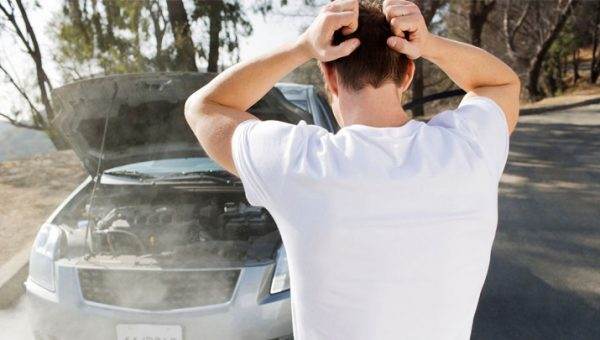

Summer has finally arrived and you are on your way to the beach for a long-awaited family vacation. Everything is fine and you are only a few hours from your destination when an unexpected event abruptly interrupts your journey. As the reading presented by your vehicle’s temperature gauge begins to soar, you realize that something is wrong.
A quick glance under your vehicle’s hood reveals a lack of coolant in the cooling system’s overflow reservoir, indicating an apparent leak. Although the nearest store within walking distance does not stock coolant, the store clerk offers several gallons of water to top up your vehicle’s cooling system.
This raises an intriguing question. Can you put water in your vehicle’s radiator or cooling system in an emergency, and does it pose a risk to your vehicle’s engine?
Read on to learn more about using water in automotive cooling systems, as well as how to properly handle such roadside emergencies if faced in the future.
What Happens If You Use Water Instead of Coolant?
In the vast majority of cases, it is perfectly safe to fill your vehicle’s cooling system with water in an emergency. However, before doing so, it is important to understand that water offers no protection against freezing and also boils at lower temperatures than antifreeze.
Therefore, water should only be used as a temporary substitute for coolant. A vehicle’s cooling system should be filled with the appropriate coolant as soon as all underlying leaks have been repaired. Failure to replace this water with the appropriate type of coolant can lead to a multitude of troubling problems over time.
Over extended periods, using water can lead to the development of corrosion in a vehicle’s cooling system. As this corrosion continues to worsen, overheating problems can manifest, as rust particles clog cooling passages and restrict radiators.
Once this corrosion cycle begins, it can be quite difficult to stop, leading to years of overheating problems.
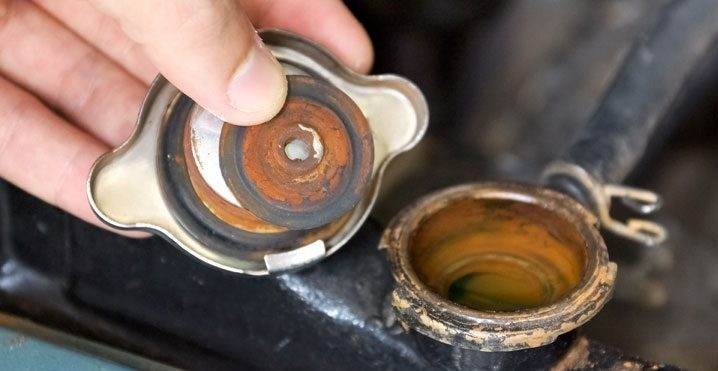
Water must also be drained from an engine before the onset of cold weather, as water offers no freeze protection. When water freezes, it expands and occupies a significantly larger volume than when in its liquid state.
Although most engines feature freeze plugs, which are intended to relieve the pressure from this expansion, water freezing within an engine’s cooling system still poses a high risk of damage.
Engine blocks and cylinder heads are known to crack or break under the stress imposed by the expansion of frozen water. Similarly, radiators rarely stand a chance against such expansion.
Ultimately, problems of this variety will often prove to be much more problematic than those that led to your engine’s initial coolant leak.
Does the Type of Water Matter?
Although water of any type is never intended to be extended (by itself) in an engine’s cooling system, some types of water are more suitable for such uses than others. This is because certain types of water present an increased risk of corrosion and scale buildup within the cooling system.
Whenever possible, the use of ordinary tap water for such purposes should be avoided. Tap water contains many minerals that are catalysts for corrosion. Therefore, using tap water in an engine’s cooling system can lead to an accelerated buildup of problematic deposits, in turn worsening issues related to overheating.
In order to avoid the problems presented by tap water, softened or purified water should be used as an alternative, whenever possible. However, one can use distilled or bottled water for the same purpose, if such products are readily available.
Use:
- Purified water
- Softened water
- Distilled water
Do not use:
- Tap water
- Spring water
Will a Car Overheat With Just Water in the Radiator?
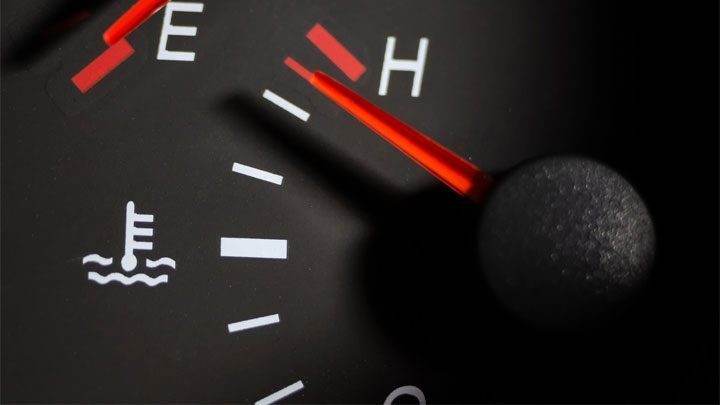
Although water is relatively effective at keeping an engine cool, its boiling point is slightly lower than that of coolant. Water boils at a temperature of 212° F, while 50/50 coolant boils at 223° F.
Although this gap seems somewhat minor, it is significant enough to make coolant far more effective at preventing boil-over than water. Therefore, using water alone, in a vehicle’s cooling system, leaves an engine susceptible to overheating under strenuous or demanding circumstances.
Although such inefficiencies might not be evident at cruising speeds, motorists should remain mindful that an engine is not sufficiently protected against overheating when running pure water in its cooling system.
Should I Pour Water On My Engine to Cool It Down?
When an engine overheats, the vast majority of motorists are intent on providing additional cooling by any means necessary. However, one can do more harm than good by taking action, without considering the possible consequences. Pouring cold water on an overheated engine is a prime example of this.
The reason for this is quite simple. Metal, like that which makes up the engine block and cylinder heads, expands when heated. Upon cooling, this metal will contract back to its normal state.
Metal is capable of withstanding these fluctuations when heating/cooling occurs gradually. On the other hand, rapid heating or cooling can cause metal surfaces to crack in one or more locations.
Pouring cold water on an overheated engine is one of the leading causes of thermal shock-related damage. The sudden cooling provided by pouring water on an engine causes its block and cylinder heads to contract rapidly.
More often than not, this will lead to the development of one or more cracks in an engine’s vital structural components. Damage of this nature can be quite costly to repair and might even exceed the overall value of a vehicle itself.
How to Safely Top Up Coolant in Radiator With Water
Although water can be used to top up a vehicle’s cooling system in an emergency, several special measures must be taken when attempting to accomplish such a task.
The following steps, when followed, will help you safely add water to your engine’s radiator.
#1 – Let Engine Cool
Water should never be added to a hot engine. Instead, one should allow their engine to cool to room temperature, before attempting to top up the system.
#2 – Remove Cap
With the engine cooled, you will now remove your engine’s cooling system fill cap. In some applications, this cap will be located along the upper radiator tank, while other systems will be capped at a remote overflow reservoir.
In any case, this cap should be opened slowly, using a cloth or towel in hand. You do NOT want any spray of scalding coolant on your hands, arms, or even your face.
#3 – Add Water
Water should be added slowly to any cooling system, allowing as much air as possible to escape from the system itself.
Most overflow reservoirs are stamped with a “full” mark, which will provide visual confirmation of the system’s fluid level.
Alternatively, systems without an overflow reservoir should be filled until reaching a level just below the radiator’s fill neck.
#4 – Burp System
With water added, it will now be time to “burp” your engine’s cooling system of air. This is accomplished by letting the engine idle, with the system’s fill cap still removed. You should notice small bubbles being expelled upward through the water contained within the system.
Burping should continue until the engine has warmed sufficiently to allow the system’s thermostat to open. At this point, water will again be added if necessary and the system’s fill cap will be reinstalled.
#5 – Keep A Watchful Eye
When driving, one should keep an eye on their vehicle’s temperature gauge, in order to identify the early signs of overheating. Identifying the root cause of your engine’s initial coolant loss should also be prioritized.
Once all repairs have been made, the water should be drained from the system and the appropriate coolant added. Be sure to consult your vehicle’s owner’s manual to determine acceptable coolant types.