

In the past, your vehicle’s throttle body had a cable that connected to the pedal. When you pressed the pedal, you opened the throttle body and increased the amount of air entering your engine. But as technology advanced, physical linkages were replaced by sensors and actuators.
While this system allows for better air/fuel ratios for improved fuel economy and better engine performance, the trade-off is that if a sensor or actuator breaks, you lose control of your throttle. That’s why car manufacturers have equipped their vehicles with numerous sensors and a comprehensive system to monitor your electronic throttle control.
But what does it mean when your throttle control light comes on and what should you do? More importantly, is it safe to drive your vehicle or should you take it directly to a repair shop? We will answer all these questions and more here.
Electronic Throttle Control Light Meaning
When your vehicle’s electronic throttle control light illuminates, it means your car has detected a fault in the electronic throttle control system.
The electronic throttle control system monitors and controls the throttle position. While older vehicles use a cable directly linked to the throttle body, most modern cars accomplish this through sensors and your vehicle’s ECM.
While this offers many benefits, if anything isn’t working as it should, you won’t accelerate as you should.
Electronic Throttle Control Light Function
Your electronic throttle control light monitors the throttle control system to ensure everything is working properly. When it’s not, the light comes on to alert you that there’s a problem.
The only other time you should see the electronic throttle control light is when you start your vehicle. At that point, your vehicle performs a system check and when everything checks out, the light should turn off. However, if the light stays on, you have an underlying issue that needs addressing.
The easiest way to pinpoint where you need to look is by plugging in an OBD-II scanner. While these tools can’t tell you with 100% certainty what the problem is, they can give you a good starting point for your investigation.
Electronic Throttle Control Light Causes
The most common causes of an electronic throttle control light are a faulty throttle control sensor or a faulty accelerator pedal position sensor. But while these are the most common causes of an electronic throttle light, they’re not the only things that could be happening.
We’ve detailed the three most common problems below.
1. Faulty Throttle Control Sensor
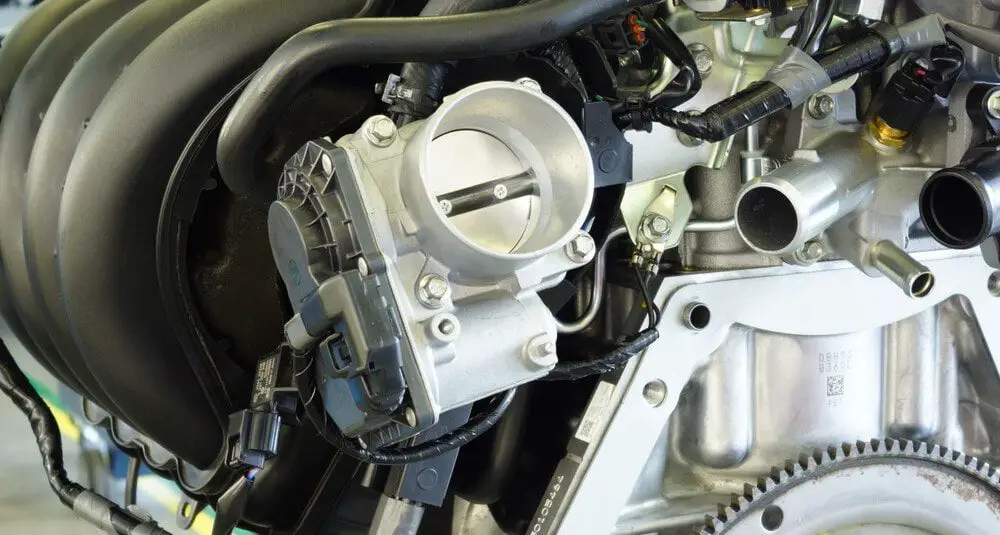
Just because your vehicle’s ECM tells the throttle to open a specific amount doesn’t mean the ECM is convinced it will do so. It actually relies on the throttle control sensor to tell it how much the throttle actually opened and makes air-fuel ratio adjustments based on that.
As any good mechanic knows, you need to trust but verify. That’s exactly what your ECM does by listening to the throttle control sensor. So when things don’t come back as expected, it throws an electronic throttle control light so you can check what’s happening.
2. Faulty Accelerator Pedal Position Sensor
There are several different components in your electronic throttle control system, and an integral part is the accelerator pedal position sensor. This sensor communicates with your vehicle’s ECM to let it know how fast you want to go.
From there, the ECM tells the throttle how much to open or close. But if the ECM can’t get an accurate reading from the pedal due to a faulty sensor, you’ll never get the desired acceleration. If the computer recognizes something is wrong with the sensor, you’ll get an electronic throttle control light.
3. Stuck Throttle Body

It doesn’t matter if everything on the electrical side of the house is working properly if the physical throttle body is stuck. There are many reasons why the throttle body might get stuck, but one common reason is carbon buildup.
Take a look at your throttle body and make sure it can easily open and close. If it can’t, see if you can remove any obstructions and try cleaning it with a high-quality fuel system cleaner. If that still doesn’t work, you might need to replace the throttle body.
Is It Safe To Drive With an Electronic Throttle Control Light?
It is not safe to drive with an electronic throttle control light. While you might get lucky and only experience reduced fuel efficiency or slightly decreased acceleration, the problem can quickly worsen if sensor readings continue to go wrong.
The throttle body controls the amount of air entering the engine, and if your vehicle’s ECM can’t keep an accurate eye on this, it can quickly lead to an uncontrollable engine. If you have an electronic throttle light on, you can quickly damage your engine, which can lead to even more expensive repairs when you get it to a repair shop.
This is true even if you don’t notice a significant drop in throttle response or vehicle performance. This is because the air/fuel ratio isn’t what it should be, which can lead to premature engine wear over time.
Summary
While you might think everything gets more complicated in modern vehicles, these complex features offer huge benefits. Not only do you get better fuel economy, but you get a more powerful and responsive engine.
So even though you might curse the electronic throttle control light now, when you get everything working properly again, you’ll be glad you have it. And despite what the crusty mechanic at the shop might tell you, the old linkage systems broke down from time to time too.