

Most people don’t realize how much energy is wasted during braking. Moving vehicles generate a significant amount of kinetic energy. In traditional braking systems, friction is used to convert this kinetic energy into heat, thereby slowing the vehicle. Unfortunately, the heat dissipates, meaning a large portion of the energy produced is no longer usable. This is where the concept of regenerative braking comes in.
The car concept dates back to 1967 when the American Motor Car Company (AMC) developed a braking system capable of regenerating electrical energy. Today, many electric vehicles (EV) and hybrids (HEV) produced are equipped with this innovative braking technology. The system increases the vehicle’s efficiency by using the kinetic energy produced during braking to recharge the electric car’s battery. This energy recovery mechanism not only extends the car’s range but simultaneously reduces the mechanical wear of the brakes.
HOW DOES THE SYSTEM WORK?
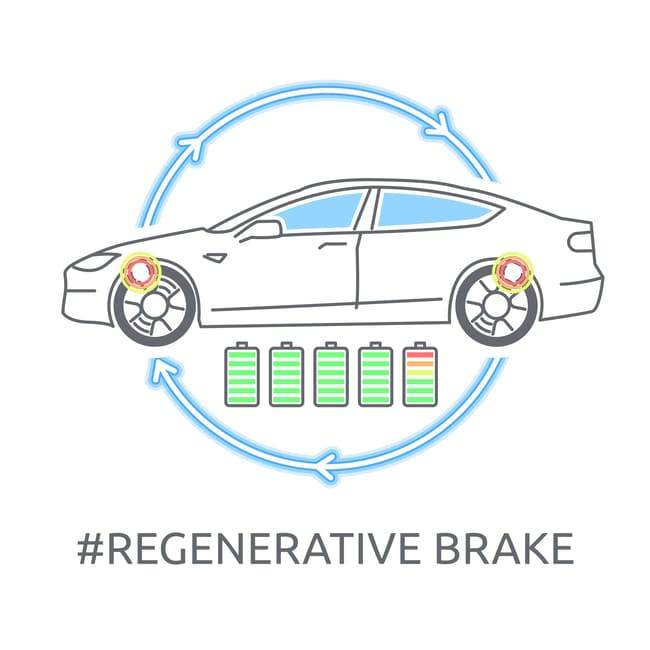
In a conventional hydraulic braking system, friction components such as brake pads and discs do most of the work to slow the vehicle. When using regenerative brakes, however, the electric motor is the main component of the system. When the electric car’s brakes are activated or the driver lifts their foot off the accelerator pedal, the motor operates in reverse, causing it to turn backward and apply resistance to the wheels. In doing so, it acts as an electric generator, generating electricity that is then stored in the batteries.
For the majority of electric and hybrid vehicles, this energy recovery mechanism is used in combination with your standard hydraulic braking system. This means that when the regenerative braking system (RBS) does not provide enough torque to stop the vehicle, hydraulic torque is applied. A regenerative brake controller manages this switching process between the systems, while also helping to determine the duration and speed of brake application. Some systems allow for what is called “one-pedal driving,” meaning the RBS is capable of completely stopping the vehicle when the driver releases the accelerator pedal without using the brake pedal.
THE BENEFITS AND LIMITATIONS OF REGENERATIVE BRAKING
FREQUENTLY ASKED QUESTIONS (FAQ)
⚠ How long do brakes last in a regenerative braking system?
There doesn’t seem to be a straightforward answer to this question. It is a fact that the motor should take away some of the resistance and pressure from the hydraulic components as they are used less in a regenerative braking system, leading to less wear. However, it is still recommended for EV and HEV owners to pay attention to brake pad wear indicators and periodically check the braking system components.
Elon Musk made a bold statement on Twitter, stating that the brake pads on a Tesla would last the lifetime of the car. While there may be some truth to this claim, it is important to take into consideration factors such as driving habits and driving environment. In a recent survey on Toyota hybrids, 60% of respondents said the brake pads and rotors on their Toyota hybrid vehicle lasted over 100,000 miles and 20% said the components lasted over 200,000 miles. The results would likely be similar from one brand to another.
⚠ Can regenerative brakes be turned off?
The short answer to this question would be no. Tesla has developed the technology so the driver can adjust the standard settings to a lower level of regenerative braking, but it is not possible to turn it off completely. Other EV manufacturers, such as Jaguar, offer different regeneration modes.