
Symptoms of a Bad Ground Strap, If you are like most people, you haven’t heard of the ground strap, even though it has a very important function to perform. If you start to notice some of the symptoms of a bad ground strap, you may want to learn more about this vital component.
We have gathered the main symptoms of a bad ground cable, as well as some useful tips for diagnosing the problem. We also show you the location of this part, explain its function, and discuss the replacement cost before answering your main questions.
Symptoms of a Bad Ground Strap
When the ground strap is faulty, you will notice flickering headlights or warning lights on the dashboard. It can also prevent the battery from charging, lead to low battery voltage, and cause difficulty starting the car. You may also notice strange electrical system malfunctions that don’t seem logical.
Some of these symptoms can also be caused by other problems, but let’s take a closer look.
1. Flickering Headlights

As with any charging system malfunction, you may face flickering headlights. When the ground strap is damaged or not connected properly, the electrical circuit encounters more resistance while powering the headlights. The result is a flickering sensation or dimming over time.
If you only notice the flickering once, the ground strap may have come loose but remained in a good position. Most likely, the problem will persist, and you will need to tighten the ground strap or replace it.
2. Dashboard Warning Lights
With so many different warning lights on the dashboard, it can be difficult to try to figure out what the vehicle is trying to tell you. With this problem, you may see the battery warning light on the dashboard, indicating that the battery is getting low and cannot charge properly.
Yet, a bad ground connection is not the only cause of this problem. It can also be due to faulty wiring or a defective alternator. If you need to drive the car a little further when this light comes on, turn off all electrical equipment, such as the radio and air conditioning. This step helps you preserve the battery a little longer.
3. The Battery Does Not Charge Properly
As we just mentioned, the battery may stop charging when the ground strap is faulty. The car must have a good ground to charge the battery.
Again, a dead car battery is not solely due to the ground cable. It may legitimately be time to replace it, or you may have a failing alternator. For this reason, it is important to perform a full diagnosis before replacing anything.
4. Low Battery Voltage
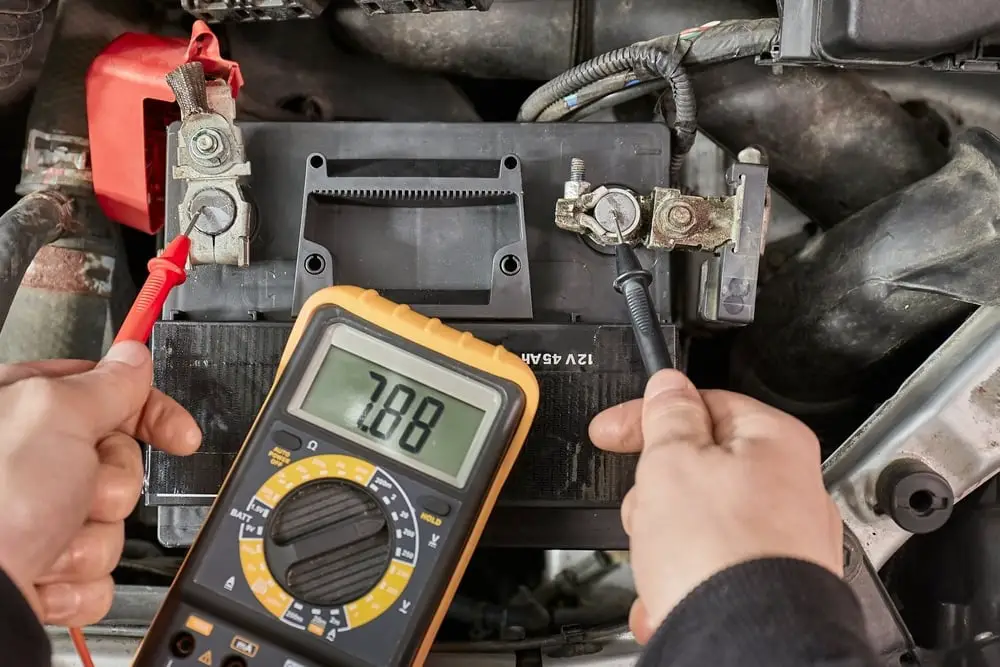
If your vehicle’s electrical system doesn’t seem to have as much power as usual, there may be a problem with the ground strap. A digital multimeter can help you discern the amount of voltage coming from the battery terminals.
This reading should be around 12.6 volts with the car not running. If it is lower than that, you might have a dead battery or a grounding issue.
5. Problems Starting Your Car
There are many reasons why your car won’t start, but you should never overlook the possibility of a bad ground connection. If the ground is the cause, you will hear clicking noises when you try to start the car.
This noise comes from the starter solenoid as it repeatedly opens and closes. Without a proper ground connection, the starter cannot get the correct voltage, but this also happens if your battery is dead.
6. Various Strange Electrical Problems
When there is a bad ground, you may notice difficulties in the electrical system, especially when it is under immense load. For example, you may notice that things become problematic when your air conditioning is running and your aftermarket stereo system has a subwoofer.
If you try to use two functions at once, such as power windows and high beams, you may notice that one of them is not getting the power it needs. Any strange electrical problem should be examined as a possible bad ground connection.
What is the Function of a Ground Strap?
The vehicle’s ground cable connects the negative terminal of the battery to the chassis. The car’s ground strap provides the grounding connection that links the engine to the car’s body. With the engine connected to these areas, an alternative path for electricity is created.
For safety reasons, most electrical components must be grounded. By grounding the connection, a complete circuit is created where electricity can flow along a defined path. Electricity flows freely from the positive terminal of the battery to the electrical components where it is needed. After that, it passes through the ground connection.
In case of a short circuit or power surge, the ground connection provides protection against damage. It dissipates into the ground connection. Electrical devices that rely on a ground connection include:
- Air conditioning compressor
- Radiator fans
- Stereo system
- Ignition system
- Alternator
You can learn more about your car’s ground connections by consulting the diagram available in your service manual.
Where is the Ground Strap Located?
The ground cable runs from the negative terminal of the battery to the chassis. It looks like a battery cable. Because it is prone to corrosion, the connection can sometimes be compromised.
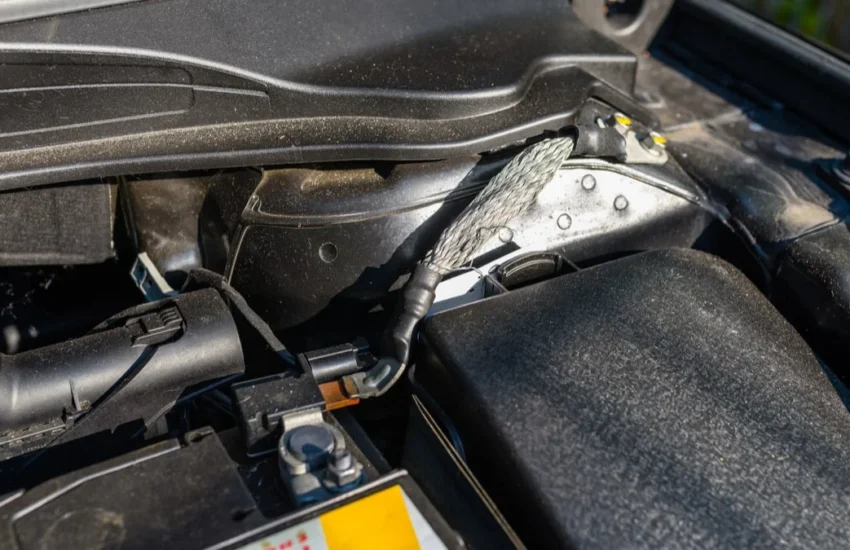
The ground strap runs from the engine to the chassis. Although it’s called a strap, it looks more like braided steel to create a strap.
Over time, this steel strap can fray and become damaged. It is subjected to weather conditions, vibrations, heat, and hot oil leaking from the engine. If the strands of the strap deteriorate too much, they will break, reducing the effectiveness of the ground strap.
How to Test a Ground Strap?
Your first test should be a visual inspection of the ground strap. Look for the plain black cable. It will be connected to the negative terminal of the battery and the car’s chassis. Check that the entire cable is not damaged. Even a small amount can cause electrical interference.
Your car has several ground connections, including the one that goes to the engine block. Make sure to locate all of them to check for damage.
If you find no physical damage, you can test the connection with a multimeter. The digital multimeter is inexpensive and handy for such diagnostics.
- Park your car in a dry place, such as a garage. The area must be completely dry.
- Remove all your jewelry since you will be working with electricity.
- Set your multimeter to 20 V DC.
- Touch the red probe to the positive (red) terminal of the battery and the black probe to the negative (black) terminal of the battery. This reading should be about 12.6 volts.
- Place the black probe on the ground connection. It should continue to read 12.6 volts. Anything well below that indicates a bad ground strap.
- Connect your black probe to a part of the engine block that is metal. This tests the ground connection with the engine. It must match the specifications in your service manual. If not, you need to replace or reconnect the cable.
If your tests reveal nothing, you may want to check for a blown fuse, especially if you cannot start the car. If your symptoms are flickering headlights, sporadic electrical issues, and battery charging problems, your alternator may also be failing.
How Much Does it Cost to Replace a Ground Strap?
It is not expensive to replace a ground cable. You can spend between $150 and $250 to have the ground cable replaced by a professional. The part only costs about $20 to $40, while labor can add another $130 to $210.
On some vehicles, it is difficult to access the ground cable, which would lengthen the installation time. However, you can probably figure out how to do it yourself if you have a few basic tools and a high-quality service manual. These manuals give you the diagrams and provide step-by-step instructions.
If you are unsure of the procedure, it’s better to pay a professional to handle it. As mechanics, we prefer drivers to ask for help rather than do something that could damage the electrical system. You could end up with a much higher repair bill if you fry something electronic because you are unsure of the procedures.
Why is a Ground Strap Necessary?
The ground cable is the negative battery cable that completes a circuit from the battery to the chassis. It is necessary to prevent electrical overloads or short circuits from damaging the car’s valuable components. However, when it is not properly connected or is worn out, it can cause electrical malfunctions.
What is the Difference Between a Ground Wire and a Ground Strap?
The ground strap is usually a braided metal strip that connects the engine to the car’s chassis. In comparison, the ground wire or cable is used to connect the negative terminal of the battery to the vehicle’s chassis. Other electronic equipment may also use some form of ground wire.
Will a Car Start Without a Ground Strap?
No, the starter will not receive the voltage it needs to start the car without the ground cable or strap. Even if you could drive the car for a short period, the battery would stop charging, leaving you stranded anyway. That’s why it’s a good idea to replace the ground strap at the first signs of trouble.
How to Know if the Grounding is Correct?
You can use a digital multimeter to get readings from the battery terminals and the ground to see if it has been properly grounded. Compare the readings with the specifications in your service manual to ensure everything is working correctly. If the ground is bad, replace it or tighten the connection to avoid problems.
How to Install Ground Straps?
Remove the old ground straps and connect the sturdy cable to the negative terminal of the battery. The other end connects to the metal of the engine block or chassis. Make sure both connections are tight and clean. Ensure there is enough length so the ground is not torn under torque.
With a bad ground strap or a loose connection, many problems can occur. It is best to fix the connection at the first signs of trouble, so you don’t end up stranded somewhere. With some basic mechanical expertise, you can replace the broken cable yourself.
However, some cars have a difficult configuration, making it harder to access the strap and its grounding points. In that case, you might be better off paying a professional to handle the replacement for you, unless you have a bit more free time and a good service manual to consult.
1. What is a Ground Strap? (Function and Importance)
- Content:
- Technical definition: “The ground strap is a cable connecting the engine/chassis to the battery, allowing the return of electrical current.”
- Explanatory diagram (example: [Insert an image of a ground strap on a Volkswagen engine]).
- Consequences of a faulty strap: electrical malfunctions, accelerated corrosion, etc.
2. How to Test a Faulty Ground Strap? (DIY)
- Content:
- Tools needed: multimeter, socket wrench.
- Steps:
- Measure the resistance between the engine and the battery (expected value: < 0.5 Ω).
- Check for corrosion at the terminals.
- Test the voltage with the engine running (less than 0.1V drop).
3. Real Workshop Cases (Case Studies)
- Content:
- Example 1: “A 2015 Audi A4 with flickering headlights – Cause: oxidized ground strap.”
- Example 2: “A Peugeot 308 that won’t start – Solution: replacement of the ground strap.”
4. FAQ on Ground Straps
- Questions/Answers:
- “Can a ground strap cause a total breakdown?” → Yes, if the circuit is interrupted.
- “What is the replacement cost?” → €20 to €80 depending on the model.
- “Can I use a jumper cable as a ground strap?” → No, risk of overheating.