
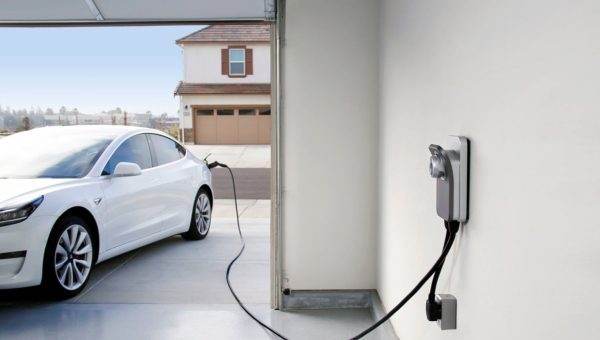

Although on average, electric vehicle (EV) batteries take about 8 hours to recharge from empty to full, the number can vary significantly, ranging from 30 minutes to 12 hours. This depends on the charging speed allowed by your electric vehicle, the power of your charger, and other factors.
There are a number of things you need to know about charging electric vehicles to properly and efficiently recharge your baby, whether at home or at a public charging station. Continue reading to discover the basics of electric vehicle charging and the most common reasons that could slow down your vehicle’s home charging speed.
AC Charging vs DC Charging: The Basics
Before starting, it is essential that you understand the two types of electrical power or “fuels” that electric cars consume, as they enable two types of charging with different charging speeds: alternating current (AC) and direct current (DC). While the energy from the grid is always alternating current, batteries like those in your smartphone or electric vehicle only store energy as direct current.
This means that your electric vehicle, as well as most electronic devices, have a built-in converter in the plug to convert the grid’s alternating current into direct current, which the batteries can store. With EV charging, the difference between AC charging and DC charging is whether the AC power is converted inside the car or outside.
AC Charging: AC charging is the standard and still the most common charging method for electric vehicles. All electric vehicles have a built-in converter inside, called an onboard charger, to convert alternating current to direct current and then feed it into the car’s battery. The conversion occurs inside the car with AC charging.
DC Charging: Unlike AC charging, the conversion of AC power from the grid to DC power occurs inside the DC charger, thanks to the converter built into the charger itself. This means there is no need for the car’s onboard converter, since the DC charger can convert AC power to DC and directly supply the car’s battery with DC current.
DC chargers available at public charging stations are an exciting breakthrough with a much faster charging speed. They are larger and enable a faster charging experience. This type of charger typically takes about 20 minutes to charge your battery to 50% and about 75 minutes to restore it to full charge.
Home EV Charging
You can charge your EV at home, at the office, or on the go while traveling using domestic outlets in your home or CEE outlets.
Domestic Outlets: All electric vehicles come with a charging cable that allows you to plug into any 120-volt domestic wall outlet you find inside your home. The charging cable and plug for charging with a standard wall outlet are often provided by the car manufacturer for emergency charging on the go. Domestic outlets can also sometimes be found at public charging stations.
With the appropriate fuse, you can plug your EV into a domestic outlet to achieve a charging speed of up to 3.7 kW (230 V, 16 A). This is called Level 1 charging. If you plug into a domestic outlet at an unknown location and therefore haven’t been able to check it beforehand, a maximum charging power of only 2.3 kW (230 V, 10 A) is highly recommended to avoid electrical problems.
CEE Outlets: The more advanced version of Level 1 home charging is a charging cable with a connector for different industrial CEE outlets for higher charging speeds. The CEE plug is available in single-phase and three-phase variants:
- A single-phase CEE plug is also called a camping plug and is blue in color, with a charging power of up to 3.7 kW (230 V, 16 A)
- A three-phase CEE plug is red in color and is intended for industrial outlets:
- large industrial CEE 32 outlets with a maximum charging speed of 22 kW (400 V, 32 A)
- small industrial CEE 16 outlets with a maximum charging speed of 11 kW (400 V, 26 A)
Level 2 Home Charging Station: For some electric vehicles, you can install a Level 2 charging station in your own garage for convenient home charging, but this will require professional installation and wiring. It is generally not a DIY project. Level 2 home chargers are often available for all-electric cars.
Level 2 charging stations offer a charging speed several times faster than Level 1 charging, at 240 volts AC. For any purely electric vehicle like the Nissan Leaf, having a home charging station is essential for overnight charging.
Slow Home Charging Speed: Reasons
If you find Level 1 charging too slow, opt for Level 2 for more efficient and faster charging. But note that when you recharge your EV at Level 2, the electrical flows between the grid and your vehicle can be hindered by some potential bottlenecks, as follows:
Mismatch Between the Charger’s Rated Current and the Electric Vehicle’s Maximum Charging Rate
The term “Level 2 residential charging stations” or “Level 2 chargers” may not have as much consistency as you think. Level 2 chargers for recharging your EV at home are typically rated in amperes, which specify the amount of current a given charger provides at 240 volts. And Level chargers can have varying amperages: 12, 16, 20, 24, 32, 40, 48, 64, or 80 amperes.
The maximum recharge rate of an electric vehicle is expressed in kilowatts. This metric concerns the vehicle’s onboard charger module, which converts alternating current to direct current. The more power the car can accept, the faster it can recharge.
To enable the most efficient and therefore fastest charging, your charger must match your electric vehicle’s charging rate. How can you tell when they are in different measurements? Simply multiply 240 volts by the amperes the charger is designed for and you get watts, which can be converted to kilowatts.
For example, if you have a Level 2 charger rated at 20 amperes, then 240 times 20 equals 4,800 watts or 4.8 kW. This is a good charger for the best-selling Nissan Leaf, which has a maximum charging rate of 3.3 kW. In short, the amount of current provided by a charger at 240 volts, when converted to kilowatts, must be greater than your electric vehicle’s maximum charging rate.
Nowadays, around 7.2 kW is more common for pure all-electric vehicles, and newer models even offer 10 kW and more, such as the Ford Mustang Mach-E with 10.5 kW and the Volkswagen ID.4 with 11 kW.
You Don’t Have a 240-Volt Circuit Capable of Harnessing Your Electric Vehicle’s Full Charging Capacity
For more efficient charging and shorter charging time, you need a dedicated circuit that can fully utilize the maximum charging capacity of your electric vehicle and your charger. Every 240-volt circuit has a current limit, which is determined by the diameter of its wires and the distance those wires have to run between the fuse box and the location where you charge your electric vehicle.
Longer cords have more resistance, which slows down the charging speed. To meet the current demand for Level 2 EV charging, you need sufficiently robust wiring, which in turn will require a larger conduit.
The circuit breaker should always provide about a 25% margin. For example, a Level 2 charger rated at 32 amperes will require a 40-ampere circuit breaker. A 40-ampere Level 2 charger will require a 50-ampere circuit breaker.