
Symptoms and Severity of the Code
The engine may not start due to the park/neutral switch, which is internal to most transmission range sensors. It may experience irregular shifting or even potentially start in gear. There could also be a lack of power because the transmission controls are in “limp home” mode.
There is certainly a safety factor to consider in association with this code, and it should be repaired as soon as possible.
Causes
Potential causes for setting this code are as follows:
- Faulty transmission range sensor “B”
- Open or shorted wiring
- Misadjusted transmission range sensor “B”
- Faulty PCM
Diagnostic and Repair Procedures
To diagnose this code, we first need to have a basic understanding of two things:
1. What is an open circuit?
An open circuit is a circuit that does not form a complete loop from the battery negative to the battery positive. For example, when a light bulb stops working because the filament has broken in two, the circuit would be open at the broken filament.
2. What is a short circuit?
A short circuit occurs when the battery negative comes into contact with the battery positive without any type of load between them. In other words, there must be a component (i.e., a light, motor, sensor, etc.) in the circuit. A short circuit is like dropping a key on top of your car battery, and it touches both terminals and sparks. This is called a direct short.
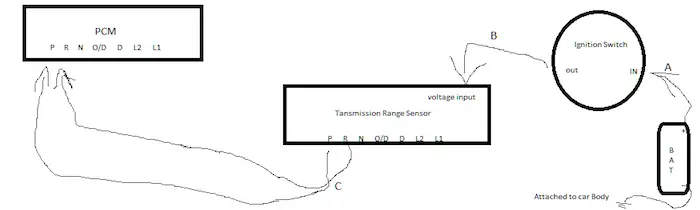
Now, with basic circuit 101 aside, refer to the diagram below. An open circuit at point A, B, or C would cause low voltage at the PCM. A short circuit at the same points would cause a blown fuse and again low voltage at the PCM. Both of these conditions will set the DTC P2802.
To check the exact cause of the DTC, simply check the voltage at points A, B, and C. If there is voltage at A and B but not at C, suspect a faulty range sensor. If there is voltage at C, suspect shorted wiring or, in rare cases based on my experience, a faulty PCM. If there is voltage at A, check only the fuses.
 Related Transmission Range Sensor Codes: P2800, P2801, P2803, and P2804.