

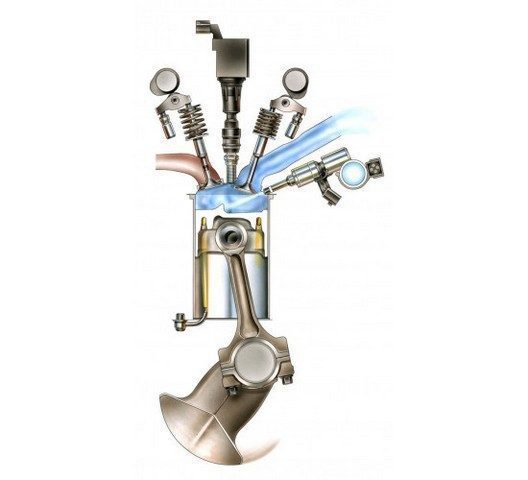
Direct fuel injection is a fuel delivery technology that allows gasoline engines to burn fuel more efficiently, resulting in more power, cleaner emissions, and increased fuel economy.
How Direct Fuel Injection Works
Gasoline engines operate by drawing a mixture of gasoline and air into a cylinder, compressing it with a piston, and igniting it with a spark. The resulting explosion drives the piston downward, producing power. Traditional indirect fuel injection systems pre-mix gasoline and air in a chamber just outside the cylinder called the intake manifold. In a direct injection system, air and gasoline are not pre-mixed. Instead, air enters through the intake manifold, while gasoline is injected directly into the cylinder.
Advantages of Direct Fuel Injection
Combined with ultra-precise computer management, direct injection allows for more precise control of fuel metering, which is the amount of fuel injected and the timing of injection, the exact moment when fuel is introduced into the cylinder. The injector’s location also allows for more optimal atomization that breaks down the gasoline into small droplets. The result is more complete combustion. In other words, more of the gasoline is burned, resulting in more power and less pollution per drop of gasoline.
Disadvantages of Direct Fuel Injection
The main disadvantages of direct injection engines are complexity and cost. Direct injection systems are more expensive to build because their components must be more robust. They handle fuel at significantly higher pressures than indirect injection systems, and the injectors themselves must be able to withstand the heat and pressure of combustion inside the cylinder.
How Much More Powerful and Efficient is the Technology?
The Cadillac CTS was sold with both indirect and direct injection versions of its 3.6-liter V6 engine. The indirect engine produces 263 horsepower and 253 lb-ft of torque, while the direct version develops 304 hp and 274 lb-ft. Despite the extra power, the EPA fuel economy estimates for the direct injection engine are 1 MPG higher in the city (18 MPG vs. 17 MPG) and equal on the highway. Another advantage is that Cadillac’s direct injection engine runs on regular 87-octane gasoline. Competing cars from Infiniti and Lexus, which use 300 hp indirect injection V6 engines, require premium fuel.
Renewed Interest in Direct Fuel Injection
Direct injection technology has existed since the mid-20th century. However, few automakers adopted it for mainstream cars. Electronically controlled indirect fuel injection did the job nearly as well at a significantly lower production cost and offered huge advantages over the mechanical carburetor, which was the dominant fuel delivery system until the 1980s. Developments such as rising fuel prices and stricter fuel economy and emissions legislation have led many automakers to begin developing direct fuel injection systems. You can expect to see more and more cars using direct injection in the near future.
Diesel Cars and Direct Fuel Injection
Almost all diesel engines use direct fuel injection. However, because diesel engines use a different process to burn their fuel, where a traditional gasoline engine compresses a mixture of gasoline and air and ignites it with a spark, diesel engines compress air only, then spray fuel that is ignited by the heat and pressure, their injection systems differ in design and operation from gasoline direct injection systems.