
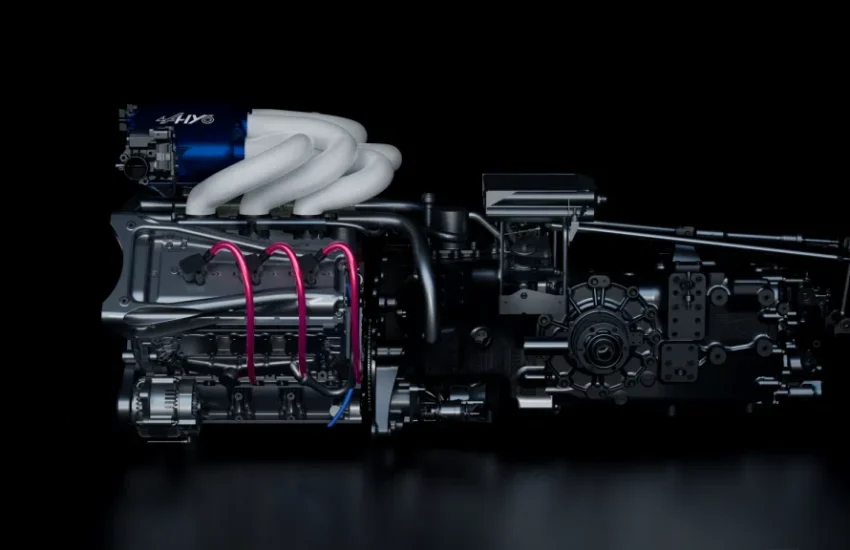
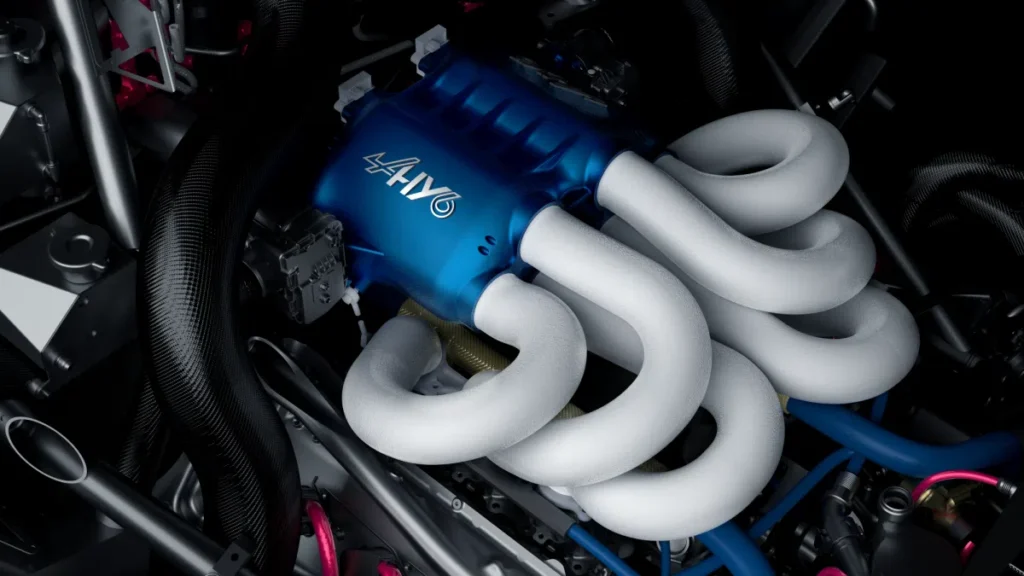
Hydrogen is often presented as the fuel of the future. While fuel cells are the most well-known technology utilizing this energy, hydrogen internal combustion engines (HICE) offer an interesting alternative. Alpine has chosen this path with its concept car “Alpenglow Hy6,” demonstrating the potential of this technology.
How does a hydrogen internal combustion engine work?
The operating principle of HICE is similar to that of a gasoline engine: a mixture of fuel (hydrogen) and air is compressed in the cylinder and then ignited. The resulting explosion pushes the piston, which in turn drives the crankshaft.
However, hydrogen has specific characteristics that require technical adaptations:
- Faster flame and higher temperature: Hydrogen combustion is faster than gasoline and releases higher temperatures. Therefore, the materials used in the engine must be more resistant.
- Need for excess air: Hydrogen requires a high air/fuel ratio for optimal combustion.
- Specific injectors and spark plugs: Injectors must be able to precisely meter hydrogen, and spark plugs must produce a more powerful spark.
Advantages of hydrogen internal combustion engines
- High performance: Hydrogen provides high energy efficiency, allowing for greater specific power output.
- Reduced emissions: Hydrogen engines primarily emit water vapor and very small amounts of nitrogen oxides (NOx). Due to the absence of carbon, they do not produce CO2 during combustion.
- Existing infrastructure: HICE can be integrated into existing vehicles, making their deployment easier.
Challenges to overcome
- Hydrogen production: The production of “green” hydrogen from renewable energy sources is still costly and requires appropriate infrastructure.
- Hydrogen storage: Due to its low energy density per volume, storing hydrogen in vehicles presents a technical challenge.
- Safety: Hydrogen is a flammable gas, necessitating special precautions in tank design and manufacturing.
Future prospects
Hydrogen internal combustion engines offer an interesting alternative to battery-electric vehicles, especially for applications requiring long range and quick refueling times. However, their large-scale development will depend on resolving challenges related to hydrogen production, storage, and distribution.
Conclusion
Hydrogen internal combustion engines represent a promising pathway for decarbonizing transportation. While technical challenges remain, the progress achieved in this field is encouraging. By choosing this technology for its Alpenglow Hy6 concept car, Alpine is contributing to accelerating the development of this innovative solution.
Keywords: hydrogen engine, HICE, Alpine, Alpenglow Hy6, hydrogen, internal combustion engine, clean vehicles, environment, energy, sustainable mobility.