
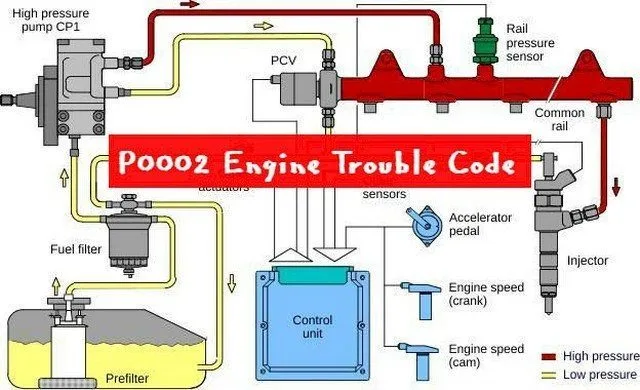
Fuel Volume Regulator Control Circuit Range/Performance P0002

What is the P0002 code?

The P0002 diagnostic code is a generic powertrain code (OBD-II). It applies to many vehicles (Ford, Dodge, Vauxhall/Opel, Volkswagen, Mazda, etc.). Although generic, specific repair steps may vary by make and model.

Symptoms of the P0002 code

This fault, which is not very common, often manifests as:

  • Illuminated check engine light
  • Loss of power or hesitation during acceleration
  • Abnormally high fuel consumption
  • Difficulty starting
  • The vehicle may enter limp mode

What are the likely causes of the P0002 fault?

The P0002 code indicates a problem with the Fuel Volume Regulator Control Circuit Range/Performance. It is frequently observed on common rail diesel engines and direct injection gasoline engines (GDI).

High-pressure fuel systems include a high-pressure fuel pump. Its role is to increase fuel pressure to deliver it to the common rail and injectors. This pump has a fuel volume regulator that controls the pressure. The P0002 code signals that the engine control module (ECU) has detected an electrical value (voltage, resistance, or control signal) outside the normal operating range for this regulator.

Main causes:

  • Faulty fuel volume regulator: The component itself is defective.
  • Wiring problem: Damaged, loose, corroded, or shorted cables related to the regulator.
  • Faulty connector: Poor contact at the regulator plug.
  • Failing high-pressure fuel pump: An internal mechanical issue can skew measurements.
  • Problem with the engine control module (ECU): A rare but possible internal failure.

Diagnosis and repair of the P0002 code

Warning: Handling high-pressure fuel circuits is dangerous. It is strongly recommended to have the diagnosis performed by a qualified mechanic.

The diagnostic process generally includes:

  1. Using an OBD-II scanner to confirm the code and check live data.
  2. Complete visual inspection of the wiring and connectors associated with the regulator for damage.
  3. Electrical measurements (multimeter) to check the regulator’s supply voltage, ground, and control signal.
  4. Measuring the regulator’s resistance and comparing it with manufacturer specifications.
  5. High-pressure fuel pump performance tests.

Conclusion and call to action

The P0002 code points to an electrical malfunction in the fuel volume regulator control circuit. Ignoring this fault can lead to performance loss, excessive fuel consumption, or more severe damage to the injection system.

Is your vehicle displaying the P0002 code? Don’t take risks. Have your vehicle diagnosed by a professional to identify the exact cause and proceed with the appropriate repair to get a personalized quote and get your vehicle back in working order.
P0003 Low Value in Fuel Volume Regulator Control Circuit

Code P0003: Low Value in Fuel Volume Regulator Control Circuit

The fault code P0003 is a generic powertrain code (OBD-II) that indicates an electrical problem in the Fuel Volume Regulator (FVR) control circuit. This fault, often seen in Common Rail diesel engines and Gasoline Direct Injection (GDI) vehicles, signals that the electrical value of the circuit is below the normal range specified by the manufacturer.

What is the Fuel Volume Regulator (FVR)?

In high-pressure systems, the High-Pressure Fuel Pump (HPFP) compresses fuel to deliver it to the common rail and injectors. The Fuel Volume Regulator (FVR) is a solenoid controlled by the Powertrain Control Module (PCM). It regulates pressure by controlling the volume of fuel delivered to the high-pressure pump. A faulty electrical circuit prevents this regulator from functioning correctly, thus disrupting the entire fuel system.

Symptoms of Code P0003

  • Malfunction Indicator Lamp (MIL) illuminated on the dashboard.
  • Hard starting or vehicle not starting.
  • Reduced engine performance (limp mode or random issues).
  • Hesitation, stalling, or loss of power during acceleration.

Potential Causes of P0003 Fault

  • Faulty Fuel Volume Regulator (FVR) Solenoid: The component itself is out of service.
  • Wiring Problem: Cut, chafed, corroded, or short-circuited wires in the harness connected to the FVR.
  • Faulty Connector: Poor contact, oxidation, or damage on the regulator’s electrical connector.
  • Failing PCM (less common): The engine control module does not generate the correct signal.

How to Diagnose and Fix Code P0003?

  1. Check Technical Service Bulletins (TSBs): Consult manufacturer updates for your vehicle (make, model, year, engine). A TSB may sometimes provide a quick solution.
  2. Visual Inspection of Wiring: Examine the harness and connectors between the PCM and the regulator. Look for any signs of damage, corrosion, or disconnection.
  3. Electrical Check: Using a multimeter, measure the resistance and voltage of the FVR circuit following the workshop manual specifications. Warning: Never apply battery voltage directly to the solenoid, as it may damage the PCM.
  4. Replacement of the Regulator: If the wiring is intact, the fuel volume regulator is likely faulty and must be replaced.
  5. Professional Consultation: For an accurate diagnosis, always refer to the official repair manual for your vehicle or consult a qualified mechanic.

Codes Related to P0003

Code P0003 is often associated with other fuel regulation system faults, including:

  • P0001: Fuel Volume Regulator Circuit Performance/Range Problem
  • P0002: Fuel Volume Regulator Circuit Low Value
  • P0004: Fuel Volume Regulator Circuit High Value

Need help diagnosing your vehicle? Use a professional OBD2 scanner and refer to your manufacturer’s service manual for detailed procedures specific to your model.

High Value of the P0004 Fuel Volume Regulator Control Circuit

What is the P0004 fault code?

The P0004 fault code is a generic powertrain (OBD-II) code that indicates a high value in the fuel volume regulator control circuit. It applies to many vehicle brands (Ford, Dodge, Vauxhall, VW, Mazda, etc.), but specific diagnostic steps may vary by model and engine type.

This relatively rare fault is more commonly observed in common rail diesel (CRD) engines and vehicles equipped with gasoline direct injection (GDI). It signals that the powertrain control module (PCM) has detected an abnormally high voltage or electrical signal in the fuel volume regulator (FVR) circuit, a key component in high-pressure systems.

Role of the Fuel Volume Regulator (FVR)

In a high-pressure fuel system, the high-pressure fuel pump (HPFP) supplies the common rail. The fuel volume regulator is a solenoid controlled by the PCM that modulates the fuel flow entering the high-pressure pump to maintain optimal pressure at the rail. A faulty circuit prevents precise regulation, affecting engine performance.

This code is related to codes P0001, P0002, and P0003, which indicate other anomalies in the same circuit.

Symptoms of the P0004 Code

  • 📛 Malfunction Indicator Lamp (MIL) illuminated on the dashboard
  • 🔧 Activation of limp mode with noticeable power loss
  • 🚗 Difficulty starting or failure to start
  • ⛽ Unstable idle and poor fuel consumption

Potential Causes of the P0004 Fault

Several elements can cause this high circuit value:

  • 🔌 Electrical problem: Short to voltage in the FVR wiring or connector.
  • 🛠️ Faulty fuel volume regulator (FVR): Internal solenoid shorted.
  • 💻 PCM failure: An internal failure of the control module is rare but possible.

How to Diagnose and Fix the Problem?

1. Consult Technical Service Bulletins (TSBs)

First, consult the Technical Service Bulletins (TSBs) from your manufacturer for your vehicle’s year, make, and model. A known TSB may provide a direct solution and save valuable time.

2. Visual Inspection of Wiring

Thoroughly inspect the wiring harness and connectors between the PCM and the fuel volume regulator. Look for obvious signs of damage: frayed, burned, pinched wires, or corrosion on the connectors. Repair or replace any damaged components.

3. Electrical Verification

Warning: Never apply battery voltage directly to the FVR wires, as this could severely damage the PCM.

Using a digital multimeter, check the resistance and continuity of the FVR solenoid and ensure there is no short to ground or voltage. Compare your measurements with the manufacturer’s specification values.

4. Professional Diagnosis

Accurate diagnosis of a P0004 code often requires the use of an advanced automotive scanner and reference to vehicle-specific technical documentation. If the previous steps have not identified the cause, it is highly recommended to consult a professional mechanic or refer to your vehicle’s repair manual.

Conclusion and Call to Action

A P0004 code directly affects the fuel system and your engine’s performance. Although a simple visual inspection may sometimes resolve the issue, the complexity of modern systems often makes expert intervention essential.

🔧 Unable to diagnose the fault? Avoid costly trial-and-error repairs. Entrust the diagnosis to a professional equipped with the appropriate tools and technical data for an effective and lasting repair.

P0005 Fuel Shutoff Valve A Control Circuit / Open

Code P0005: Fuel Shutoff Valve A – Control Circuit Open

The error code P0005 is a generic OBD-II code indicating an electrical problem in the fuel shutoff valve control circuit, specifically an open circuit. Although rare, this fault requires special attention to ensure the proper functioning of your vehicle’s fuel system.

Symptoms of Code P0005

The most immediate symptom is the illumination of the Malfunction Indicator Lamp (MIL) on your dashboard. Depending on the vehicle, you may also experience:

  • Difficulty starting the engine
  • Engine misfires or power loss
  • Abnormal increase in fuel consumption
  • Engine stalling at idle

Likely Causes of the Fault

A P0005 code is primarily related to a problem in the electrical circuit of the fuel shutoff valve. The most common causes include:

  • A blown fuse or faulty relay
  • Damaged, corroded, or loose wiring harness
  • Faulty or oxidized electrical connector
  • Internal failure of the fuel shutoff valve itself
  • A problem with the Powertrain Control Module (PCM)

Diagnosis and Possible Solutions

Troubleshooting a P0005 code requires a methodical approach to identify the exact source of the open circuit.

  1. Visual Inspection: Carefully inspect the wiring and connectors associated with the fuel shutoff valve for any obvious signs of damage, corrosion, or poor connection.
  2. Electrical Testing: Using a multimeter, check the supply voltage and ground of the valve control circuit. Also test the resistance of the valve coil to confirm it is not open.
  3. Fuse/Relay Inspection: Consult your vehicle’s fuse diagram to locate and test the fuse and relay dedicated to the valve circuit.

For precise diagnostic procedures and specific test values for your vehicle model, it is highly recommended to consult a factory repair manual or the manufacturer’s technical data.

Repair and Prevention

Once the root cause is identified, the repair may involve:

  • Replacing a blown fuse
  • Repairing or replacing a damaged wiring harness
  • Cleaning oxidized connectors
  • Replacing the faulty fuel shutoff valve

🚗 Need help diagnosing your vehicle? This code often requires the use of specialized diagnostic equipment. If you do not have the necessary tools or expertise, consult a professional mechanic for an accurate diagnosis and reliable repair.

P0006 Low Control Circuit Value for Fuel Shutoff Valve “A

Fault Code P0006: Fuel Shutoff Valve “A” Control Circuit Low

The diagnostic trouble code P0006 is a generic code related to the fuel shutoff valve control circuit. It indicates that the Powertrain Control Module (PCM) has detected an abnormally low voltage (a short to ground) in the fuel shutoff valve “A” control circuit.

Symptoms of Code P0006

Although this code is rare, its appearance is often accompanied by the following symptoms:

  • Illumination of the Malfunction Indicator Lamp (MIL) on the dashboard.
  • Unstable or irregular idle.
  • Engine starting difficulties.
  • Loss of power or poor engine performance.
  • In rare cases, the engine may not start at all.

Probable Causes of the Fault

The P0006 fault is mainly related to an electrical problem in the valve circuit. The most common causes are:

  • Damaged wiring: frayed, cut, or melted wires.
  • A faulty connector: oxidized, loose, or corroded pins.
  • A short to ground in the control circuit.
  • The fuel shutoff valve itself is faulty (internal short circuit).
  • A rare failure of the Powertrain Control Module (PCM).

Diagnosis and Possible Solutions

Diagnosing this code requires a methodical approach. It is highly recommended to consult a vehicle-specific repair manual for exact procedures (reference voltages, resistance values, component locations). Here are the general troubleshooting steps:

  1. Clear the code and see if it returns to confirm the fault.
  2. Visually inspect the wiring and connectors associated with the fuel shutoff valve. Look for any signs of damage, corrosion, or debris.
  3. Using a multimeter, test the resistance of the fuel shutoff valve and compare it to the manufacturer’s specifications.
  4. Check for continuity and the absence of a short to ground in the control wires.
  5. If the wiring and connectors are in good condition, the fuel shutoff valve or the PCM is likely faulty.

⚠️ Warning: This code is complex and pertains to automotive electronics. If you do not have the necessary skills or equipment (multimeter, oscilloscope), it is advisable to entrust the diagnosis to a professional mechanic.

Call to Action

The P0006 code should not be ignored, as it can affect your vehicle’s performance and reliability. Consult a professional for an accurate diagnosis or obtain a service manual specific to your model to guide your repairs.

P0007 High Value of Fuel Shutoff Valve Control Circuit “A

What is the P0007 fault code?

The P0007 fault code is a generic code related to the high value of the fuel shutoff valve “A” control circuit. This relatively rare code indicates that the Powertrain Control Module (PCM) has detected an abnormally high voltage in the electrical circuit controlling the fuel shutoff valve.

Symptoms of the P0007 code

Although the most common symptom is the illumination of the Malfunction Indicator Lamp (MIL) on your dashboard, other signs may accompany this fault:

  • Difficulty starting the engine
  • Rough or unstable idle
  • Loss of power or hesitation during acceleration
  • In rare cases, the engine may not start at all

Potential causes of the fault

A “high value” in an electrical circuit generally points to an open circuit problem or excessive resistance. Possible causes of the P0007 code include:

  • Damaged wiring that is loose, corroded, or short-circuited in the valve circuit
  • A faulty or oxidized connector at the fuel shutoff valve or the PCM
  • A problem with the PCM itself (rare internal failure)
  • A faulty fuel shutoff valve

How to diagnose and resolve the P0007 code?

Diagnosing this code requires automotive mechanical skills and the use of specific tools like a multimeter and an OBD2 scanner.

Recommended troubleshooting steps:

  1. Visual Inspection: Start with a thorough inspection of all wiring and connectors associated with the fuel shutoff valve. Look for obvious signs of damage, corrosion, or poor connections.
  2. Electrical Testing: Using a multimeter, check the voltage and continuity of the valve control circuit to identify any breaks or abnormal resistance.
  3. Consulting a Repair Manual: Since the exact procedure varies significantly from one vehicle to another, it is highly recommended to consult a technical service manual specific to your model for reference values and the precise electrical diagram.

Is it safe to drive with a P0007 code?

It is not advisable to drive long distances with this active fault. Although the vehicle may seem to operate normally in some cases, the problem can lead to an inability to start the engine or a sudden breakdown.

Call to action

Diagnosing the P0007 code can be complex. If you are not comfortable with electrical testing, entrust the diagnosis to a professional mechanic. They will have the expertise and necessary tools to identify and resolve the issue quickly and effectively, saving you from costly trial-and-error repairs.

P0008 Engine Position System Performance, Bank 1

What is the P0008 fault code?

The P0008 fault code is a generic powertrain-related code that indicates a performance issue with the engine position system on bank 1. It applies to most vehicles equipped with the OBD-II standard, including brands like General Motors (Chevrolet, GMC, Cadillac, Buick), Suzuki, and Holden.

Causes and Meaning of the P0008 Fault

This code is triggered when the Engine Control Module (ECM) detects an abnormal misalignment between the camshafts on bank 1 and the crankshaft. The ECM continuously compares learned timing values to a stored reference value. If the deviations exceed a certain calibrated threshold, the P0008 code is recorded in the computer’s memory.

This issue is often related to a stretched or malfunctioning timing chain, particularly on certain GM engines known for this weakness, such as the 3.6L LY7, 3.6L LLT, or 2.8L LP1. Technical Service Bulletins (TSBs) exist for these models, often recommending the replacement of the timing chain and tensioners.

It is common for P0008 to appear alongside other engine timing-related codes, such as P0009, P0016, P0017, P0018, and P0019. “Bank 1” always refers to the side of the engine where cylinder number 1 is located.

Symptoms of the P0008 Code

When this fault is active, you may observe one or more of the following symptoms:

  • 🚨 Malfunction Indicator Lamp (MIL) illuminated on the dashboard
  • 🔊 Abnormal metallic rattling noise coming from the timing cover
  • Reduced engine performance and loss of power
  • Excessive fuel consumption
  • 🔁 Irregular idle or difficulty accelerating
  • 🔧 In the most severe cases, stalling or failure to start

Diagnosis and Possible Solutions

Diagnosing this code requires the use of a professional OBD2 scanner to check live data from the position sensors (camshaft sensor, crankshaft sensor). A mechanical inspection of the timing system is often essential.

Possible causes include:

  • A timing chain that is loose, stretched, or faulty
  • A worn or broken chain tensioner or guide
  • A defective pulley or timing component
  • Insufficient engine oil pressure
  • A faulty position sensor (camshaft/crankshaft)
  • An issue with engine timing after repair work

The most common repair for many GM vehicles is the complete replacement of the timing kit (chain, tensioners, guides, sprockets).

Call to Action

The P0008 code indicates a potentially serious mechanical problem that can lead to significant engine damage if left untreated. It is highly recommended to consult a professional mechanic for an accurate diagnosis. Avoid driving the vehicle long distances until the issue is resolved.

Need help diagnosing or repairing this fault? Contact a specialized garage today for a personalized quote.

P0009 Engine Position System Performance, Row 2

Code P0009: Engine Position System Performance, Bank 2

The fault code P0009 is a generic powertrain code (OBD-II) that indicates a timing problem between the camshafts of engine bank 2 and the crankshaft. This guide explains its causes, symptoms, and repair solutions.

What is Code P0009?

The Engine Control Module (ECM) continuously monitors the alignment of the camshafts relative to the crankshaft. Code P0009 is triggered when the ECM detects a persistent and significant misalignment on bank 2 of the engine (the side that does not contain cylinder #1), exceeding the manufacturer’s specified tolerances.

This fault is common on certain engines from brands like General Motors (GM, Cadillac, Buick, Holden) and Suzuki, for which technical service bulletins often exist. It rarely appears alone and is usually accompanied by other timing-related codes, such as P0008, P0016, P0017, P0018, or P0019.

Symptoms of Fault P0009

When this code is stored, you may observe one or more of the following symptoms:

  • 🔴 Illumination of the check engine light (MIL) on the dashboard
  • Loss of power and hesitant acceleration
  • Increased fuel consumption
  • 🔊 Rattling or knocking noise coming from the timing cover
  • 🚗 Engine running rough at idle

Possible Causes of Code P0009

The misalignment causing code P0009 typically stems from one of these issues:

  • Stretched or worn timing chain (most common cause on GM engines)
  • Faulty chain tensioner or worn guide
  • Misaligned crankshaft reluctor wheel
  • Problem with the drive sprockets or phasers
  • Poor quality engine oil or insufficient oil level

How to Diagnose and Repair Code P0009?

Warning: If your vehicle is still under powertrain warranty, take it immediately to an authorized dealer.

For other cases, here is the recommended procedure:

  1. Start with a complete fault code scan to identify all present DTCs.
  2. Inspect the engine oil level and quality. Perform an oil change if necessary.
  3. Using an advanced diagnostic tool, observe the real-time data from the camshaft position (CMP) and crankshaft position (CKP) sensors.
  4. Visually inspect the timing cover to check the chain tension, and the condition of the tensioner and guides.
  5. Check the alignment of the timing marks.
  6. On affected GM engines (such as the 3.6L LY7/LLT or 2.8L LP1), the official fix often involves replacing the complete timing kit (chains, tensioners, guides).

⚠️ Important Tip: Always consult a repair manual specific to your make and model for exact timing procedures and torque values. This repair is complex and requires mechanical expertise.

Call to Action

Code P0009 indicates a serious mechanical problem that should not be ignored. An overly stretched timing chain can jump and cause catastrophic engine damage.

Suspect a timing problem? Don’t take risks. Have your vehicle diagnosed by a professional today to get an accurate quote and avoid a costly breakdown.

P000A Slow Response Camshaft Position, Bank 1

What is the P000A Code?

The error code P000A, also known as “A Camshaft Position Slow Response, Bank 1,” is a generic code related to the powertrain. It applies to vehicles equipped with a Variable Valve Timing (VVT) system and indicates that the Powertrain Control Module (PCM) has detected a slow response from the intake camshaft (bank 1) during phase changes.

VVT System Operation

Modern vehicles use Variable Valve Timing (VVT) to optimize performance and reduce fuel consumption. The PCM controls a solenoid that directs engine oil to an actuator located on the camshaft. This actuator then adjusts the angular position (phase) of the camshaft. A Camshaft Position (CMP) sensor monitors this position in real time. Code P000A is triggered when the actual position does not match the position desired by the PCM with an abnormal delay.

Decoding the P000A Code

  • A: Refers to the intake camshaft (or left/front).
  • Bank 1: The side of the engine where cylinder number 1 is located.

This code is often associated with codes P000B, P000C, and P000D.

Severity and Symptoms of Code P000A

The severity of this code is moderate to severe. It is recommended to perform diagnostics as soon as possible to avoid potential engine damage.

Common Symptoms

  • Illuminated check engine light
  • Reduced performance and hesitation during acceleration
  • Abnormally high fuel consumption
  • Start-up noise or abnormal sounds
  • Increased pollutant emissions

Possible Causes of Code P000A

  • Low engine oil level or poor-quality oil
  • Faulty Camshaft Position (CMP) sensor
  • Clogged or malfunctioning VVT control solenoid
  • Stuck or worn VVT actuator (phaser)
  • Voltage or wiring issue
  • Excessive play or timing chain problem
  • Rare PCM failure

How to Diagnose and Repair Code P000A?

Important Tip: Procedures vary by model. Always consult the specific wiring diagrams and diagnostic flowchart for your vehicle (via ALLDATA or a repair manual).

1. Preliminary Checks

  • Check the engine oil level and condition. Dirty oil or a low level is a common cause.
  • Visually inspect the wiring and connectors of the CMP sensor and VVT solenoid for any signs of damage or corrosion.
  • Check the Technical Service Bulletins (TSB) for your vehicle.

2. Testing the Camshaft Position (CMP) Sensor

Hall Effect Sensor (3 wires): Connect a digital multimeter (DMM) to the signal wire. With the engine running, the voltage should fluctuate. A steady reading indicates a faulty sensor.
Magnetic Sensor (2 wires): Measure the AC voltage across the sensor terminals. It should fluctuate at idle. If not, replace the sensor.

3. Testing the VVT Solenoid

  • Disconnect the connector and measure its internal resistance with a multimeter. Compare the reading to the manufacturer’s specifications.
  • Remove the solenoid and clean or replace its internal filter if it is clogged with metal debris.

4. Checking the Timing Chain and Actuators

If electrical tests are good, the problem may be mechanical. It may be necessary to disassemble components to inspect:

  • The play of the timing chain.
  • The condition of the guides and tensioners.
  • The wear of the VVT actuator (phaser) teeth.

Call to Action

Diagnosing code P000A can be complex. If you do not have the necessary equipment or expertise, consult a professional mechanic for accurate diagnosis and reliable repair.

P000B B Camshaft Position Slow Response Bank 1

What is the P000B Code?

The error code P000B is a generic powertrain code indicating a slow response from camshaft position “B”, bank 1. It applies to vehicles equipped with a Variable Valve Timing (VVT) system. This issue affects brands such as Subaru, Dodge, VW, Audi, Jeep, GMC, Chevrolet, Saturn, Chrysler, Ford, etc.

VVT System Operation and Causes of the Fault

The VVT system optimizes performance and fuel consumption. The Powertrain Control Module (PCM) controls a solenoid that directs engine oil to adjust the camshaft position via an actuator. Code P000B is triggered when the actual camshaft position does not match the position desired by the PCM.

The designation “B” typically refers to the exhaust camshaft, and “bank 1” indicates the side of the engine where cylinder number 1 is located.

Severity and Symptoms

This fault is of moderate to severe severity and should be addressed promptly to avoid engine damage.

Common Symptoms:

  • Check engine light illuminated
  • Decreased engine performance
  • Increased fuel consumption
  • Abnormal noises from the engine
  • Excessive pollutant emissions

Possible Causes of Code P000B

  • Insufficient engine oil level or pressure
  • Faulty Camshaft Position Sensor (CMP)
  • VVT control solenoid stuck or clogged
  • Damaged VVT actuator
  • Timing chain issue (excessive slack, worn guides)
  • Damaged electrical wiring or faulty connectors
  • PCM failure (rare)

How to Diagnose Code P000B?

⚠️ Warning: These steps are general. Refer to the specific technical documentation for your vehicle for an accurate procedure.

1. Preliminary Checks

  • Check the engine oil level and condition.
  • Visually inspect the CMP sensor, VVT solenoid, and their wiring for damage or loose connections.
  • Consult Technical Service Bulletins (TSB) for your model.

2. Camshaft Position Sensor (CMP) Test

Identify the sensor type (Hall effect or permanent magnet) and use a multimeter to measure its signal. A lack of fluctuating signal indicates a faulty sensor.

3. Sensor Circuit Test

Check the sensor circuit’s power supply (5V or 12V depending on type) and ground using a multimeter.

4. VVT Control Solenoid Test

  • Measure its internal resistance and compare it to the manufacturer’s specifications.
  • Inspect and clean the solenoid’s filter screen, often clogged with metal debris.

5. Solenoid Circuit Test

Verify that the solenoid receives 12V power and that its ground circuit is functional.

6. Mechanical Inspection

If electrical tests are conclusive, inspect the timing chain (tension, guide wear) and VVT actuators for any mechanical play or damage.

Conclusion and Call to Action

Code P000B is often related to an oil issue, faulty sensor, or solenoid. A methodical diagnosis is essential to avoid costly repairs.

Not comfortable performing these tests yourself? Leave the diagnosis to a professional. Use our online tool to get a personalized quote.