
P04A8 Low Circuit Value of Exhaust Pressure Control Solenoid Valve B

What Does It Mean?


This generic powertrain diagnostic trouble code (DTC) generally applies to all OBD-II equipped vehicles with an exhaust pressure control valve sensor or switch. This may include, but is not limited to, vehicles from VW, Audi, Toyota, etc. Although generic, the exact repair steps may vary by make/model.

The Exhaust Pressure Control (EPC) valve is a solenoid valve used to regulate backpressure during cold weather. This allows for increased cabin heat, facilitates cold starting, and windshield defrosting.

In most cases, the Powertrain Control Module (PCM) uses information from the Exhaust Back Pressure (EBP) sensor, Intake Air Temperature (IAT) sensor, and Manifold Absolute Pressure (MAP) sensor to determine valve control. If the PCM detects a problem with the EPC or IAT, it will disable the ECP. Typically, the ECP is found on diesel engines.

In the codes described in this article, the “B” indicates that the issue concerns a part of the system circuit, rather than a specific symptom or component.

The P04A8 code is set when the PCM detects a signal from the low exhaust pressure control valve circuit. This usually indicates that the circuit is short-circuited.
How Severe Is This DTC?


The severity of this code is moderate to severe. It’s a good idea to address this code as soon as possible.

What are some of the symptoms of the code?

Symptoms of a P04A8 trouble code may include:

Check Engine Light
Increased emissions
Poor engine performance
Hard starting

What are some common causes of the code?

Causes

of this code may include:

Faulty exhaust pressure control valve
Wiring issues
Faulty PCM

What are the troubleshooting steps for P04A8?


Start by checking the exhaust pressure control valve and its corresponding wiring. Look for loose connections, damaged wiring, etc. If damage is detected, repair as necessary, clear the code, and see if it returns. Next, check Technical Service Bulletins (TSBs) regarding the issue. If nothing is found, you’ll need to proceed with step-by-step system diagnostics.

The following is a generalized procedure, as tests for this code vary by vehicle. To accurately test the system, you’ll need to refer to the manufacturer’s diagnostic flowchart.
Check the Wiring

Before continuing, you’ll want to consult factory wiring diagrams to determine which wires are which. Autozone offers free online repair manuals for many vehicles, and ALLDATA offers single-vehicle subscriptions.
Test the Solenoid

Remove the solenoid connector. Use a digital multimeter set to ohms to check the solenoid’s internal resistance. To do this, connect the multimeter between the solenoid’s B+ terminal and the solenoid’s ground terminal. Compare the resistance measurement to factory repair specifications. If the meter displays a reading outside specifications or Out of Limits (OL) indicating an open circuit, the solenoid must be replaced.
Check the Power Side of the Circuit

Ensure the vehicle has been sitting for at least a few hours (overnight is preferable) and is cold. Remove the solenoid connector. With the ignition on, use a digital multimeter set to DC volts to check the solenoid’s power (usually 12 volts). To do this, connect the multimeter’s negative lead to ground and the multimeter’s positive lead to the solenoid’s B+ terminal on the harness side of the connector. If voltage is not present, set the meter to ohms (ignition off) between the solenoid connector’s B+ terminal and the PCM’s solenoid supply voltage terminal. If the meter reads Out of Limits (OL), there is an open circuit between the PCM and the sensor that will need to be located and repaired. If the meter reads a numerical value, there is continuity.

If everything is okay up to this point, you’ll want to check that the PCM is powered. To do this, turn the ignition on and set the meter to DC volts. Connect the meter’s positive lead to the PCM’s EPC supply voltage terminal and the negative lead to ground. If there is no reference voltage from the PCM, the PCM is likely faulty. However, PCMs rarely fail, so it’s a good idea to recheck your work up to this point.
Check the Ground Side of the Circuit

With the ignition off, use a digital multimeter set to ohms to check for ground continuity. Remove the solenoid connector. Connect the multimeter between the solenoid’s ground terminal and chassis ground. If the meter reads a numerical value, there is continuity. If the meter reads Out of Limits (OL), there is an open circuit between the PCM and the solenoid that will need to be located and repaired.

P04A9 High Value in Exhaust Pressure Control Valve B Circuit

What does it mean?


This generic powertrain diagnostic trouble code (DTC) generally applies to all OBD-II equipped vehicles with an exhaust pressure control valve sensor or switch. This may include, but is not limited to, vehicles from VW, Audi, Toyota, etc. Although generic, the exact repair steps may vary by make/model.

The exhaust pressure control (EPC) valve is a solenoid valve used to regulate backpressure during cold weather. This allows for increased cabin heat, facilitates cold starting, and windshield defrosting.

In most cases, the powertrain control module (PCM) uses information from the exhaust backpressure (EBP) sensor, intake air temperature (IAT) sensor, and manifold absolute pressure (MAP) sensor to determine valve control. If the PCM detects a problem with the EPC or IAT, it will disable the EPC. Typically, the EPC is found on diesel engines.

In the codes described in this article, the “B” indicates that the issue concerns a part of the system circuit, rather than a specific symptom or component.

Code P04A9 is set when the PCM detects a high exhaust pressure control valve circuit signal. This usually indicates an open circuit.
How severe is this DTC?


The severity of this code is moderate to severe. It’s a good idea to address this code as soon as possible.

What are some of the symptoms of the code?

Symptoms of a P04A9 trouble code may include:

Check engine light
Increased emissions
Poor engine performance
Hard starting

What are some common causes of the code?

Causes

of this code may include:

Faulty exhaust pressure control valve
Wiring issues
Faulty PCM

What are the troubleshooting steps for P04A9?


Start by checking the exhaust pressure control valve and its corresponding wiring. Look for loose connections, damaged wiring, etc. If damage is found, repair as needed, clear the code, and see if it returns. Then, check for technical service bulletins (TSBs) regarding the issue. If nothing is found, you’ll need to proceed with step-by-step system diagnostics.

The following is a generalized procedure, as tests for this code vary by vehicle. To accurately test the system, you’ll need to refer to the manufacturer’s diagnostic flowchart.
Check the wiring

Before continuing, you’ll want to consult factory wiring diagrams to determine which wires are which. Autozone offers free online repair manuals for many vehicles, and ALLDATA offers single-vehicle subscriptions.
Test the solenoid

Remove the solenoid connector. Use a digital multimeter set to ohms to check the solenoid’s internal resistance. To do this, connect the multimeter between the solenoid’s B+ terminal and the solenoid’s ground terminal. Compare the resistance measurement to factory repair specifications. If the meter displays a reading outside specifications or out of limits (OL) indicating an open circuit, the solenoid must be replaced.
Check the power side of the circuit

Ensure the vehicle has been sitting for at least a few hours (overnight is preferable) and is cold. Remove the solenoid connector. With the ignition on, use a digital multimeter set to DC volts to check the solenoid’s power (usually 12 volts). To do this, connect the multimeter’s negative lead to ground and the multimeter’s positive lead to the solenoid’s B+ terminal on the harness side of the connector. If voltage is not present, set the meter to ohms (ignition off) between the solenoid connector’s B+ terminal and the PCM’s solenoid supply voltage terminal. If the meter reads out of limits (OL), there is an open circuit between the PCM and the sensor that will need to be located and repaired. If the meter reads a numerical value, there is continuity.

If everything is okay up to this point, you’ll want to check that the PCM is powered. To do this, turn the ignition on and set the meter to DC volts. Connect the meter’s positive lead to the PCM’s EPC supply voltage terminal and the negative lead to ground. If there is no reference voltage from the PCM, the PCM is likely faulty. However, PCMs rarely fail, so it’s a good idea to recheck your work up to this point.
Check the ground side of the circuit

With the ignition off, use a digital multimeter set to ohms to check for ground continuity. Remove the solenoid connector. Connect the multimeter between the solenoid’s ground terminal and chassis ground. If the meter reads a numerical value, there is continuity. If the meter reads out of limits (OL), there is an open circuit between the PCM and the solenoid that will need to be located and repaired.

P04AA Intermittent Exhaust Pressure Control Valve Circuit

What does it mean?


This generic powertrain diagnostic trouble code (DTC) generally applies to all OBD-II equipped vehicles with an exhaust pressure control valve sensor or switch. This may include, but is not limited to, vehicles from VW, Audi, Toyota, etc. Although generic, the exact repair steps may vary by make/model.

The Exhaust Pressure Control (EPC) valve is a solenoid valve used to regulate backpressure during cold weather. This allows for increased cabin heat, facilitates cold starting, and windshield defrosting.

In most cases, the Powertrain Control Module (PCM) uses information from the Exhaust Back Pressure (EBP) sensor, the Intake Air Temperature (IAT) sensor, and the Manifold Absolute Pressure (MAP) sensor to determine valve control. If the PCM detects a problem with the EPC or IAT, it will disable the ECP. Typically, the ECP is found on diesel engines.

In the codes described in this article, the “B” indicates that the problem concerns a part of the system circuit, rather than a specific symptom or component.

The P04AA code is set when the PCM detects an intermittent problem with the exhaust pressure control valve circuit.
How severe is this DTC?


The severity of this code is moderate to severe. It’s a good idea to address this code as soon as possible.

What are some of the symptoms of the code?

Symptoms of a P04AA trouble code may include:

Check Engine Light illuminated
Increased emissions
Poor engine performance
Hard starting

What are some of the common causes of the code?

Causes

of this code may include:

Faulty exhaust pressure control valve
Wiring problems
Faulty PCM

What are the troubleshooting steps for P04AA?


Start by checking the exhaust pressure control valve and its corresponding wiring. Look for loose connections, damaged wiring, etc. If damage is detected, repair as necessary, clear the code, and see if it returns. Next, check for Technical Service Bulletins (TSBs) related to the issue. If nothing is found, you will need to proceed with step-by-step system diagnostics.

The following is a generalized procedure, as tests for this code vary by vehicle. To accurately test the system, you will need to refer to the manufacturer’s diagnostic flowchart.
Check the wiring

Before continuing, you will want to consult factory wiring diagrams to determine which wires are which. Autozone offers free online repair manuals for many vehicles, and ALLDATA offers single-vehicle subscriptions.
Test the solenoid

Remove the solenoid connector. Use a digital multimeter set to ohms to check the internal resistance of the solenoid. To do this, connect the multimeter between the solenoid B+ terminal and the solenoid ground terminal. Compare the resistance measurement to the factory repair specifications. If the meter displays a reading outside of specifications or Out of Limits (OL) indicating an open circuit, the solenoid must be replaced.
Check the power side of the circuit

Ensure the vehicle has sat for at least a few hours (overnight is preferable) and is cold. Remove the solenoid connector. Ignition on, use a digital multimeter set to DC volts to check for power at the solenoid (typically 12 volts). To do this, connect the multimeter’s negative lead to ground and the multimeter’s positive lead to the solenoid B+ terminal on the harness side of the connector. If voltage is not present, set the meter to ohms (ignition off) between the solenoid connector B+ terminal and the solenoid power supply voltage terminal at the PCM. If the meter reads Out of Limits (OL), there is an open circuit between the PCM and the sensor that will need to be located and repaired. If the meter reads a numerical value, there is continuity.

If everything is okay up to this point, you will want to check that the PCM is providing power. To do this, turn the ignition on and set the meter to DC volts. Connect the meter’s positive lead to the EPC power supply voltage terminal at the PCM and the negative lead to ground. If there is no reference voltage from the PCM, the PCM is likely faulty. However, PCMs rarely fail, so it’s a good idea to double-check your work up to this point.
Check the ground side of the circuit

Ignition off, use a digital multimeter set to ohms to check for ground continuity. Remove the solenoid connector. Connect the multimeter between the solenoid ground terminal and chassis ground. If the meter reads a numerical value, there is continuity. If the meter reads Out of Limits (OL), there is an open circuit between the PCM and the solenoid that will need to be located and repaired.

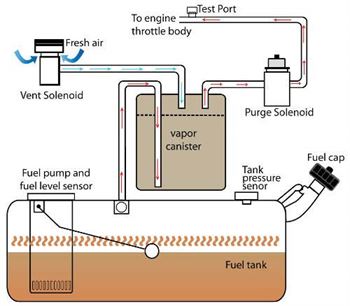
EVAP System Control Circuit Malfunction – Code P0446 – Toyota

The OBD-II code P0446 often triggers along with other related EVAP codes (such as P0441), and the specific combination of codes can give your mechanic a better idea of where the actual problem lies.

What the code indicates

More specifically, P0446 indicates a malfunction in the vent control circuit of the Evaporative Emission Control (EVAP) system. Generally, this points to a faulty vent valve, a bad control circuit for that valve, or a blockage in the vent valve. In any case, it clearly indicates to the mechanic that an inspection of the EVAP vent valve is necessary.

The job of the vent valve is to seal the vent so that the EVAP system can pressurize and check itself for leaks. Battery voltage is typically supplied to the vent valve when the key is turned on via a ground circuit in the Engine Control Module (ECM). The valve closes when activated, allowing pressure to build up in the EVAP canister. If the valve does not close or if a vacuum cannot be maintained during this test, code P0441 will trigger in the ECM.

How to fix code P0446

To resolve this issue in your Toyota, you will need to test the vent valve circuit from the ECM to the valve to ensure it closes and receives power when the key is turned on (the engine does not need to be running). Check the resistance on the control circuit against the specifications in your manual. If everything is in order, replace the vent valve and reset the ECM/PCM codes.

If other codes are also triggering, before replacing the vent valve, check them to see if the problem is not further upstream and causing the P0441 as a trigger.

Random misfire detected

What does it mean?


This diagnostic code (DTC) is a generic powertrain code. It is considered generic because it applies to all makes and models of vehicles (1996 and newer), although specific repair steps may vary slightly by model. Therefore, this engine code article applies to Chevrolet, Ford, Nissan, Toyota, Dodge, Honda, GMC, etc.

Basically, this P0300 code means that the car’s computer has detected that not all of the engine’s cylinders are functioning properly.

A P0300 diagnostic code indicates a random or multiple misfire. If the last digit is a number other than zero, it corresponds to the cylinder number that misfired. A P0302 code, for example, would tell you that cylinder number two is misfiring. Unfortunately, a P0300 does not specifically tell you which cylinder(s) is/are failing, nor why.

P0300 Mechanic


Symptoms


Symptoms may include:

the engine may be harder to start
the engine may stumble/stall and/or hesitate
other symptoms may also be present

Causes


A P0300 code can mean that one or more of the following has occurred:

Faulty spark plugs or spark plug wires
Faulty coil (pack)
Faulty oxygen sensor(s)
Faulty fuel injector(s)
Burned exhaust valve
Faulty catalytic converter(s)
Stuck/blocked/leaking EGR valve/passages
Faulty camshaft position sensor
Faulty computer

Possible Solutions


If there are no symptoms, the simplest thing to do is to reset the code and see if it returns.

If there are symptoms such as the engine stumbling or hesitating, check all the wires and connectors leading to the cylinders (i.e., spark plugs). Depending on the lifespan of the ignition components in the car, it may be wise to replace them as part of your regular maintenance schedule. I would suggest spark plugs, spark plug wires, distributor cap and rotor (if applicable). Otherwise, check the coils (e.g., coil packs). In some cases, the catalytic converter has failed. If you smell rotten eggs in the exhaust, your catalytic converter needs to be replaced. I have also heard in other cases that the problems were faulty fuel injectors.

Random misfires that jump from one cylinder to another (read: P030x codes) will also set a P0300 code. The underlying cause is often a lean fuel condition, which can be due to a vacuum leak in the intake manifold or unmetered air getting past the mass airflow sensor, or an EGR valve that is stuck open.

It is helpful to have access to a factory service manual and an advanced scan tool to properly diagnose a random misfire DTC.

Misfire Cylinder No. 1

What does it mean?

This diagnostic trouble code (DTC) is a generic powertrain code, meaning it applies to vehicles equipped with OBD-II. Although generic, specific repair steps may vary by make/model.

A P0301 code means the car’s computer has detected that one of the engine’s cylinders is not functioning properly. In this case, it’s cylinder number 1.

Symptoms may include:

  • The engine may be harder to start
  • The engine may stumble/misfire and/or hesitate
  • Other symptoms may also be present

Causes A P0301 code can mean one or more of the following has occurred:

  • Faulty spark plug or wire
  • Faulty ignition coil (pack)
  • Faulty oxygen sensor(s)
  • Faulty fuel injector
  • Burned exhaust valve
  • Faulty catalytic converter(s)
  • Fuel shortage
  • Poor compression
  • Faulty computer

Possible Solutions

If there are no symptoms, the simplest thing to do is reset the code and see if it returns.

If there are symptoms such as engine stumbling or hesitation, check all cables and connectors leading to the cylinders (i.e., spark plugs). Depending on the lifespan of ignition components in the car, it may be wise to replace them as part of your regular maintenance schedule. I suggest spark plugs, spark plug wires, distributor cap and rotor (if applicable). Otherwise, check the ignition coils (e.g., coil packs). In some cases, the catalytic converter has failed. If you smell rotten eggs from the exhaust, your catalytic converter needs replacement. I’ve also heard in other cases that the issues were faulty fuel injectors.

Cylinder 2 misfire detected

Meaning of Code P0302

This generic OBD-II code indicates a specific misfire in cylinder 2, detected by the Powertrain Control Module (PCM). A misfire occurs when the air-fuel mixture fails to ignite properly, disrupting engine timing. This code applies to various vehicles (Ford, Toyota, Honda, etc.), but diagnostic steps vary by model.


Severity

Severe Level:

  • Risk of catalytic converter damage and premature engine wear.

  • Requires immediate attention to avoid costly repairs.


Common Symptoms

  • Check engine light on (flashing or steady).

  • Rough idle or abnormal vibrations.

  • Loss of power and hesitant acceleration.

  • Gasoline smell or black smoke from the exhaust.

  • Increased fuel consumption.


Possible Causes

  1. Ignition Issues:

    • Faulty ignition coil (cylinder 2).

    • Worn, cracked, or fouled spark plug.

    • Damaged spark plug wires or boots.

  2. Fuel Problems:

    • Clogged or malfunctioning fuel injector.

    • Insufficient fuel pressure (failed pump or filter).

  3. Mechanical Issues:

    • Vacuum leak (cracked hoses, intake gasket).

    • Blocked or dirty EGR system.

    • Low compression (worn rings, faulty valves).


Diagnostic Procedure

Step 1: Visual and Preliminary Inspection

  1. Check ignition components:

    • Inspect cylinder 2’s coil, spark plug, and wires (for oil, coolant, corrosion).

    • Replace spark plugs if maintenance interval is exceeded.

  2. Look for vacuum leaks:

    • Use a smoke machine or leak detection spray around the intake manifold.

Step 2: Testing Ignition and Fuel Systems

  1. Spark test:

    • Disconnect cylinder 2’s coil and observe the spark (should be blue and strong).

    • Compare with a functioning coil.

  2. Injector test:

    • Use a mechanical stethoscope to listen for injector clicking.

    • Measure injector resistance (typically 10-15 Ω).

Step 3: EGR System Check

  • Clean clogged EGR ports (use a decarbonizing agent).

  • Test the EGR valve with a diagnostic tool (check opening/closing).

Step 4: Advanced Analysis

  1. Use an OBD-II scanner:

    • Read real-time data (misfires, fuel pressure, short/long-term fuel trim).

    • Check for related codes (e.g., P0171: Lean mixture).

  2. Compression test:

    • Measure cylinder 2’s compression (a difference >15% from other cylinders indicates a mechanical issue).


Recommended Solutions

  • Replace the faulty ignition coil or spark plug.

  • Clean or replace the injector in cylinder 2.

  • Repair vacuum leaks (replace hoses or gaskets).

  • Update the PCM if technical service bulletins (TSB) recommend it.


Precautions

  • Avoid open sparks: Fuel vapors are flammable.

  • Disconnect the battery before any electrical work.

  • Use insulated tools when testing coils (dangerous 50,000 V).


Load Testing Procedure

  1. Secure the vehicle (wheel chocks, parking brake).

  2. Place the engine in drive (automatic transmission) and hold the brakes.

  3. Increase RPM to the identified misfire range.

  4. Test the spark and observe engine behavior.

Misfire Cylinder No. 3

Error Code P0303: Misfire Detected in Cylinder No. 3

What does this mean?

Diagnostic code P0303 is a generic Powertrain code, meaning it applies to all vehicles equipped with an OBD-II system. Although the code is standardized, specific repair steps may vary depending on the vehicle’s make and model.

Simply put, a P0303 code indicates that your car’s engine control computer has detected a malfunction in one of the engine’s cylinders. In this specific case, the problem is located in cylinder number 3. This means the cylinder is not functioning correctly, resulting in a misfire.

Possible Symptoms

A misfire in cylinder No. 3 can manifest through various symptoms, including:

  • Difficulty starting the engine.
  • The engine may misfire, shake, or hesitate during operation.
  • Other symptoms may also be present depending on the underlying cause.

Potential Causes

Several factors can cause a P0303 code. Here is a list of the most common causes:

  • Faulty Ignition Components:
    • Faulty spark plug.
    • Damaged or faulty spark plug wire.
    • Faulty ignition coil (or coil pack).
  • Fuel Supply Problems:
    • Faulty fuel injector for cylinder No. 3.
    • Lack of fuel (low level, faulty fuel pump, clogged fuel filter).
  • Air and Exhaust Related Problems:
    • Faulty oxygen sensor(s).
    • Burnt exhaust valve.
    • Faulty catalytic converter.
  • Engine Mechanical Problems:
    • Poor compression in cylinder No. 3.
  • Electronic Problems:
    • Faulty Engine Control Unit (ECU) (rare).

Possible Solutions and Diagnostic Steps

When faced with a P0303 code, here are some troubleshooting and repair avenues:

  • Resetting the code: If no symptoms are apparent, the first simple step is to reset the error code and observe if it reappears.
  • Inspecting ignition components: If symptoms such as misfires or hesitation are present, carefully examine the wires and connectors related to the cylinders, especially those for cylinder No. 3.
  • Preventive maintenance: If the ignition components (spark plugs, wires, distributor, and rotor if applicable) are old, it may be wise to replace them as part of your vehicle’s regular maintenance.
  • Checking ignition coils: Test the operation of the ignition coil associated with cylinder No. 3 (or the coil pack).
  • Checking the catalytic converter: If you smell rotten eggs from the exhaust, the catalytic converter might be faulty and require replacement.
  • Inspecting fuel injectors: In some cases, a faulty fuel injector may be the cause of the problem.

Misfire Cylinder No. 4

What does it mean?

This diagnostic code (DTC) is a generic powertrain code, meaning it applies to vehicles equipped with OBD-II. Although generic, specific repair steps may vary by make/model.

A P0304 code means the car’s computer has detected that one of the engine’s cylinders is not functioning properly. In this case, it’s cylinder number 4.

Symptoms Symptoms may include:

  • The engine may be harder to start
  • The engine may stumble/misfire and/or hesitate
  • Other symptoms may also be present

A P0304 code can mean one or more of the following events have occurred:

  • Faulty spark plug or wire
  • Faulty coil (pack)
  • Faulty oxygen sensor(s)
  • Faulty fuel injector
  • Burned exhaust valve
  • Faulty catalytic converter(s)
  • Fuel shortage
  • Poor compression
  • Faulty computer

Possible solutions

If there are no symptoms, the simplest thing to do is reset the code and see if it returns.

If there are symptoms such as engine stumbling or hesitation, check all cables and connectors leading to the cylinders (i.e., spark plugs). Depending on the lifespan of ignition components in the car, it may be wise to replace them as part of your regular maintenance schedule. I suggest spark plugs, spark plug wires, distributor cap and rotor (if applicable). Otherwise, check the coils (e.g., coil packs). In some cases, the catalytic converter has failed. If you smell rotten eggs in the exhaust, your catalytic converter needs to be replaced. I’ve also heard in other cases that the issues were faulty fuel injectors.

Cylinder 5 misfire P0305

What does it mean?

This diagnostic code (DTC) is a generic powertrain code, meaning it applies to vehicles equipped with OBD-II. Although generic, specific repair steps may vary by brand/model.

A P0305 code means the car’s computer has detected that one of the engine’s cylinders is not functioning properly. In this case, it’s cylinder No. 5.

Symptoms


Symptoms may include:

The engine may be harder to start
The engine may stumble/misfire and/or hesitate
Other symptoms may also be present

Causes

A P0305 code can mean one or more of the following has occurred:

Faulty spark plug or wire
Faulty coil (pack)
Faulty oxygen sensor(s)
Faulty fuel injector
Burned exhaust valve
Faulty catalytic converter(s)
Fuel shortage
Poor compression
Faulty computer

Possible Solutions

If there are no symptoms, the simplest thing to do is reset the code and see if it returns.

If there are symptoms such as engine stumbling or hesitation, check all cables and connectors leading to the cylinders (i.e., spark plugs). Depending on the lifespan of ignition components in the car, it may be wise to replace them as part of your regular maintenance schedule. I suggest spark plugs, spark plug wires, distributor cap and rotor (if applicable). Otherwise, check the coils (e.g., coil packs). In some cases, the catalytic converter has failed. If you smell rotten eggs in the exhaust, your catalytic converter needs to be replaced. I’ve also heard in other cases that the issues were faulty fuel injectors.