
What Does It Mean?
This is a generic diagnostic trouble code (DTC) and applies to many OBD-II vehicles (1996-newer). This may include, but is not limited to, vehicles from Buick, Chevrolet, Chrysler, Fiat, Ford, GMC, and Mercedes-Benz, etc. Although generic, the exact repair steps may vary depending on the year, make, model, and powertrain configuration.
When an OBD-II equipped vehicle has stored a P06B1 code, it means the Powertrain Control Module (PCM) has detected a low voltage condition for a specific sensor or group of sensors. Depending on the manufacturer, the sensor (or sensors) in question could be related to the exhaust gas recirculation system, the heated exhaust oxygen sensor system, the automatic transmission, or the transfer case (four-wheel drive or all-wheel drive vehicles only). The affected circuit has been designated A (A and B may also be interchanged).
Most OBD-II sensors are activated by a voltage signal supplied by the PCM or one of the other onboard controllers. The degree of voltage applied (often called reference voltage) can range from a very low voltage (typically measured in millivolts) to full battery voltage. The most common sensor voltage signal is 5 volts; closely followed by battery voltage. Obviously, you will need to determine exactly which sensor is related to this code. A reliable source of vehicle information will provide these details.
If the PCM (or one of the other onboard controllers) detects a voltage level lower than expected on the designated power supply circuit A, the P06B1 code may be stored and a Service Engine Soon / Malfunction Indicator Light (SES/MIL) illuminated. The SES/MIL illumination may require several ignition cycles with a fault.
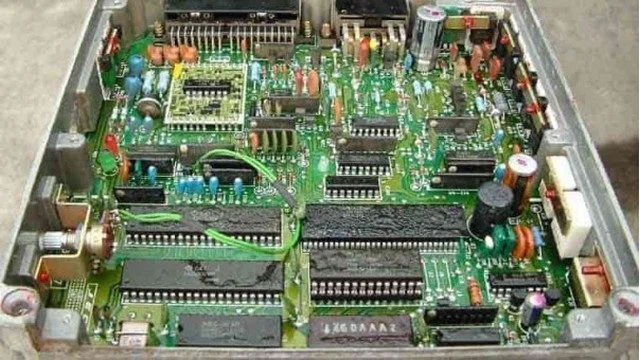
A typical Powertrain Control Module PCM, opened:
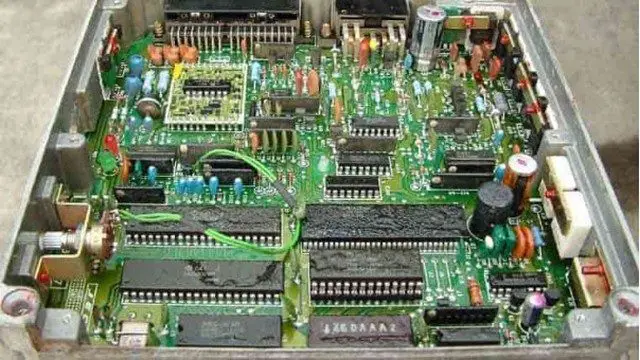
P06B1 Powertrain Control Module PCM
How Severe Is This DTC?
I would certainly classify this code as severe. Its inclusion of a wide-ranging sensor makes it difficult, if not impossible, to accurately determine how catastrophic the symptoms of the condition that contributed to storing the P06B1 code might prove to be.
What Are Some of the Symptoms of the Code?
Symptoms of a P06B1 trouble code may include:
Inoperative transfer case
Engine no-start condition
Reduced fuel economy
Engine hesitation, sag, miss, or stumble
Severe engine driveability issues
Transmission may shift erratically
Transmission may shift harshly
What Are Some of the Common Causes of the Code?
Causes
of this code may include:
Faulty engine, transmission, or transfer case sensor
Blown fuse or fusible link
Open or shorted wiring and/or connectors or grounds
PCM failure or PCM programming error
What Are the P06B1 Troubleshooting Steps?
Diagnose and repair any other sensor-related codes before attempting diagnosis for the stored P06B1.
To accurately diagnose a P06B1 code, you will need a diagnostic scanner, a digital volt/ohmmeter (DVOM), and a reliable source of vehicle information.
Without a means to reprogram controllers, reaching an accurate diagnostic conclusion for the stored P06B1 will be challenging at best. You can save yourself some headaches by researching Technical Service Bulletins (TSBs) that reproduce the stored code, the vehicle (year, make, model, and engine), and the symptoms presented. This information can be found in your vehicle information source. If you manage to locate the appropriate TSB, it could provide very useful diagnostic information.
Connect the scanner to the vehicle’s diagnostic port and retrieve all stored codes and relevant freeze frame data. After writing down this information (in case the code proves to be intermittent), clear the codes and test drive the vehicle. One of two things will happen; the code will be restored or the PCM will enter readiness mode.
If the PCM enters readiness mode (the code is intermittent), the code may be more difficult to diagnose. The condition that caused the P06B1 to be stored may need to worsen before an accurate diagnostic conclusion can be reached. However, if the code is restored, proceed with your diagnosis.
Obtain connector face views, connector pinout diagrams, component locators, wiring diagrams, and diagnostic flowcharts (related to the code and the specific vehicle) using your vehicle information source.
Visually inspect all associated wiring and connectors. Wiring that has been cut, burned, or damaged should be repaired or replaced. You can also check chassis and engine grounds and perform necessary repairs before continuing. Use your vehicle information source (power and ground locations) to obtain ground junction locations for related circuits.
If no other codes are stored and the P06B1 continues to reset, use the DVOM to test the controller power supply fuses and relays. Replace blown fuses, relays, and fusible links as needed. Fuses should always be tested with the circuit loaded to avoid misdiagnosis.
You may suspect a faulty controller or controller programming error if all controller power (input) and ground circuits are intact and the sensor supply voltage is insufficient at the output from the PCM (or another controller). Keep in mind that replacing the controller will require reprogramming. Reprogrammed controllers may be available through aftermarket sources for some applications; other vehicles/controllers will require onboard reprogramming that can only be performed by a dealer or another qualified source.
Visually inspect system controllers for signs of water, heat, or collision damage and suspect any controller showing signs of damage as faulty.
The term open can be replaced by unplugged or disconnected, cut, or broken
Excessive sensor supply voltage is likely the result of a short to battery voltage