
Understanding Error Code P06B0: Sensor “A” Supply Voltage Out of Range
Introduction
- What does the P06B0 code mean? (General definition: the PCM failed to detect the supply voltage for a sensor or group of sensors designated “A”).
- This is a generic diagnostic trouble code (DTC) applicable to many OBD-II vehicles (1996 and newer), with examples of makes.
- Although generic, the exact repair steps can vary by year, make, model, and powertrain configuration.
- The affected sensor or sensors may be related to the EGR system, heated oxygen sensor system, automatic transmission, or transfer case (on 4×4 or all-wheel drive vehicles).
- The “A” designation is used to identify the specific power circuit affected (A and B may be interchangeable depending on the manufacturer).
Operation of OBD-II Sensor Power Supply
- Most OBD-II sensors are powered by a voltage signal supplied by the PCM or other onboard control modules.
- The supply voltage (reference voltage) can vary (millivolts to battery voltage).
- Common reference voltages are 5 volts and battery voltage.
- It is crucial to determine which sensor is associated with this code by consulting a reliable vehicle information source.
Triggering and Consequences of Code P06B0
- Code P06B0 is stored and the Malfunction Indicator Lamp (MIL/SES) illuminates if the PCM (or another control module) does not detect voltage on the “A” power supply circuit.
- Illuminating the lamp may require several drive cycles with the fault present.
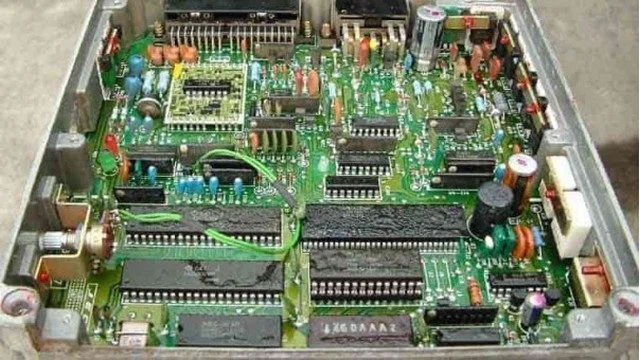
- Presentation of an illustrative image of a Powertrain Control Module (PCM).
Severity of DTC P06B0
- This code is classified as severe.
- The wide range of potentially affected sensors makes it difficult to assess the severity of symptoms without identifying the specific sensor. The consequences could be potentially catastrophic.
Possible Symptoms of Code P06B0
- List of associated symptoms:
- Inoperative transfer case
- Engine no-start condition
- Reduced fuel economy
- Engine hesitation, sag, lack of power, or misfire
- Severe engine driveability problems
- Erratic transmission shifting
- Harsh transmission shifting
Common Causes of Code P06B0
- List of potential causes:
- Faulty engine, transmission, or transfer case sensor
- Blown fuse or fusible link
- Open or shorted wiring and/or connectors or grounds
- PCM failure or PCM programming error
P06B0 Troubleshooting Steps
- Critical preliminary step: Diagnose and repair any other sensor-related codes before addressing P06B0.
- Required tools: diagnostic scanner, digital volt/ohmmeter (DVOM), reliable vehicle technical information.
- Importance of technical information: Without vehicle-specific information (wiring diagrams, pinouts, etc.), accurate diagnosis is difficult.
- Researching Technical Service Bulletins (TSBs): Check for TSBs matching the code, vehicle, and symptoms, as they can provide valuable diagnostic information.
- Using the scanner:
- Connect the scanner and retrieve all stored codes and freeze frame data.
- Record this information and clear the codes.
- Test drive the vehicle to see if the code returns immediately or if the PCM enters readiness mode.
- If the code is intermittent (PCM in readiness mode), diagnosis may be more difficult.
- Consulting technical information: Obtain connector face views, wiring diagrams, component locations, and diagnostic flowcharts specific to the code and vehicle.
- Visual inspection: Carefully inspect associated wiring and connectors for any damage (cut, burn, corrosion). Repair or replace as necessary. Also check ground points.
- Testing fuses and relays: Use the DVOM to test control module power fuses and relays. Important: Test fuses with the circuit loaded. Replace faulty fuses, relays, or fusible links.
- Suspected control module failure: If the control module power and grounds are correct and no supply voltage is output for the sensor, suspect a faulty control module or a programming issue. Caution: Control module replacement will require reprogramming (by a dealer or qualified source).
- Visual inspection of control modules: Look for signs of damage (water, heat, collision) on system control modules. Any damaged control module should be considered potentially faulty.
- Clarification of terms: “Open” can mean unplugged, disconnected, cut, or broken.
- Excessive supply voltage: Is likely due to a short to battery voltage.