
What Does It Mean?
This diagnostic trouble code (DTC) is a generic powertrain code, meaning it applies to OBD-II equipped vehicles. This may include, but is not limited to, vehicles from Ford, Chevrolet, Honda, etc. Although generic, specific repair steps may vary by make/model.
If your OBD-II vehicle has a stored P06A8 code, it means the Powertrain Control Module (PCM) has detected an out-of-range reference voltage signal or a performance issue with a specific sensor designated as “C”. The sensor in question is typically associated with the automatic transmission, transfer case, or one of the differentials.
A more specific sensor code will almost always accompany this code. P06A8 adds that the sensor’s reference circuit voltage is out of range or not performing as expected. To determine the location and function of the “C” sensor for the specific vehicle, consult a reliable vehicle information source (e.g., AllDataDIY). Consider a PCM programming error if P06A8 is stored alone. You’ll need to diagnose and repair any other sensor codes before addressing P06A8—but keep in mind the reference voltage range/performance condition.
The sensor in question is supplied with reference voltage (typically 5 volts) through a switched circuit (powered with the key on). There will also be a ground signal. The sensor will be of variable resistance or electromagnetic type and will complete the circuit. The sensor’s resistance should decrease as pressure, temperature, or speed increases, and vice versa. When the sensor’s resistance changes (under varying conditions), it provides the PCM with an input voltage signal.
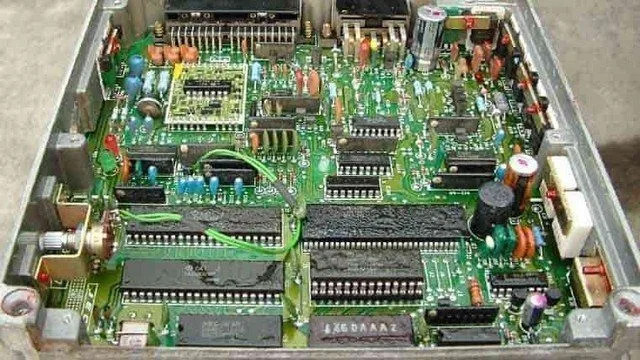
Example PCM Photo:

P06A8 PCM
If the input voltage signal received by the PCM is outside expected parameters, a P06A8 will be stored. A Malfunction Indicator Lamp (MIL) may also illuminate. Some vehicles require multiple drive cycles (with a failure) for the MIL to turn on. Allow the PCM to enter readiness mode before considering a repair successful. Simply clear the code once repairs are made and drive the vehicle normally. If the PCM enters readiness mode, the repair was successful. If the code resets, the PCM won’t enter readiness mode, indicating a malfunction still exists.
Severity and Symptoms
The severity of this DTC depends on which sensor circuit is experiencing the abnormal voltage situation. Other stored codes must be considered before determining severity.
Symptoms of a P06A8 code may include:
Transmission failure to switch between sport and economy modes
Transmission shifting malfunctions
Delayed (or no) transmission engagement
Transmission failure to switch between 4WD and 2WD modes
Transfer case failure to shift from low to high range
Lack of front differential engagement
Lack of front hub engagement
Erratic or inoperative speedometer/odometer
Causes
Possible causes of this engine code include:
Faulty sensor
Defective or blown fuses and/or fusible links
Faulty system power relay
Open circuits and/or connectors
Diagnostic and Repair Procedures
A diagnostic scanner, digital volt/ohmmeter (DVOM), and reliable vehicle information source (like All Data DIY) will be needed to diagnose a stored P06A8 code. A portable oscilloscope may also prove useful in your diagnosis.
First, consult your vehicle information source to determine the location and function of the sensor in question for your specific vehicle. Perform a visual inspection of wiring harnesses and connectors related to the sensor system. Repair or replace damaged or burned wiring, connectors, and components as needed. Second, connect the scanner to the vehicle’s diagnostic port and retrieve all stored trouble codes and freeze frame data. Note the codes, the order in which they were stored, and any associated freeze frame data, as this information may prove useful if the code proves intermittent. You can now proceed to clear the code; then test drive the vehicle to see if it immediately resets.
If the code immediately resets, use the DVOM to test the reference voltage and ground signals at the sensor in question. You would normally expect to find 5 volts and ground at the sensor connector.
Continue by testing the sensor’s resistance and continuity levels if voltage and ground signals are present at the sensor connector. Obtain testing specifications from your vehicle information source and compare them to your actual results. Sensors not meeting these specifications should be replaced.
Disconnect all associated controllers from system circuits before testing resistance with the DVOM. Failure to do so could result in PCM damage. If reference voltage is low (at the sensor), use the DVOM to check circuit resistance and continuity between the sensor and PCM. Replace open or shorted circuits as needed. If the sensor in question is electromagnetic with an alternating signal, use the oscilloscope to monitor live data. Focus on issues and completely open circuits.
Additional Diagnostic Notes:
This type of code is typically provided as support for a more specific code
A stored P06A8 code is normally associated with the transmission