
What Does It Mean?
This generic powertrain diagnostic trouble code (DTC) generally applies to many OBD-II vehicles. This may include, but is not limited to, vehicles from Toyota, Chevy, Saturn, Chevrolet, GMC, Pontiac, Seadoo, Hummer, etc.
When a P060E code is stored, it means the Powertrain Control Module (PCM) has detected an internal performance error with the Throttle Position Sensor (TPS) circuit. Other controllers may also detect an internal PCM performance error (in the TPS circuit) and cause a P060E to be stored.
The internal control module monitoring processors are responsible for various controller self-test tasks and the overall responsibility of the internal control module. The input and output signals from the TPS/APP sensor are self-tested and are constantly monitored by the PCM and other associated controllers. The Transmission Control Module (TCM), the Traction Control System Module (TCSM), and other controllers are subject to interaction with the TPS/APP sensor.
Most OBD-II equipped vehicles use the Drive-By-Wire (DBW) system (instead of a cable throttle). This not only helps reduce exhaust emissions and increase fuel efficiency but also promotes more effective interaction with stability and traction control systems and helps optimize the accuracy of cruise control systems.
Controlled by the PCM using an electric throttle actuator motor, the DBW system uses one or more Accelerator Pedal Position (APP) sensors (also called pedal position sensors) and multiple Throttle Position Sensors (TPS). All these sensors are supplied with a 5-volt reference (usually) and a ground signal.
The TPS/APP sensors are typically of the potentiometer type. The sensor’s resistance (circuit voltage) varies depending on the position of the throttle plate (TPS) or the accelerator pedal (APP). Each individual sensor completes a specific circuit. The sensors are actuated by a pivoting extension on the accelerator pedal pivot or the throttle plate shaft. As the sensor contacts move across a printed circuit board, the sensor’s resistance changes; causing variations in the circuit resistance and (thus) the signal input voltage in the PCM and other controllers.
Inside the vehicle’s cockpit, the APP sensors are mounted on the accelerator pedal assembly. From one APP sensor, the PCM and other controllers receive an input signal (to open or close the throttle plate) whenever the pedal is pressed/released. From a second APP sensor, the PCM and other controllers receive a signal determining how far the throttle plate should be opened/closed.
A separate signal from the TPS is input to the PCM (and other controllers), reflecting the actual throttle position. The onboard controllers constantly monitor the signals from the APP sensor and the TPS and compare the actual throttle position with the desired throttle position.
Whenever the ignition is turned on and the PCM is powered up, the APP sensor and TPS self-tests are initiated. In addition to performing internal controller self-tests, the Controller Area Network (CAN) also compares the signals from each individual module to ensure each controller is functioning correctly. These tests are performed simultaneously.
If the TPS/APP sensor inputs exceed the maximum degree of variance as indicated by the manufacturer, an APP sensor or TPS code will be stored and a Malfunction Indicator Lamp (MIL) may be illuminated. Normally, the PCM will enter limp mode. In this mode, engine acceleration will be limited. Furthermore, if the PCM detects a discrepancy between any of the onboard controllers, which would indicate an internal APP sensor or TPS error, a P060E code will be stored and a Malfunction Indicator Lamp (MIL) may be illuminated. Several failure cycles may be required for MIL illumination, depending on the perceived severity of the malfunction.
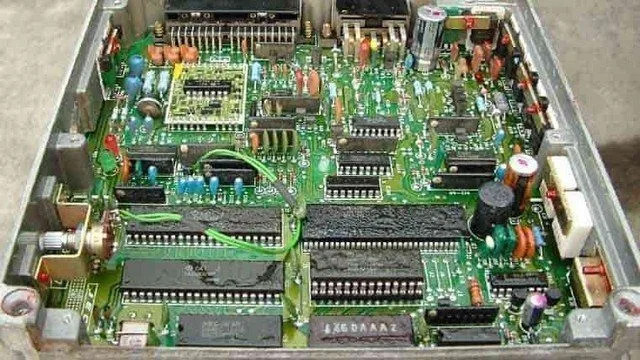
Photo of a PCM with the cover removed:

Powertrain Control Module PCM
How Severe Is This DTC?
Internal Control Module Processor codes should be classified as severe. A stored P060E code could lead to serious drivability and fuel economy issues, suddenly and without warning.
What Are Some of the Symptoms of the Code?
Symptoms of a P060E trouble code may include:
Various drivability issues
Harsh or erratic automatic transmission shifting
Reduced fuel efficiency
Irregular idle or stalling (especially at idle)
Hesitation during acceleration
Limited or no acceleration
Stuck throttle (at any engine speed)
Inoperative cruise control
What Are Some of the Common Causes of the Code?
Causes
of this code may include:
Faulty controller or controller programming error
Open or shorted circuit or connectors in the CAN harness
Insufficient control module ground
Faulty TPS or APP sensor
Corroded electrical connectors
Open or shorted circuits between the TPS/APP sensor and the PCM
Faulty DBW actuator motor
What Are the P060E Troubleshooting Steps?
Diagnosing a P060E code can prove to be quite a challenge, even for the most experienced and well-equipped professional technician. There is also the issue of reprogramming. Without the necessary reprogramming equipment, it will be impossible to replace a faulty controller and perform a successful repair.
If any ECM/PCM power codes are present, they will obviously need to be rectified before attempting to diagnose a P060E. Furthermore, if there are any TPS/APP sensor codes, these should be diagnosed and repaired first.
Several preliminary tests can be performed before declaring an individual controller faulty. A diagnostic scanner, a digital volt/ohmmeter (DVOM), and a reliable vehicle information source will be required. An oscilloscope may also be helpful.
Connect the scanner to the vehicle’s diagnostic port and retrieve all stored codes and freeze frame data. You will want to note this information, just in case the code proves to be intermittent. After recording all relevant information, clear the codes and test drive the vehicle until the code resets or the PCM enters readiness mode. If the PCM enters readiness mode, the code is intermittent and will be more difficult to diagnose. The condition which caused the P060E to be stored may even need to worsen before a diagnosis can be made. If the code resets, continue with this short list of preliminary tests.
When trying to diagnose a P060E, information can be your best tool. Search your vehicle information source for Technical Service Bulletins (TSBs) that parallel the stored code, the vehicle (year, make, model, and engine), and the symptoms presented. If you find the right TSB, it may provide diagnostic information that will help you significantly.
Use your vehicle information source to obtain connector face views, connector pinout diagrams, component locators, wiring schematics, and diagnostic flowcharts related to the code and the specific vehicle.
The scanner data stream (or oscilloscope) can provide useful information regarding faults and voltage spikes in the individual TPS/APP sensors.
You can use the DVOM to test the individual sensors if no inconsistencies are detected using the oscilloscope (or scanner display stream). Test the APP sensor and TPS resistance according to the manufacturer’s specifications and procedures. If all sensors and circuits appear to be functioning as expected, test the controller’s power and ground.
Use the DVOM to test the controller’s power fuses and relays. Test and replace blown fuses as needed. Fuses should be tested with the circuit loaded.
If all fuses and relays appear to be functioning as expected, a visual inspection of the wiring and harnesses related to the controller is necessary. You will also want to check the chassis and engine ground junctions. Use your vehicle information source to obtain ground locations for the related circuits. Use the DVOM to test ground integrity.
Visually inspect the system controllers for signs of water, heat, or collision damage. Any damaged controller, especially by water, should be considered faulty.
If the controller’s power and ground circuits are intact, suspect a faulty controller or a controller programming error. Replacing the controller will require reprogramming. In some cases, you can purchase pre-programmed controllers through aftermarket sources. Other vehicles/controllers will require onboard reprogramming that can only be performed by a dealership or another qualified source.
Unlike most other codes, P060E is likely caused by a faulty controller or a controller programming error
Test the system ground integrity by connecting the DVOM’s negative test lead to ground and the positive test lead to battery voltage