
What does it mean?
This is a generic diagnostic trouble code (DTC) for the powertrain and generally applies to OBD-II vehicles. This may include, but is not limited to, vehicles from Ford, Mazda, Smart, Land Rover, Dodge, Ram, etc. Although generic, the exact repair steps may vary depending on the year, make, model, and powertrain configuration.
When a P064E code is stored, it means that the Powertrain Control Module (PCM) has detected an internal processor performance error related to the Heated Oxygen Sensor (HO2S) circuit for engine bank two. Other controllers may also detect an internal PCM performance error (related to the HO2S circuit for bank one) and result in the storage of a P064E code.
Bank 2 refers to the engine bank that does not contain cylinder number 1.
The HO2S consists of a zirconium dioxide sensing element and a tiny sampling chamber enclosed in a vented steel housing. The sensing element is connected to the conductor wires of the HO2S wiring harness with small platinum electrodes. The HO2S wiring harness is connected to the engine control harness, which provides the PCM with data regarding the percentage of oxygen in the engine’s exhaust gases compared to the oxygen content in the ambient air.
The upstream HO2S is located in the exhaust pipe (between the exhaust manifold and the catalytic converter). The most common method for this is to insert the sensor directly into a threaded boss that is welded into the exhaust pipe. The threaded boss is placed in the downpipe at the most convenient position and angle for sensor access and optimal functionality. Removal and installation of threaded oxygen sensors will require specially designed wrenches or sockets, depending on the vehicle application. The HO2S may also be secured using threaded studs (and nuts) welded to the exhaust pipe.
Exhaust gases are pushed through the exhaust manifold and into the downpipe where they pass over the upstream HO2S. The exhaust gases flow through specially designed vent holes in the HO2S steel housing and through the sensing element. Ambient air is drawn into a small sampling chamber in the center of the sensor, through openings in the conductor wires. In this chamber, the air is heated, forcing ions to produce a voltage (energy). Variations between the concentration of oxygen molecules in the exhaust gases and the ambient air (drawn into the HO2S) create fluctuations in the oxygen ion concentration (inside the sensor). These fluctuations cause the oxygen ions (inside the HO2S) to bounce (rapidly and repeatedly) from one platinum layer to the other. As the oxygen ions move between the platinum layers, it causes voltage changes. These voltage changes are recognized by the PCM as variations in exhaust oxygen concentration and reflect whether the engine is running lean (too little fuel) or rich (too much fuel). When more oxygen is present in the exhaust (lean condition), the voltage signal output by the HO2S is lower. When less oxygen is present in the exhaust (rich condition), the voltage signal output is higher. This data is used by the PCM to calculate, among other things, fuel delivery strategy and ignition timing.
The upstream HO2S typically oscillates between 100 and 900 millivolts (0.1 and 0.9 volts) when the engine is idling and the PCM is operating in closed loop. In closed-loop operation, the PCM considers input signals from the upstream HO2S sensors to regulate the fuel injector pulse width and (ultimately) fuel delivery. When the engine enters open-loop mode (during cold start and wide-open throttle conditions), the fuel delivery strategy is pre-programmed.
The internal control module monitoring processors are responsible for various controller self-test tasks and the overall responsibility of the internal control module. HO2S input and output signals are subjected to self-test and are continuously monitored by the PCM and other associated controllers. The Transmission Control Module (TCM), Traction Control System Module (TCSM), and other controllers also interact with the HO2S.
Whenever the ignition is turned on and the PCM is powered up, HO2S self-tests are initiated. In addition to running internal controller self-tests, the Controller Area Network (CAN) also compares the signals from each individual module to ensure each controller is functioning correctly. These tests are performed simultaneously.
If the PCM detects an internal anomaly in HO2S functionality, a P064E code will be stored, and a Malfunction Indicator Lamp (MIL) may be illuminated. Furthermore, if the PCM detects a problem between any of the onboard controllers that would indicate an internal HO2S error, a P064E code will be stored, and a Malfunction Indicator Lamp (MIL) may be illuminated. Multiple failure cycles may be required for MIL illumination, depending on the perceived severity of the malfunction.
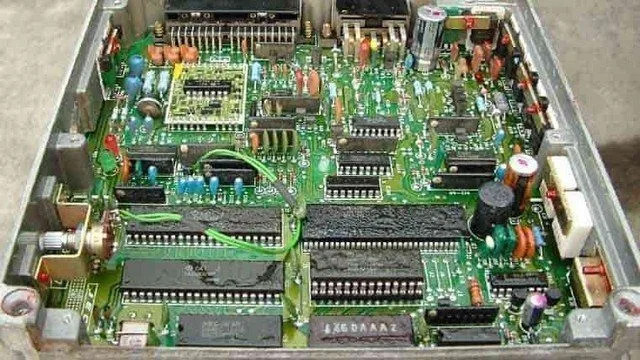
Photo of a PCM with the cover removed
 :
:
Powertrain Control Module PCM
How severe is this DTC?
Internal Control Module Processor codes should be classified as severe.
A stored P064E code could lead to various driving issues, including decreased fuel efficiency.
What are some of the symptoms of the code?
Symptoms of a P064E fault code may include:
Reduced fuel efficiency
A general lack of engine performance
A variety of engine driving symptoms
Other stored diagnostic trouble codes
What are some common causes of the code?
Causes
of this P064E DTC code may include:
Faulty controller or controller programming error
Faulty HO2S
Rich or lean exhaust conditions
Burned, chafed, broken, or disconnected wiring and/or connectors
Engine exhaust leaks
A faulty controller power relay or blown fuse
Open or shorted circuit or connectors in the CAN harness
Insufficient control module ground
What are the P064E troubleshooting steps?
Even for the most experienced and well-equipped professional technician, diagnosing a P064E code can be very challenging. There is also the issue of reprogramming. Without the necessary reprogramming equipment, it will be impossible to replace a faulty controller and perform a successful repair.
If ECM/PCM power codes are present, they will obviously need to be rectified before attempting to diagnose a P064E.
There are several preliminary tests that can be performed before declaring a controller faulty. A diagnostic scanner, a digital volt/ohmmeter (DVOM), and a reliable source of vehicle information will be necessary.
Connect the scanner to the vehicle’s diagnostic port and retrieve all stored codes and freeze frame data. You will want to note this information, just in case the code proves to be intermittent. After recording all relevant information, clear the codes and test-drive the vehicle until the code resets or the PCM enters readiness mode. If the PCM enters readiness mode, the code is intermittent and will be more difficult to diagnose. The condition that caused the P064E to be stored may even need to worsen before a diagnosis can be made. If the code resets, continue with this short list of preliminary tests.
When trying to diagnose a P064E, information can be your best tool. Search your vehicle information source for Technical Service Bulletins (TSBs) that parallel the stored code, the vehicle (year, make, model, and engine), and the symptoms presented. If you find the right TSB, it can provide diagnostic information that will assist you significantly.
Use your vehicle information source to obtain connector face views, connector pinout diagrams, component locators, wiring schematics, and diagnostic flowcharts related to the code and the specific vehicle.
Use the DVOM to test the controller power fuses and relays. Test and replace blown fuses as needed. Fuses should be tested with the circuit loaded.
If all fuses and relays appear to be functioning as expected, a visual inspection of the wiring and harnesses related to the controller is warranted. You will also want to check the chassis and engine ground junctions. Use your vehicle information source to obtain ground locations for the related circuits. Use the DVOM to test ground integrity.
Visually inspect the system controllers for signs of water, heat, or collision damage. Any damaged controller, especially by water, should be considered faulty.
If the controller power and ground circuits are intact, suspect a faulty controller or a controller programming error. Replacing the controller will require reprogramming. In some cases, you can purchase pre-programmed controllers through aftermarket sources. Other vehicles/controllers will require onboard reprogramming that can only be performed by a dealership or another qualified source.
HO2S Test
Ensure the engine is running efficiently before attempting to diagnose the HO2S. Misfire codes, throttle position sensor codes, manifold air pressure codes, and mass air flow sensor codes should be addressed before attempting to diagnose HO2S or lean/rich exhaust codes.
Some automobile manufacturers use a fused circuit to supply voltage to the HO2S system. Test these fuses using the DVOM.
If all fuses are in good working order, locate the HO2S for engine bank one. The vehicle will need to be raised on an appropriate hoist or lifted and secured on safety stands. Once you have accessed the sensor in question, disconnect the harness connector and turn the ignition key to the ON position. You are looking for battery voltage at the HO2S connector. Use the wiring schematic to determine the circuit used to supply battery voltage. Also check the system ground at this point.
If HO2S voltage and ground are present, reconnect the HO2S. Start the engine and test-drive the vehicle. After a test drive, let the engine idle (with the transmission in neutral or park). Use the scanner to observe the HO2S input data. Limit the data stream scope to include only relevant data, and you will get a faster data response. Assuming the engine is running efficiently, the upstream HO2S should regularly switch from rich to lean (and vice versa) with the PCM in closed loop.
Unlike most other codes, P064E is likely caused by a faulty controller or a controller programming error
Test the system ground integrity by connecting the DVOM’s negative test lead to ground and the positive test lead to battery voltage