
What Does It Mean?
This is a generic diagnostic trouble code (DTC) and applies to many OBD-II vehicles (1996-newer). This may include, but is not limited to, vehicles from GMC, Chevy, Buick, Cadillac, Ford, etc. Although generic, the exact repair steps may vary depending on the year, make, model, and powertrain configuration.
A stored P069E code means that the Powertrain Control Module (PCM) has detected a malfunction with the fuel pump control module, which has requested the illumination of the Malfunction Indicator Lamp (MIL).
The fuel pump control module is responsible for supplying and regulating the voltage to the fuel pump relay and the fuel pump. Typically, the fuel pump controller is integrated into the PCM, but it can also be a standalone module. The fuel pump supplies pressurized fuel to the fuel injection system. It is most often located inside the fuel tank but can also be found along the fuel supply line. Diesel propulsion systems most commonly use high-pressure pumps mounted on and driven by the engine.
Whenever the ignition is turned on (and the PCM is powered), several controller self-tests are performed. The fuel pump control module is included among these controllers. By performing internal controller self-tests, the PCM can monitor serial data transmitted over the Controller Area Network (CAN) to ensure that the onboard controllers interface correctly.
If the fuel pump control module has requested the MIL to be illuminated, a P069E code will be stored, and a Malfunction Indicator Lamp (MIL) may light up.
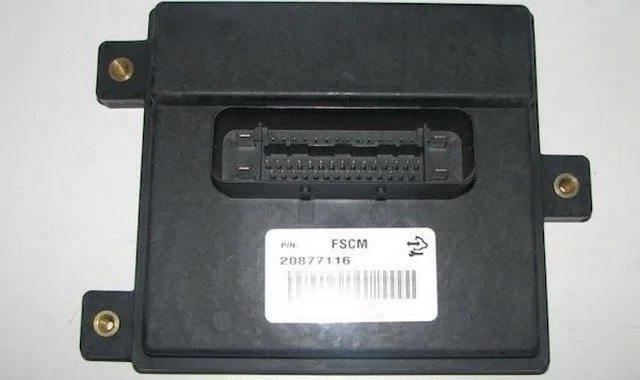
Photo of a typical fuel pump control module:
P069E Fuel Pump Control Module
How Severe Is This DTC?
Fuel pump control module codes should always be taken seriously. Conditions that lead to the storage of a P069E code can cause many driving issues and/or a no-start condition.
What are some of the symptoms of the code?
Symptoms of a P069E trouble code may include:
Delayed engine starting
No-start condition
Engine driving issues
Other stored codes
What are some common causes of the code?
Causes
of this code may include:
Faulty fuel pump controller or PCM
Open circuit in the fuel pump control module voltage supply
Faulty or triggered fuel pump voltage cutoff switch
PCM failure or PCM programming error
What are the troubleshooting steps for P069E?
If other fuel pump and/or fuel supply codes are stored, diagnose and repair them before attempting to diagnose the P069E code.
Consult your vehicle’s information source for Technical Service Bulletins (TSBs) that match the stored code, the vehicle (year, make, model, and engine), and the symptoms presented. If you find the relevant TSB, it may provide helpful diagnostic information.
A diagnostic scanner, a digital volt/ohmmeter (DVOM), and a reliable source of vehicle information will be needed to diagnose a P069E code.
Start by connecting the scanner to the vehicle’s diagnostic port and retrieving all stored codes and freeze frame data. You should note this information in case the code turns out to be intermittent. After recording all relevant information, clear the codes and test the vehicle (if possible) until the code resets or the PCM enters readiness mode.
If the PCM enters readiness mode, the code is intermittent and will be more difficult to diagnose. The condition that caused the P069E to be stored may need to worsen before an accurate diagnosis can be made. If the code resets, continue with your diagnosis.
Use your vehicle information source to obtain connector face views, connector pinout diagrams, component locators, wiring diagrams, and diagnostic flowcharts related to the code and the specific vehicle.
Check for battery voltage on the fuel pump control circuit using the appropriate wiring diagram and your DVOM. If not present, check the system’s fuses and relays and replace faulty parts as needed. If the vehicle is equipped with a fuel pump voltage cutoff switch, test it to ensure it has not been activated or is faulty.
If there is no voltage (and/or ground) on the fuel pump control circuit (and all fuses and relays appear to be functioning correctly), inspect the wiring and harnesses related to the controller. You should also check the chassis and engine ground junctions. Use your vehicle information source to locate ground points for the related circuits.
If there is voltage (and ground) on the fuel pump control circuit, inspect the system controllers for signs of water, heat, or collision damage. Any damaged controller (especially by water) should be considered faulty.
If the controller’s power and ground circuits are intact, suspect a faulty controller or a controller programming error. Replacing the controller will require reprogramming.
If the vehicle has been involved in a collision, first check the fuel pump voltage cutoff switch
Test the controller’s integrity by connecting the DVOM’s negative test lead to ground and the positive test lead to battery voltage