
What Does It Mean?
This is a generic diagnostic trouble code (DTC) for the powertrain and generally applies to OBD-II vehicles. Vehicle brands may include, but are not limited to, Chevrolet, GMC, VW, Audi, Dodge, Jeep, Volkswagen, Volvo, Peugeot, Ram, Chrysler, Kia, Mazda, Harley, Cadillac, etc.
The ECM (Engine Control Module), among many other modules, not only monitors the various sensors and switches involved in the proper functionality of the engine, but it also ensures to maintain the comfort of our creatures in place (e.g., cruise control).
Many factors can alter your vehicle’s speed when driving on the road. Some of the new adaptive cruise control (ACC) systems actually adjust vehicle speeds based on the environment (e.g., overtaking, slowing traffic, lane departure, emergency maneuvers, etc.).
Beyond the point, with this fault, they refer to the malfunction of the cruise control/brake switch circuit “A”. The proper functioning of the brake switch is an integral part of your cruise control operation. Since one of the many ways to deactivate or turn off cruise control is to press the brake pedal, you will want to take care of it. Especially if you use cruise control in your daily commutes. In this case, the designated letter – “A” – may refer to a specific wire, connector, harness, etc. To determine which one this code refers to, you will need to consult the appropriate manufacturer-specific service manual. If you are having trouble finding what you need, it is always a good idea to look for a wiring diagram for the cruise control. These diagrams, often, can provide you with valuable information (sometimes the location, specifications, wire colors, etc.).
The P0572 cruise control/brake switch A circuit low and related codes (P0571 and P0573) are defined when the ECM (Engine Control Module) detects a malfunction in the cruise control/brake switch circuit “A”. In this case, it means there is a low voltage condition detected in the circuit.
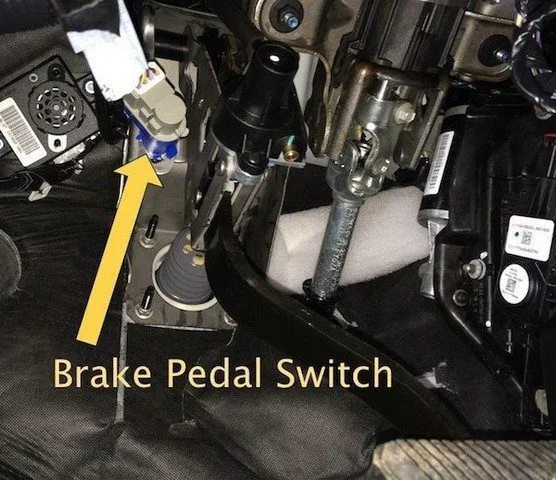
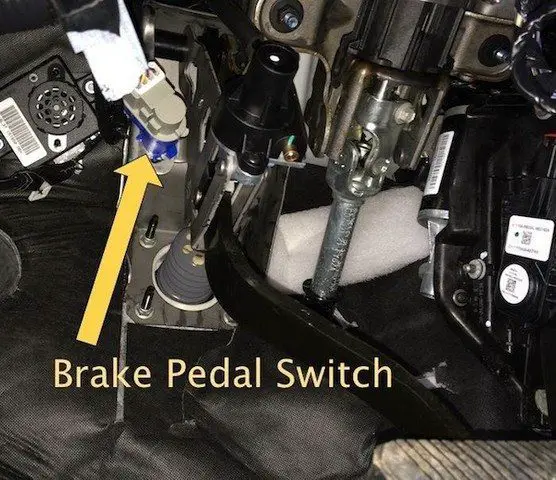
Example of a Brake Switch and Its Location:
How Severe Is This DTC?
Usually, with cruise control systems, I would say the severity is set to low. But in this case, I will go with moderately severe. The fact that there is a possibility that this fault could cause a malfunction of the brake switch, or vice versa, is a significant concern.
One of the other functions of your brake switch is to provide the signal to turn on your rear brake lights to inform other drivers of your deceleration/braking. That said, its operation is quite important when considering the overall safety of the driver.
What Are Some of the Symptoms of the Code?
Symptoms of a P0572 Diagnostic Code May Include:
Cruise control completely inoperative
Irregular cruise control operation
Certain functions not working as they should (e.g., set, resume, accelerate, etc.)
Cruise control on but without engagement
No brake lights if the brake light switch is faulty
What Are Some of the Common Causes of the Code?
Causes
of This P0572 Cruise Control Code May Include:
Faulty cruise control/brake switch
Wiring issue (e.g., pinched on the brake pedal, chafed, etc.)
ECM (Engine Control Module) problem (i.e., internal short circuit, open circuit, etc.)
Debris/dirt mechanically interfering with the brake switch operation
Misadjusted brake switch
Brake switch out of its mount
What Are the Diagnostic and Troubleshooting Steps for P0572?
The first step in the troubleshooting process for any malfunction is to check the Technical Service Bulletins (TSBs) for known issues with the specific vehicle.
Advanced diagnostic steps become very vehicle-specific and may require the appropriate advanced equipment and knowledge to operate accurately. We include the basic steps below, but refer to a repair guide specific to the year/make/model/powertrain for steps specific to your vehicle.
Basic Step #1
The first thing I would do in this case is probably take a look under the dashboard and inspect the brake switch right away. It is usually mounted on the brake pedal arm itself. I have sometimes seen the driver’s foot completely knock the switch off its mount, so I mean if it is not mounted properly and/or completely broken, you will be able to tell immediately and potentially save yourself time and shop fees.
So, that said, if that is the case, I would recommend replacing the cruise control/brake switch with a new one. Be sure to follow the manufacturer-specific brake switch installation and adjustment procedures to avoid damaging the sensor or even causing more problems.
Basic Step #2
Check the affected circuit. Refer to a wiring diagram in your service manual to determine the color codes and circuit designation for the cruise control/brake switch A. Often, to rule out the possibility that the fault is present in the harness itself, you can disconnect one end from the brake switch and the other from the ECM. Using a multimeter, there are many tests you can perform. A common test is a continuity test. The specifications provided by the manufacturer are necessary to compare actual values to desired ones. Generally, you will check the resistance of the particular circuit to determine any open circuits, high resistances, etc., present. If you perform this test, it would be a good idea to inspect the connector pins, the switch, and the ECM. Sometimes, moisture can seep in and cause intermittent connections. If there is corrosion, use an electrical connection cleaner to remove it before reconnecting everything.
Basic Step #3
Take a look at your ECM (Engine Control Module). It is important to note that sometimes with cruise control, it is the BCM (Body Control Module) that monitors and adjusts this system. Identify which one your system uses and physically inspect for any water intrusion. Anything suspicious here? Take the vehicle to your reputable shop/dealer.