
What does it mean?
This is a generic powertrain diagnostic trouble code (DTC), meaning it covers all makes/models from 1996 and newer. Specific troubleshooting steps vary by vehicle.
This P0391 code essentially means that the Powertrain Control Module (PCM) has detected a problem with the “B” camshaft signal for Bank 2. Bank 2 refers to the cylinder bank in the engine that does not contain cylinder #1.
Description and correlation of crankshaft and camshaft position sensors
In today’s vehicles, it is important to understand what these sensors are and how they interact. All distributorless ignition vehicles use a crank and cam sensor to replace the module and trigger wheel found in an electronic distributor.
The Crankshaft Position Sensor (CPS) signals the engine control module the location of the pistons relative to top dead center for fuel injection and spark plug firing. The CMP signals the position of the camshaft intake lobe relative to the CPS signal and the opening of the intake valve for fuel injection on each cylinder.
Description and location of sensors
The crank and cam sensors provide an “on/off” signal. Both are either Hall effect or magnetic.
A Hall effect sensor uses an electromagnetic sensor and a reluctor. The reluctor is shaped like small cups with squares cut out on the sides, making it look like a fence. The reluctor rotates while the sensor is stationary and mounted very close to the reluctor. Whenever a post passes by the sensor, a signal is produced, and when the post passes, the signal turns off.
A magnetic sensor uses a fixed sensor and a magnet attached to the rotating part. Whenever the magnet passes by the sensor, a signal is produced.
Locations
A Hall effect crank sensor is located on the harmonic balancer at the front of the engine. The magnetic sensor may be located on the side of the engine block where it uses the center of the crankshaft for a signal, or it may be in the bell housing where it uses the flywheel as a trigger. The camshaft sensor mounts at the front or rear of the camshaft. P0391 specifically refers to Bank 2, which is the cylinder bank that does not contain cylinder #1.
Symptoms
The car will likely run with this set of codes, as it is often intermittent and also because the PCM can often operate the vehicle in “limp-in/limp-home” mode even with a cam sensor signal problem. There may be no noticeable symptoms other than:
Malfunction Indicator Lamp (MIL) illumination (i.e., Check Engine light)
Lack of power
No start condition possible
Stumbling
Causes
A P0391 code can mean that one or more of the following events have occurred:
Faulty “B” Camshaft Position Sensor (CMP)
Poor wiring connection to the “B” cam sensor
Short or open electrical condition in the associated wiring
Weak/bad battery
Possible solutions
A good starting point is always to search for a Technical Service Bulletin (TSB) for your specific vehicle. The vehicle manufacturer may have a PCM flash/reprogram to cover this issue, and it is worth checking before finding out you’ve taken a long/wrong path.
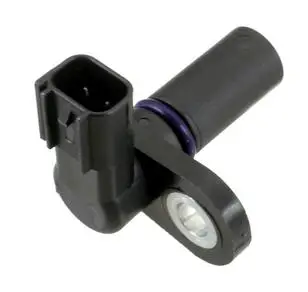
Example photo of a Camshaft Position Sensor (CMP):

Often, replacing the sensor fixes this code, but not necessarily. Therefore, it is important to check the following points:
Check the battery condition. A weak battery can cause the code to set.
Visually inspect the sensor wiring for any signs of burning, discoloration indicating melting or rubbing. Also look for corrosion or bent pins.
Visually inspect the cam sensor for any damage
Visually inspect the reluctor wheel through the cam sensor port (if possible) for any missing teeth or damage
If the reluctor is not visible from outside the engine, visual testing can only be done by removing the camshaft or intake manifold (depending on engine design)
Replace the “B” camshaft position sensor
Related camshaft fault codes: P0340, P0341, P0342, P0343, P0345, P0346, P0347, P0348, P0349, P0365, P0366, P0367, P0368, P0369, P0390, P0392, P0393, P0394.